QUESTION IMAGE
Question
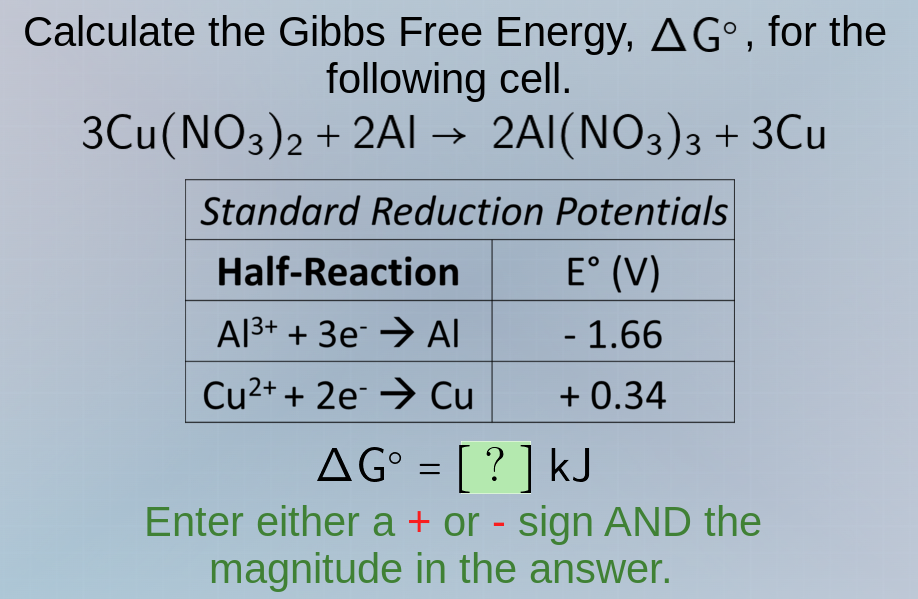
calculate the gibbs free energy, $\delta g^\circ$, for the following cell.
$3\text{cu(no}_3\text{)}_2 + 2\text{al} \
ightarrow 2\text{al(no}_3\text{)}_3 + 3\text{cu}$
standard reduction potentials
| half-reaction | e° (v) |
|---|
|$\text{al}^{3+} + 3\text{e}^- \
ightarrow \text{al}$| - 1.66|
|$\text{cu}^{2+}+ 2\text{e}^- \
ightarrow \text{cu}$| + 0.34|
$\delta g^\circ = ?$ kj
enter either a + or - sign and the magnitude in the answer.
Step1: Identify oxidation and reduction half - reactions
In the reaction \(3Cu(NO_{3})_{2}+2Al
ightarrow2Al(NO_{3})_{3}+3Cu\), Al is oxidized (loses electrons) and \(Cu^{2 + }\) is reduced (gains electrons).
The oxidation half - reaction: \(Al
ightarrow Al^{3+}+3e^{-}\), \(E_{ox}^{\circ}=-E_{red}^{\circ}\) for \(Al^{3 + }+3e^{-}
ightarrow Al\), so \(E_{ox}^{\circ}=1.66\ V\)
The reduction half - reaction: \(Cu^{2+}+2e^{-}
ightarrow Cu\), \(E_{red}^{\circ}=0.34\ V\)
Step2: Find the number of moles of electrons transferred (\(n\))
First, balance the electrons in the two half - reactions.
Oxidation: \(2Al
ightarrow2Al^{3+}+6e^{-}\) (multiply by 2 to get 6 electrons)
Reduction: \(3Cu^{2+}+6e^{-}
ightarrow3Cu\) (multiply by 3 to get 6 electrons)
So, \(n = 6\) moles of electrons.
Step3: Calculate the cell potential (\(E_{cell}^{\circ}\))
\(E_{cell}^{\circ}=E_{red}^{\circ}+E_{ox}^{\circ}\)
\(E_{cell}^{\circ}=0.34\ V + 1.66\ V=2.00\ V\)
Step4: Calculate \(\Delta G^{\circ}\) using the formula \(\Delta G^{\circ}=-nFE_{cell}^{\circ}\)
Where \(F = 96485\ C/mol\) (Faraday's constant), \(n = 6\) mol, \(E_{cell}^{\circ}=2.00\ V\)
\(\Delta G^{\circ}=-6\ mol\times96485\ C/mol\times2.00\ V\)
\(1\ J = 1\ C\times V\), so \(\Delta G^{\circ}=-6\times96485\times2.00\ J\)
\(\Delta G^{\circ}=- 1157820\ J\)
Convert to kJ: \(\Delta G^{\circ}=-1157.82\ kJ\approx - 1160\ kJ\) (or more precisely - 1158 kJ, but let's check the calculation again)
Wait, let's recalculate:
\(n = 6\), \(F = 96485\ C/mol\), \(E_{cell}^{\circ}=2.00\ V\)
\(\Delta G^{\circ}=-nFE_{cell}^{\circ}=-6\times96485\times2.00\)
\(6\times96485 = 578910\)
\(578910\times2=1157820\ J = 1157.82\ kJ\)
So \(\Delta G^{\circ}=- 1158\ kJ\) (rounded to a reasonable number of significant figures, since the given potentials have two decimal places, maybe we can keep it as - 1160 kJ or - 1158 kJ)

Snap & solve any problem in the app
Get step-by-step solutions on Sovi AI
Photo-based solutions with guided steps
Explore more problems and detailed explanations
\(-1160\) (or \(-1158\))