QUESTION IMAGE
Question
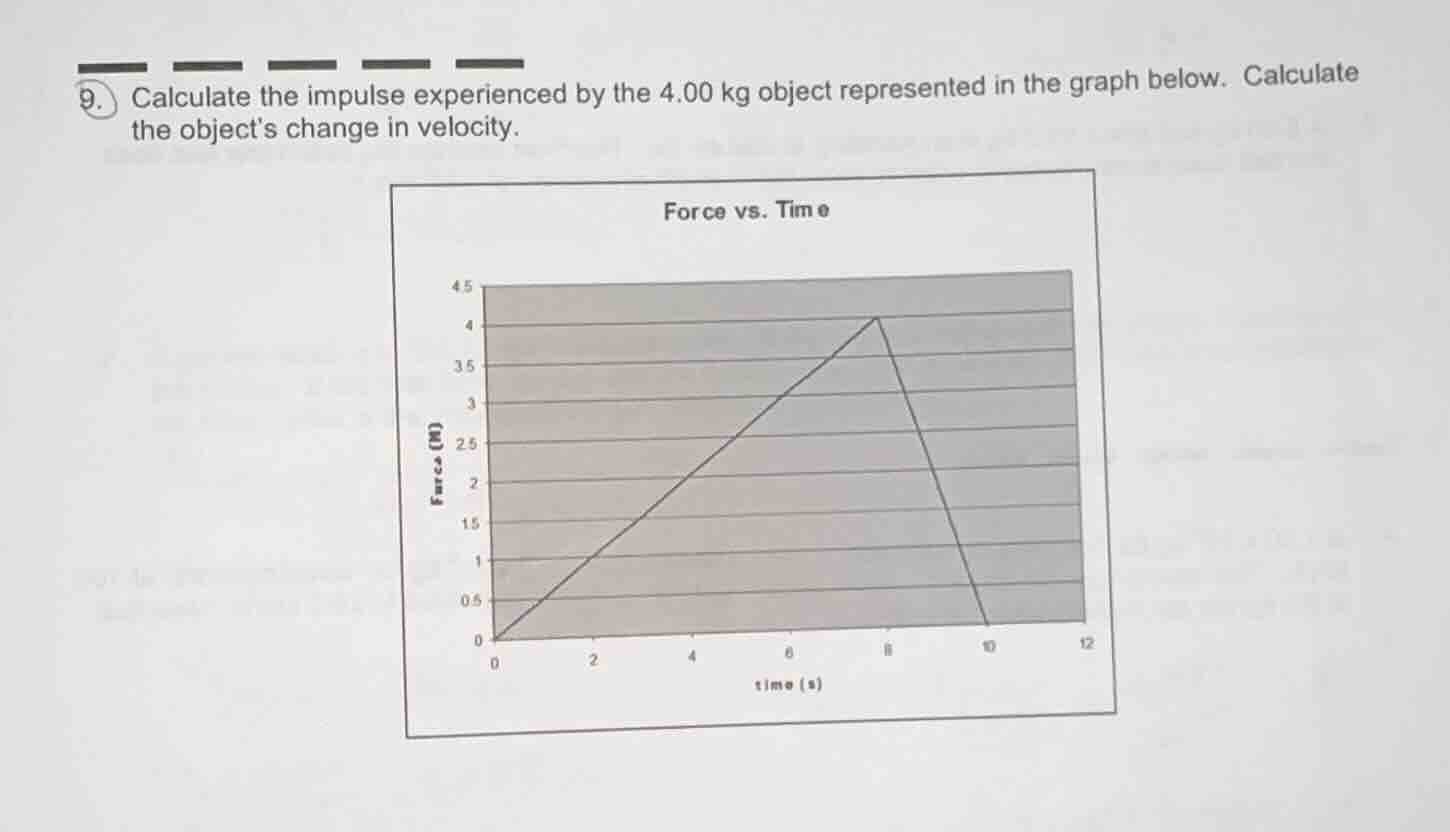
- calculate the impulse experienced by the 4.00 kg object represented in the graph below. calculate the object’s change in velocity.
force vs. time
(graph with force (n) on y - axis from 0 to 4.5 and time (s) on x - axis from 0 to 12, showing a line from (0,0) to (8,4) then to (10,0))
Step1: Find Impulse (Area of F-t Graph)
The graph is a combination of a triangle (from 0 to 8 s) and a triangle (from 8 to 10 s)? Wait, no, from 0 to 8 s, it's a line from (0,0) to (8,4) N? Wait, no, looking at the graph: at t=8s, F=4N; at t=10s, F=0. So the graph is a trapezoid? Wait, no, from t=0 to t=8s, it's a triangle with base 8s and height 4N? Wait, no, at t=8, F=4; at t=10, F=0. Wait, actually, the graph is a polygon: from (0,0) to (8,4) to (10,0) to (0,0)? Wait, no, the x-axis is time from 0 to 12, but the force goes to 0 at t=10. Wait, the graph is a triangle? Wait, no, from 0 to 8, it's a line increasing to 4N, then from 8 to 10, it's a line decreasing to 0. So the area under the F-t graph is the impulse. The shape is a triangle? Wait, no, from 0 to 10s, the graph is a triangle? Wait, at t=0, F=0; t=8, F=4; t=10, F=0. Wait, no, the first part is from 0 to 8, slope (4-0)/(8-0)=0.5 N/s. Then from 8 to 10, slope (0-4)/(10-8)= -2 N/s. So the area is the area of the trapezoid? Wait, no, it's a triangle? Wait, no, the figure is a triangle with base 10s? No, wait, the graph is a triangle with vertices at (0,0), (8,4), (10,0). Wait, no, the area of a triangle is (base height)/2. Wait, the base here is 10s? No, the height is 4N, and the base along the time axis is 10s? Wait, no, the area can be calculated as the area of the triangle from 0 to 8 (base 8, height 4) plus the area of the triangle from 8 to 10 (base 2, height 4). Wait, no, from 0 to 8, it's a triangle with base 8 and height 4: area = (84)/2 = 16 N·s. From 8 to 10, it's a triangle with base 2 and height 4: area = (24)/2 = 4 N·s. Total impulse J = 16 + 4 = 20 N·s? Wait, no, wait, the graph from 0 to 8 is a line from (0,0) to (8,4), so that's a triangle with base 8 and height 4: area (84)/2 = 16. Then from 8 to 10, it's a line from (8,4) to (10,0), which is a triangle with base 2 (10-8) and height 4: area (24)/2 = 4. So total impulse J = 16 + 4 = 20 N·s. Wait, but maybe I made a mistake. Wait, the graph is actually a triangle with base 10s? No, the height is 4N, and the base is 10s? Wait, no, the area of a triangle is (base height)/2. If the graph is a triangle with vertices at (0,0), (10,0), and (8,4), then the base is 10s, and the height is 4N, but the area would be (10 4)/2 = 20 N·s. Yes, that's correct. Because the area of a triangle is (base height)/2, where base is the length along the time axis (10s) and height is the maximum force (4N). Wait, but actually, the base is the time interval where the force is non-zero, from 0 to 10s, and the height is 4N at t=8s. So the area is (10 * 4)/2 = 20 N·s. So impulse J = 20 N·s.
Step2: Use Impulse-Momentum Theorem
Impulse J = Δp = mΔv. So Δv = J / m. Given m = 4.00 kg, J = 20 N·s. So Δv = 20 / 4 = 5 m/s.
Wait, let's recheck the area. The graph is a triangle with base 10s (from t=0 to t=10s) and height 4N (at t=8s). The area of a triangle is (base height)/2 = (10 4)/2 = 20 N·s. Yes, that's correct. So impulse is 20 N·s. Then change in velocity Δv = J / m = 20 / 4 = 5 m/s.

Snap & solve any problem in the app
Get step-by-step solutions on Sovi AI
Photo-based solutions with guided steps
Explore more problems and detailed explanations
Impulse: 20 N·s, Change in velocity: 5 m/s