QUESTION IMAGE
Question
calculator
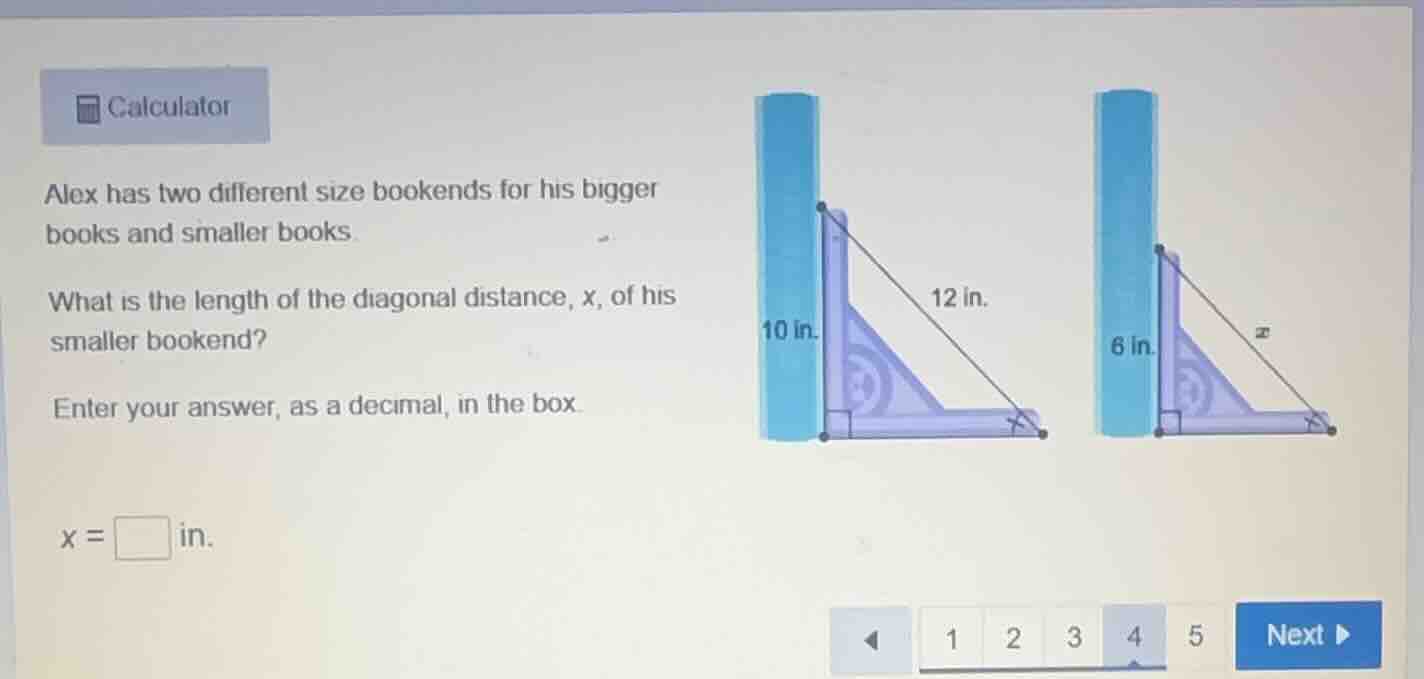
alex has two different size bookends for his bigger books and smaller books.
what is the length of the diagonal distance, x, of his smaller bookend?
enter your answer, as a decimal, in the box.
x = \boxed{} in.
(there are two images of bookends: the bigger one has height 10 in. and diagonal 12 in., the smaller one has height 6 in. and we need to find diagonal x)
Step1: Find the base length of the bigger bookend's triangle
The bigger bookend's triangle has height 10 in and hypotenuse 12 in. Using the Pythagorean theorem \(a^2 + b^2 = c^2\), where \(c = 12\) and \(a = 10\), we find the base \(b\):
\(b = \sqrt{12^2 - 10^2} = \sqrt{144 - 100} = \sqrt{44} = 2\sqrt{11}\)? Wait, no—wait, actually, the two bookends are similar triangles (same shape, different size). So the ratio of height to hypotenuse (or height to base) should be equal. Wait, the bigger bookend: height 10, hypotenuse 12? Wait, no, maybe the base is the same? Wait, looking at the diagram, the base of both triangles is the same? Wait, no, the first triangle: height 10, hypotenuse 12? Wait, no, maybe the first triangle has height 10, hypotenuse 12, and the second has height 6, hypotenuse \(x\), and the base is the same. Wait, no, actually, the two triangles are similar, so the ratio of corresponding sides is equal.
Wait, let's re-express: The first triangle (bigger bookend) is a right triangle with height \(h_1 = 10\) in, hypotenuse \(c_1 = 12\) in? Wait, no, that can't be, because \(10^2 + b^2 = 12^2\) would mean \(b = \sqrt{144 - 100} = \sqrt{44} \approx 6.633\). But the second triangle has height \(h_2 = 6\) in, and same base \(b\), so hypotenuse \(x\) would satisfy \(6^2 + b^2 = x^2\). But since \(b^2 = 12^2 - 10^2 = 44\), then \(x^2 = 6^2 + 44 = 36 + 44 = 80\), so \(x = \sqrt{80} \approx 8.944\)? Wait, no, that doesn't make sense. Wait, maybe the first triangle is height 10, base (let's say) \(b\), hypotenuse 12? No, that would mean \(b = \sqrt{12^2 - 10^2} = \sqrt{44}\), but the second triangle has height 6, same base \(b\), so hypotenuse \(x = \sqrt{6^2 + b^2} = \sqrt{36 + 44} = \sqrt{80} \approx 8.94\). But wait, maybe the two triangles are similar, so the ratio of height to hypotenuse is equal. So \(\frac{10}{12} = \frac{6}{x}\)? Wait, no, that would be inverse. Wait, similar triangles: corresponding sides are proportional. So height of first / height of second = hypotenuse of first / hypotenuse of second. So \(\frac{10}{6} = \frac{12}{x}\)? No, that would be \(\frac{10}{6} = \frac{12}{x}\) → \(10x = 72\) → \(x = 7.2\). Wait, that makes more sense. Because if the triangles are similar, the ratio of height to hypotenuse is constant. Let's check: First triangle: height 10, hypotenuse 12. Second: height 6, hypotenuse \(x\). So \(\frac{10}{12} = \frac{6}{x}\)? Wait, no, that would be \(\frac{10}{6} = \frac{12}{x}\) (corresponding sides: height1/height2 = hypotenuse1/hypotenuse2). So \(10x = 6 \times 12\) → \(10x = 72\) → \(x = 7.2\). Let's verify with Pythagoras. First triangle: height 10, hypotenuse 12, so base \(b = \sqrt{12^2 - 10^2} = \sqrt{44} \approx 6.633\). Second triangle: height 6, base same \(b \approx 6.633\), so hypotenuse \(x = \sqrt{6^2 + 6.633^2} = \sqrt{36 + 44} = \sqrt{80} \approx 8.944\). Wait, that's a contradiction. So I must have misinterpreted the diagram.
Wait, maybe the first triangle has height 10, base (let's say) \(b\), and hypotenuse 12? No, that's not possible because 10 < 12, but \(10^2 + b^2 = 12^2\) → \(b = \sqrt{44}\). The second triangle has height 6, base \(b\) (same base), so hypotenuse \(x = \sqrt{6^2 + b^2} = \sqrt{36 + 44} = \sqrt{80} \approx 8.94\). But that seems off. Alternatively, maybe the two triangles are similar with height 10 and 6, and hypotenuse 12 and \(x\), so the ratio of height to hypotenuse is \(10/12 = 5/6\), so for the smaller triangle, height 6, hypotenuse \(x\) should satisfy \(6/x = 10/12\) → \(10x = 72\) → \(x = 7.2\). But why the discrepancy?
Wait, maybe the fi…

Snap & solve any problem in the app
Get step-by-step solutions on Sovi AI
Photo-based solutions with guided steps
Explore more problems and detailed explanations
7.2