QUESTION IMAGE
Question
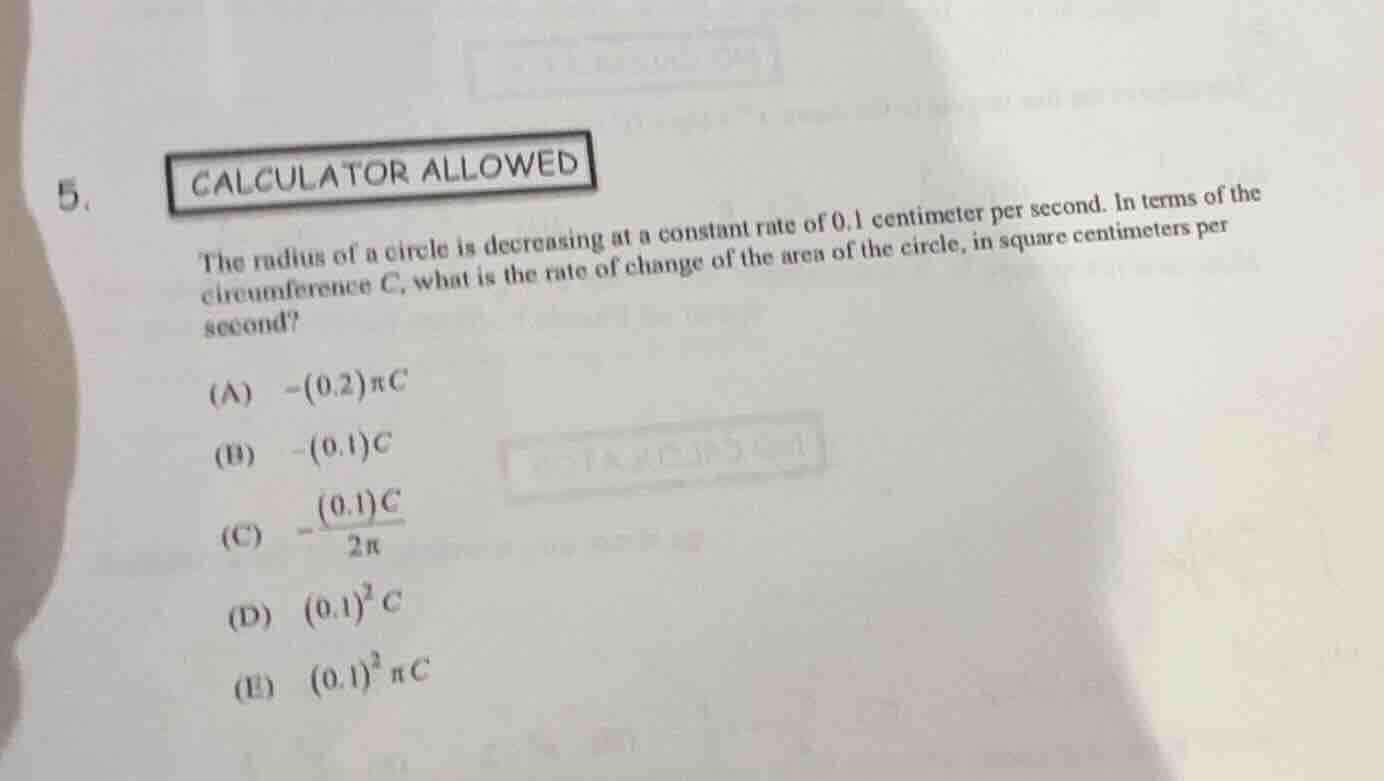
- calculator allowed the radius of a circle is decreasing at a constant rate of 0.1 centimeter per second. in terms of the circumference c, what is the rate of change of the area of the circle, in square centimeters per second? (a) (-(0.2)pi c) (b) (-(0.1)c) (c) (-\frac{(0.1)c}{2pi}) (d) ((0.1)^2 c) (e) ((0.1)^2 pi c)
Step1: Recall formulas for area and circumference of a circle
The area of a circle is \( A = \pi r^2 \), and the circumference is \( C = 2\pi r \). We need to find \( \frac{dA}{dt} \) in terms of \( C \), given \( \frac{dr}{dt} = - 0.1 \) cm/s (negative because radius is decreasing).
Step2: Differentiate the area with respect to time
Using the chain rule, \( \frac{dA}{dt} = \frac{d}{dt}(\pi r^2) = 2\pi r \frac{dr}{dt} \).
Step3: Substitute \( 2\pi r \) with \( C \)
From the circumference formula, \( C = 2\pi r \), so substitute \( 2\pi r \) in the derivative of area: \( \frac{dA}{dt} = C \cdot \frac{dr}{dt} \).
Step4: Plug in the value of \( \frac{dr}{dt} \)
We know \( \frac{dr}{dt} = - 0.1 \) cm/s, so \( \frac{dA}{dt} = C \cdot (-0.1) = - (0.1)C \).

Snap & solve any problem in the app
Get step-by-step solutions on Sovi AI
Photo-based solutions with guided steps
Explore more problems and detailed explanations
B. \(-(0.1)C\)