QUESTION IMAGE
Question
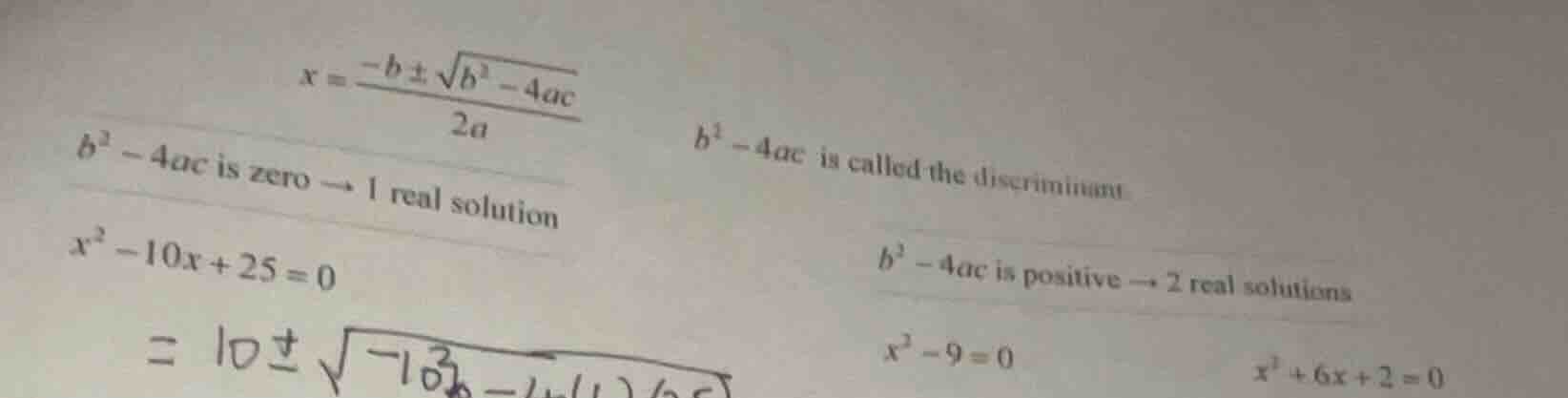
$x = \frac{-b \pm \sqrt{b^2 - 4ac}}{2a}$
$b^2 - 4ac$ is called the discriminant
$b^2 - 4ac$ is zero $\
ightarrow$ 1 real solution
$b^2 - 4ac$ is positive $\
ightarrow$ 2 real solutions
$x^2 -10x +25 = 0$
$= 10\pm\sqrt{-103 -1(1)}$
$x^2 -9 = 0$
$x^2 +6x +2 = 0$
Step1: Identify discriminant rule
For $ax^2+bx+c=0$, discriminant $D=b^2-4ac$
- $D=0$: 1 real solution
- $D>0$: 2 real solutions
---
For $x^2-10x+25=0$
Step2: Assign a,b,c values
$a=1,\ b=-10,\ c=25$
Step3: Calculate discriminant
$D=(-10)^2-4(1)(25)=100-100=0$
Step4: Determine solution count
Since $D=0$, 1 real solution
---
For $x^2-9=0$
Step5: Assign a,b,c values
$a=1,\ b=0,\ c=-9$
Step6: Calculate discriminant
$D=(0)^2-4(1)(-9)=0+36=36$
Step7: Determine solution count
Since $D>0$, 2 real solutions
---
For $x^2+6x+2=0$
Step8: Assign a,b,c values
$a=1,\ b=6,\ c=2$
Step9: Calculate discriminant
$D=(6)^2-4(1)(2)=36-8=28$
Step10: Determine solution count
Since $D>0$, 2 real solutions

Snap & solve any problem in the app
Get step-by-step solutions on Sovi AI
Photo-based solutions with guided steps
Explore more problems and detailed explanations
- $x^2-10x+25=0$: 1 real solution
- $x^2-9=0$: 2 real solutions
- $x^2+6x+2=0$: 2 real solutions