QUESTION IMAGE
Question
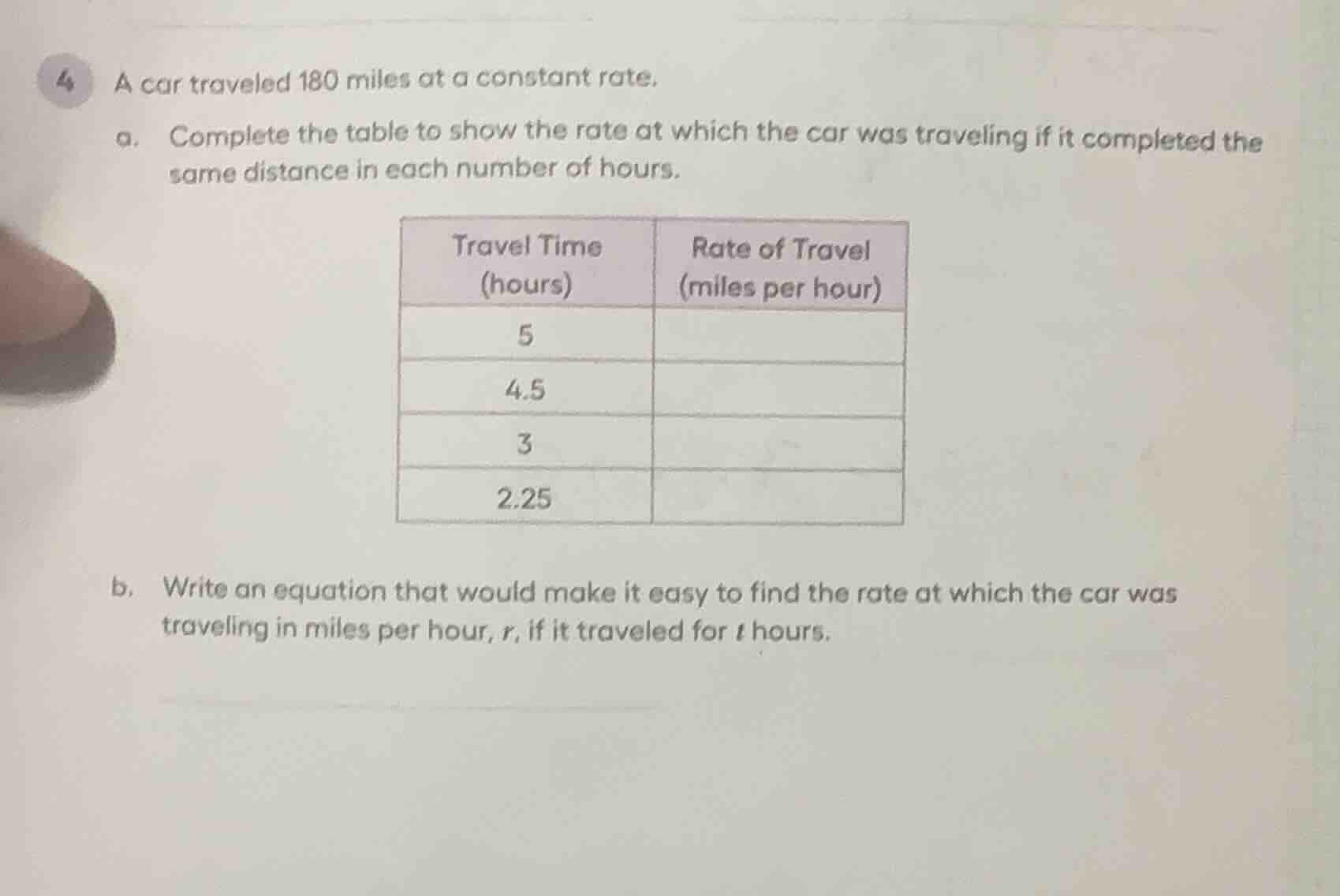
4 a car traveled 180 miles at a constant rate. a. complete the table to show the rate at which the car was traveling if it completed the same distance in each number of hours. travel time (hours) rate of travel (miles per hour) 5 4.5 3 2.25 b. write an equation that would make it easy to find the rate at which the car was traveling in miles per hour, r, if it traveled for t hours.
Part (a)
We know that the formula relating distance (\(d\)), rate (\(r\)), and time (\(t\)) is \(d = r\times t\), so we can solve for rate: \(r=\frac{d}{t}\). Here, the distance \(d = 180\) miles. We will use this formula to find the rate for each given time.
Step 1: Time = 5 hours
We use the formula \(r=\frac{d}{t}\), where \(d = 180\) and \(t = 5\).
\(r=\frac{180}{5}=36\) miles per hour.
Step 2: Time = 4.5 hours
Using \(r=\frac{d}{t}\) with \(d = 180\) and \(t = 4.5\).
\(r=\frac{180}{4.5}=40\) miles per hour (since \(180\div4.5 = 180\div\frac{9}{2}=180\times\frac{2}{9}=40\)).
Step 3: Time = 3 hours
Using \(r=\frac{d}{t}\) with \(d = 180\) and \(t = 3\).
\(r=\frac{180}{3}=60\) miles per hour.
Step 4: Time = 2.25 hours
Using \(r=\frac{d}{t}\) with \(d = 180\) and \(t = 2.25\).
\(r=\frac{180}{2.25}=80\) miles per hour (since \(180\div2.25=180\div\frac{9}{4}=180\times\frac{4}{9} = 80\)).
Part (b)
We know that distance \(d\) is equal to rate \(r\) multiplied by time \(t\) (\(d=r\times t\)). We know the distance \(d = 180\) miles. We want to solve for \(r\) in terms of \(t\). So we can rearrange the formula \(d=r\times t\) to solve for \(r\). Dividing both sides of the equation by \(t\) (assuming \(t
eq0\)), we get \(r=\frac{180}{t}\).
Part (a) Table Completion:
| Travel Time (hours) | Rate of Travel (miles per hour) |
|---|---|
| 4.5 | 40 |
| 3 | 60 |
| 2.25 | 80 |
Part (b) Equation:

Snap & solve any problem in the app
Get step-by-step solutions on Sovi AI
Photo-based solutions with guided steps
Explore more problems and detailed explanations
The equation is \(r=\frac{180}{t}\) (or equivalently \(rt = 180\) or \(r=180\div t\)).