QUESTION IMAGE
Question
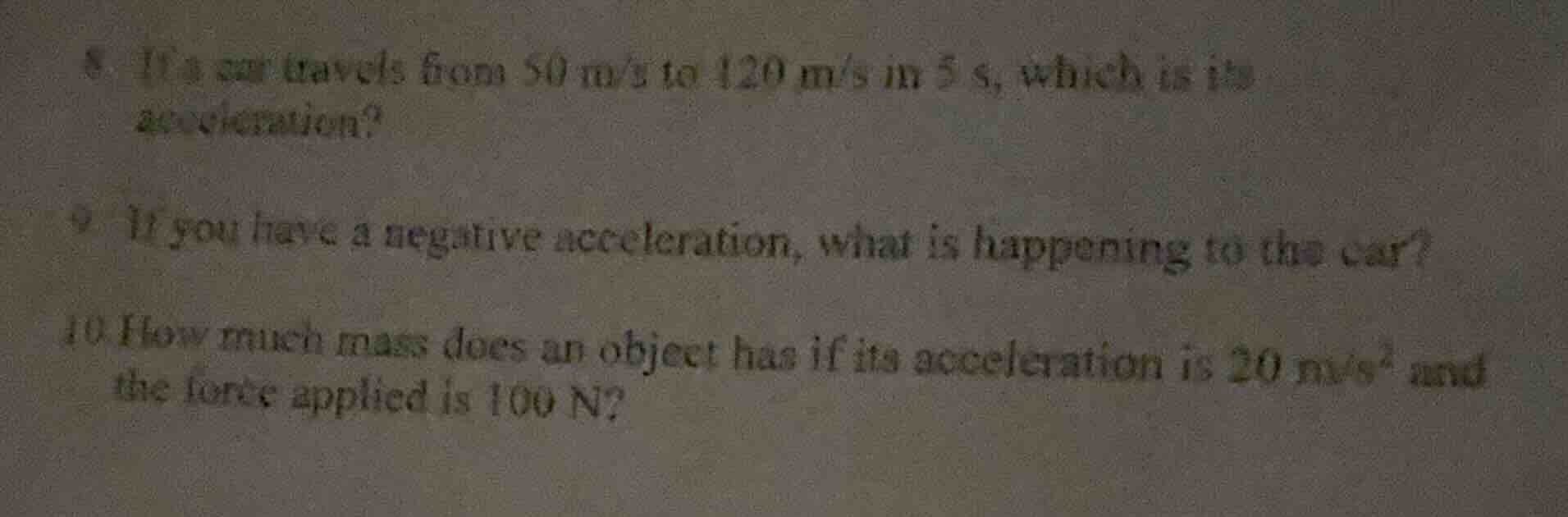
- if a car travels from 50 m/s to 120 m/s in 5 s, which is its acceleration?
- if you have a negative acceleration, what is happening to the car?
- how much mass does an object has if its acceleration is $20\\ \text{m/s}^2$ and the force applied is 100 n?
Step1: Define acceleration formula
Acceleration is $\frac{\Delta v}{\Delta t} = \frac{v_f - v_i}{t}$
Step2: Plug in values for Q8
$v_f=120\ \text{m/s}, v_i=50\ \text{m/s}, t=5\ \text{s}$
$\text{Acceleration} = \frac{120 - 50}{5} = \frac{70}{5} = 14\ \text{m/s}^2$
Step3: Explain negative acceleration (Q9)
Negative acceleration means the car's velocity is decreasing; it is slowing down (or decelerating, moving in the opposite direction of its positive velocity vector).
Step4: Use Newton's 2nd Law for Q10
Newton's 2nd Law: $F = ma$, rearranged to $m = \frac{F}{a}$
Step5: Calculate mass for Q10
$F=100\ \text{N}, a=20\ \text{m/s}^2$
$m = \frac{100}{20} = 5\ \text{kg}$

Snap & solve any problem in the app
Get step-by-step solutions on Sovi AI
Photo-based solutions with guided steps
Explore more problems and detailed explanations
- For question 8: $14\ \text{m/s}^2$
- For question 9: The car is slowing down (its velocity is decreasing, or it is decelerating relative to its initial direction of motion).
- For question 10: $5\ \text{kg}$