QUESTION IMAGE
Question
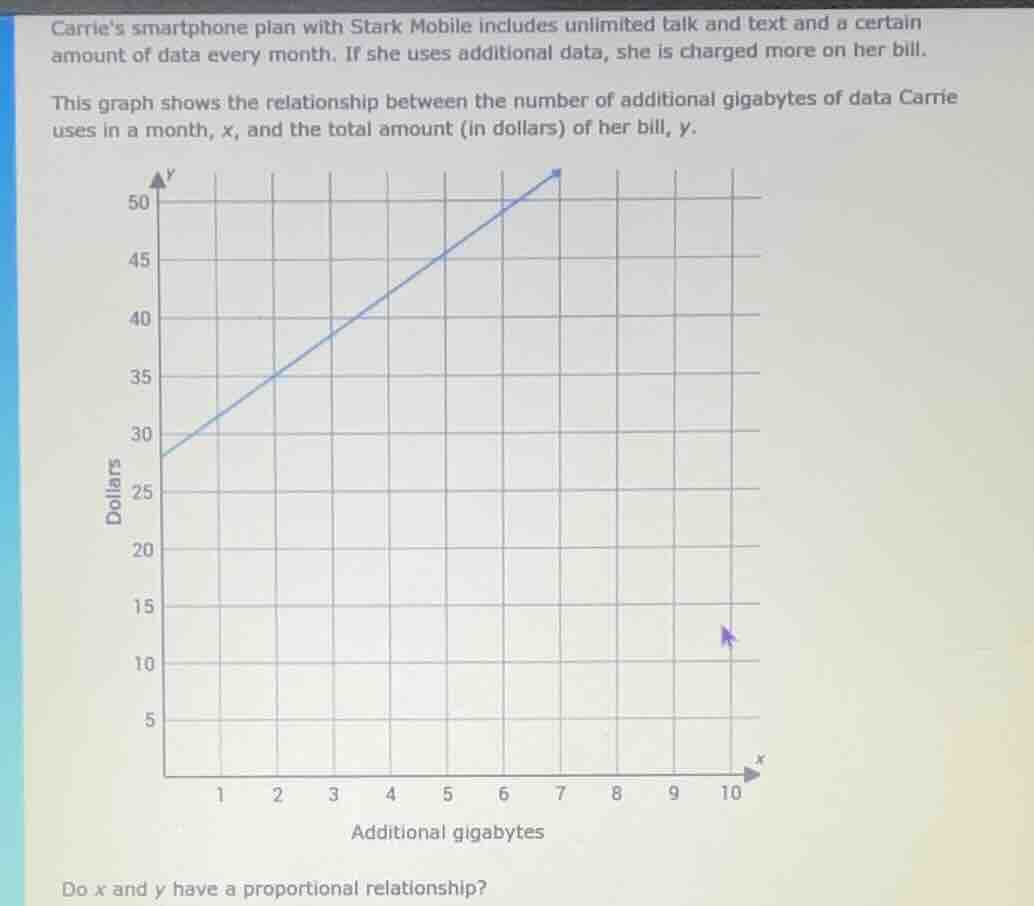
carries smartphone plan with stark mobile includes unlimited talk and text and a certain amount of data every month. if she uses additional data, she is charged more on her bill. this graph shows the relationship between the number of additional gigabytes of data carrie uses in a month, x, and the total amount (in dollars) of her bill, y. do x and y have a proportional relationship?
Step1: Recall proportional relationship
A proportional relationship between two variables \(x\) and \(y\) is of the form \(y = kx\) (where \(k\) is a constant), and its graph passes through the origin \((0,0)\).
Step2: Analyze the graph
The graph of Carrie's bill (\(y\)) vs. additional gigabytes (\(x\)) has a \(y\)-intercept. From the graph, when \(x = 0\) (no additional gigabytes), \(y\) is not \(0\) (it's around \(28 - 29\) dollars, or we can see the line starts above the origin). A proportional relationship's graph must pass through \((0,0)\) because if \(x = 0\), then \(y=k\times0 = 0\). Since this graph does not pass through the origin, \(x\) and \(y\) do not have a proportional relationship.

Snap & solve any problem in the app
Get step-by-step solutions on Sovi AI
Photo-based solutions with guided steps
Explore more problems and detailed explanations
No, \(x\) and \(y\) do not have a proportional relationship.