QUESTION IMAGE
Question
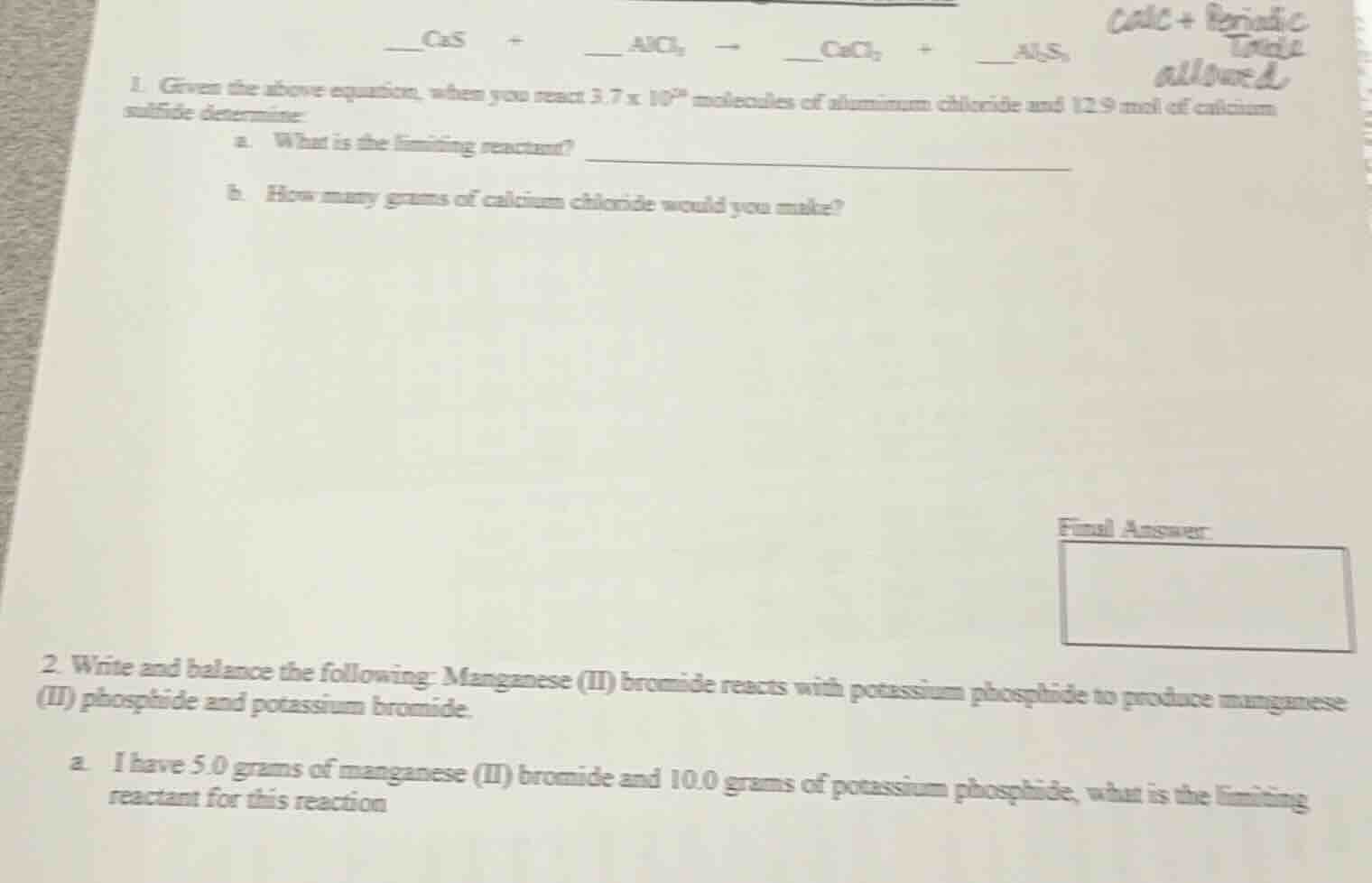
cas + alcl₃ → cacl₂ + al₂s₃
calc + periodic table allowed
- given the above equation, when you react $3.7 \times 10^{26}$ molecules of aluminum chloride and 12.9 mol of calcium sulfide determine:
a. what is the limiting reactant? ____________
b. how many grams of calcium chloride would you make?
final answer:
- write and balance the following: manganese (ii) bromide reacts with potassium phosphide to produce manganese (ii) phosphide and potassium bromide.
a. i have 5.0 grams of manganese (ii) bromide and 10.0 grams of potassium phosphide, what is the limiting reactant for this reaction
Problem 1
First, balance the given chemical equation:
Step1: Balance Al atoms
Step2: Convert $AlCl_3$ molecules to moles
Use Avogadro's number $N_A=6.022\times10^{23}\text{ mol}^{-1}$
$$n(\text{AlCl}_3)=\frac{3.7\times10^{24}}{6.022\times10^{23}}\approx6.14\text{ mol}$$
Step3: Find mole ratio for limiting reactant
From balanced equation, mole ratio $\text{CaS}:\text{AlCl}_3=3:2$
Moles of $\text{CaS}$ needed for $\text{AlCl}_3$:
$$n(\text{CaS})_{\text{needed}}=6.14\text{ mol} \times \frac{3}{2}=9.21\text{ mol}$$
Given $n(\text{CaS})=12.9\text{ mol}>9.21\text{ mol}$, so $\text{AlCl}_3$ is limiting.
Step4: Calculate moles of $\text{CaCl}_2$
Mole ratio $\text{AlCl}_3:\text{CaCl}_2=2:3$
$$n(\text{CaCl}_2)=6.14\text{ mol} \times \frac{3}{2}=9.21\text{ mol}$$
Step5: Convert moles to grams
Molar mass of $\text{CaCl}_2=40.08+2\times35.45=110.98\text{ g/mol}$
$$m(\text{CaCl}_2)=9.21\text{ mol} \times 110.98\text{ g/mol}\approx1022\text{ g}$$
Step1: Write and balance the equation
Step2: Calculate moles of reactants
Molar mass of $\text{MnBr}_2=54.94+2\times79.90=214.74\text{ g/mol}$
$$n(\text{MnBr}_2)=\frac{5.0\text{ g}}{214.74\text{ g/mol}}\approx0.0233\text{ mol}$$
Molar mass of $\text{K}_3\text{P}=3\times39.10+30.97=148.27\text{ g/mol}$
$$n(\text{K}_3\text{P})=\frac{10.0\text{ g}}{148.27\text{ g/mol}}\approx0.0674\text{ mol}$$
Step3: Find limiting reactant
Mole ratio $\text{MnBr}_2:\text{K}_3\text{P}=3:2$
Moles of $\text{K}_3\text{P}$ needed for $\text{MnBr}_2$:
$$n(\text{K}_3\text{P})_{\text{needed}}=0.0233\text{ mol} \times \frac{2}{3}\approx0.0155\text{ mol}$$
Given $n(\text{K}_3\text{P})=0.0674\text{ mol}>0.0155\text{ mol}$, so $\text{MnBr}_2$ is limiting.

Snap & solve any problem in the app
Get step-by-step solutions on Sovi AI
Photo-based solutions with guided steps
Explore more problems and detailed explanations
a. Limiting reactant: $\text{AlCl}_3$ (Aluminum chloride)
b. Mass of calcium chloride: $\approx1022\text{ g}$
---