QUESTION IMAGE
Question
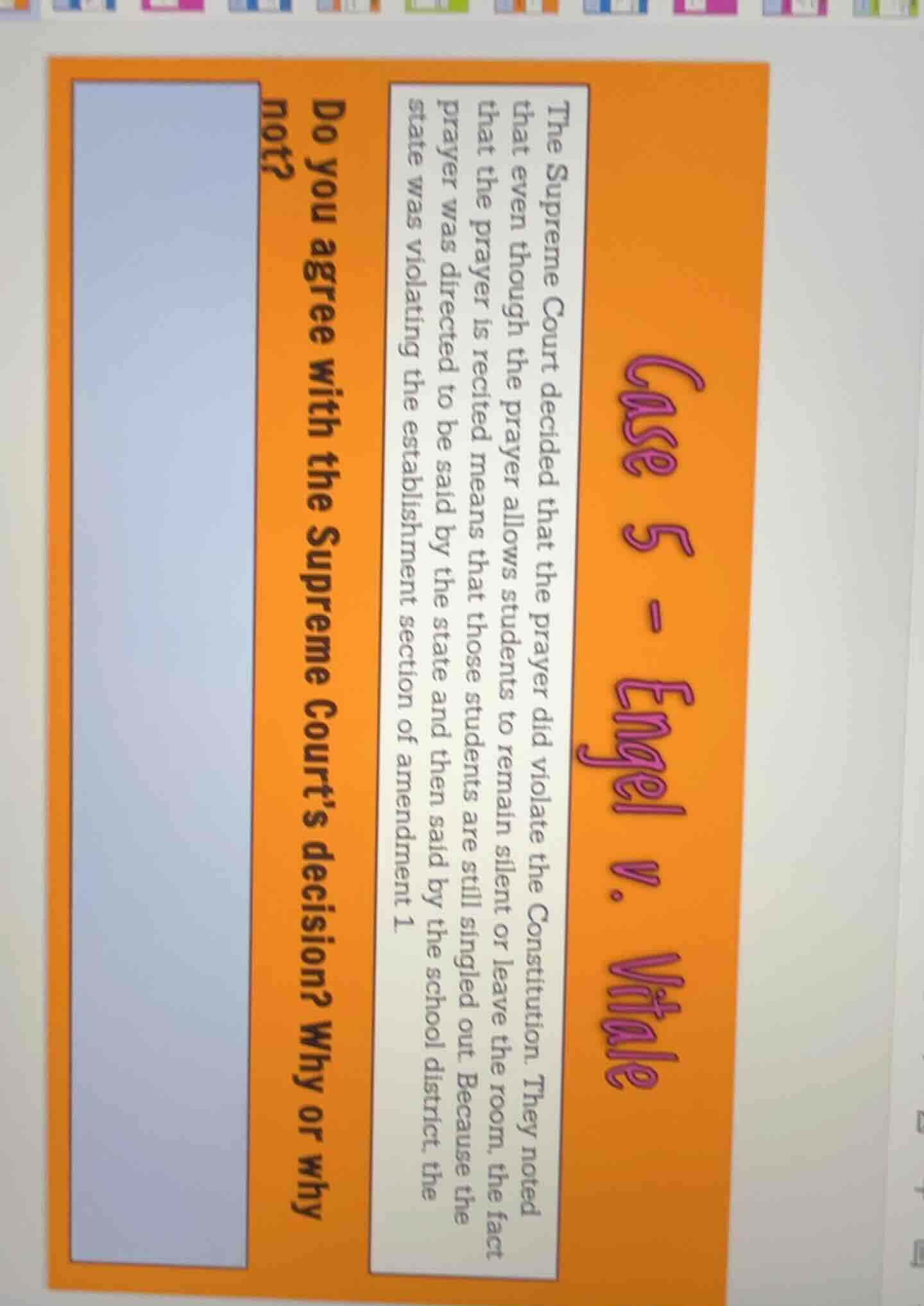
case 5 - engel v. vitale
the supreme court decided that the prayer did violate the constitution. they noted that even though the prayer allows students to remain silent or leave the room, the fact that the prayer is recited means that those students are still singled out. because the prayer was directed to be said by the state and then said by the school district, the state was violating the establishment section of amendment 1
do you agree with the supreme court’s decision? why or why not?
The problem is about the Supreme Court case Engel v. Vitale, which involves constitutional law (First Amendment's Establishment Clause) and the separation of church and state. The subfield of Law (under Social Science) is the most relevant as it deals with legal decisions, constitutional interpretation, and the application of law to cases. The question asks for an opinion on the Court's decision, which requires analyzing the legal reasoning behind the ruling (the state - directed prayer in public schools violating the Establishment Clause) and forming a judgment based on that legal context. For example, if agreeing, the reasoning could be that the Establishment Clause aims to prevent the government (including public schools) from endorsing or promoting a particular religion, and the state - directed prayer in this case did just that, even with the option to remain silent, as it still created a situation where the state was involved in religious activity. If disagreeing, one might argue about the idea of a non - denominational prayer being a way to promote moral values or community without excessive religious endorsement, but the legal precedent and the intent of the Establishment Clause support the Court's decision in terms of keeping state and religion separate in public education.

Snap & solve any problem in the app
Get step-by-step solutions on Sovi AI
Photo-based solutions with guided steps
Explore more problems and detailed explanations
(Opinion - based, example given) I agree with the Supreme Court's decision. The First Amendment's Establishment Clause is meant to prevent the government (here, the public school system, which is a state - run entity) from establishing or promoting a particular religion. The state - directed prayer, even with the option to be silent or leave, still put the state in the position of initiating a religious activity. This could make students who don't follow that religious tradition feel like outsiders or that their beliefs are not valued by the state - run school, which goes against the principle of separation of church and state.