QUESTION IMAGE
Question
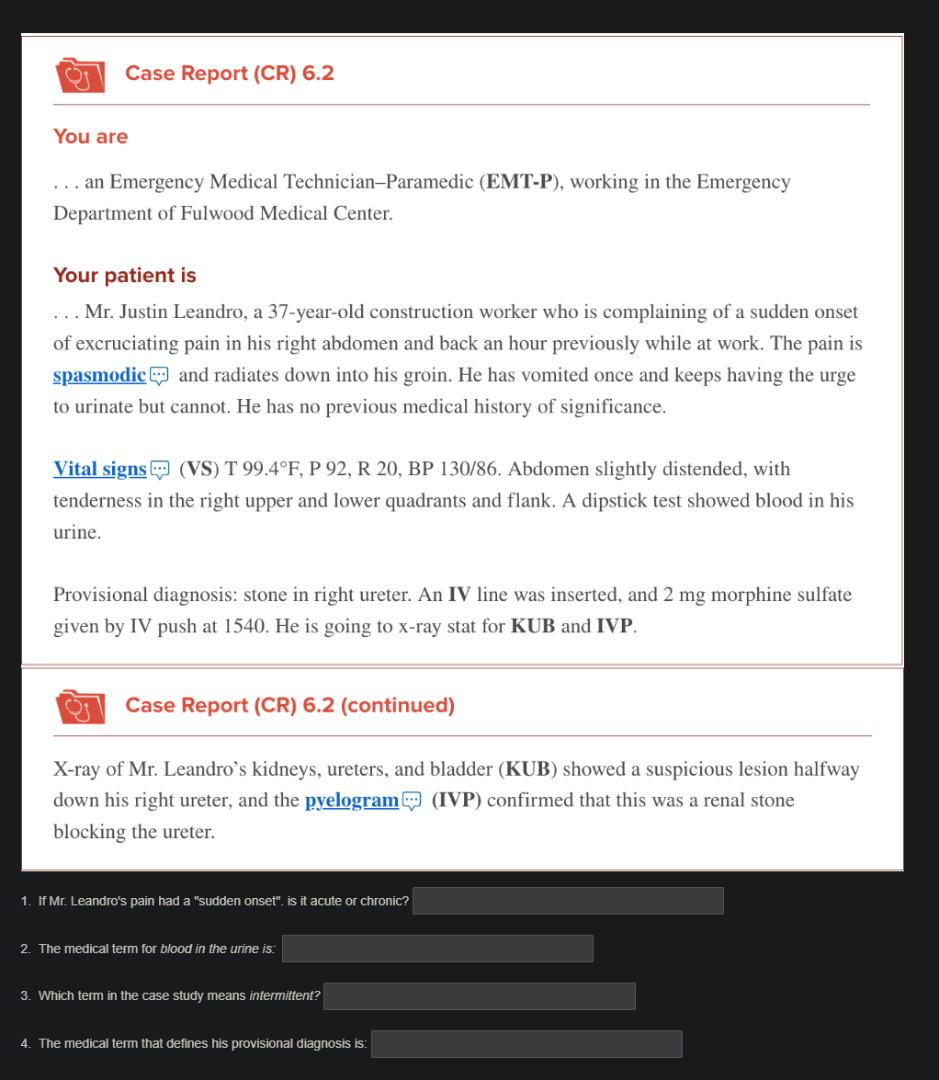
case report (cr) 6.2
you are
... an emergency medical technician–paramedic (emt-p), working in the emergency department of fulwood medical center.
your patient is
... mr. justin leandro, a 37-year-old construction worker who is complaining of a sudden onset of excruciating pain in his right abdomen and back an hour previously while at work. the pain is spasmodic and radiates down into his groin. he has vomited once and keeps having the urge to urinate but cannot. he has no previous medical history of significance.
vital signs (vs) t 99.4°f, p 92, r 20, bp 130/86. abdomen slightly distended, with tenderness in the right upper and lower quadrants and flank. a dipstick test showed blood in his urine.
provisional diagnosis: stone in right ureter. an iv line was inserted, and 2 mg morphine sulfate given by iv push at 1540. he is going to x-ray stat for kub and ivp.
case report (cr) 6.2 (continued)
x-ray of mr. leandro’s kidneys, ureters, and bladder (kub) showed a suspicious lesion halfway down his right ureter, and the pyelogram (ivp) confirmed that this was a renal stone blocking the ureter.
- if mr. leandros pain had a \sudden onset\, is it acute or chronic?
- the medical term for blood in the urine is:
- which term in the case study means intermittent?
- the medical term that defines his provisional diagnosis is:
- Sudden-onset pain is classified as acute, as chronic pain develops gradually and persists long-term.
- The standard medical term for blood in urine is hematuria, which matches the patient's dipstick finding.
- The case report uses "spasmodic" to describe the patient's intermittent, cramping pain.
- A renal stone blocking the ureter is medically termed ureterolithiasis, the formal name for a ureteral stone.

Snap & solve any problem in the app
Get step-by-step solutions on Sovi AI
Photo-based solutions with guided steps
Explore more problems and detailed explanations
- Acute
- Hematuria
- Spasmodic
- Ureterolithiasis