QUESTION IMAGE
Question
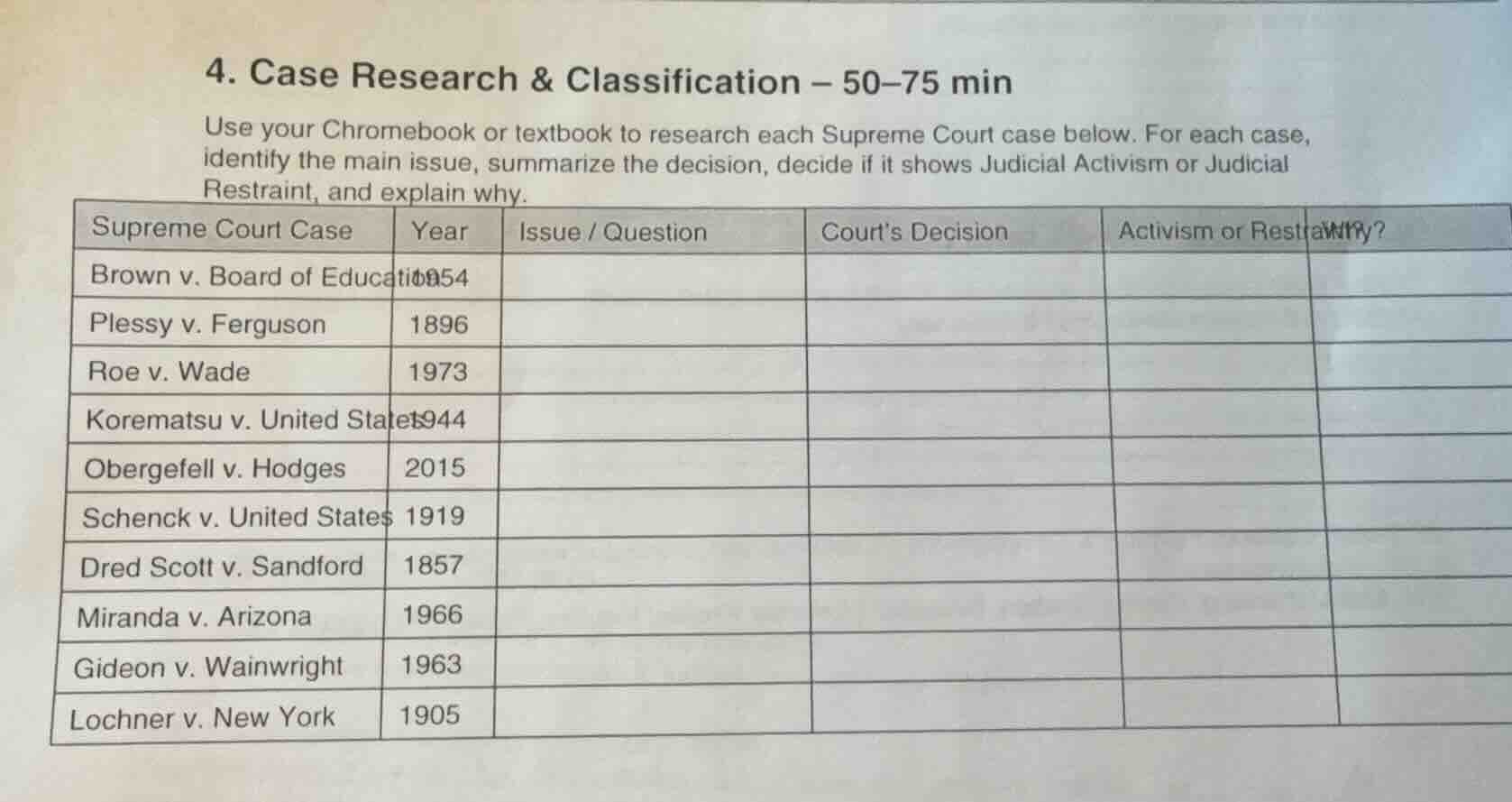
- case research & classification – 50–75 min
use your chromebook or textbook to research each supreme court case below. for each case, identify the main issue, summarize the decision, decide if it shows judicial activism or judicial restraint, and explain why.
| supreme court case | year | issue / question | court’s decision | activism or restraint | why? |
|---|---|---|---|---|---|
| plessy v. ferguson | 1896 | ||||
| roe v. wade | 1973 | ||||
| korematsu v. united states | 1944 | ||||
| obergefell v. hodges | 2015 | ||||
| schenck v. united states | 1919 | ||||
| dred scott v. sandford | 1857 | ||||
| miranda v. arizona | 1966 | ||||
| gideon v. wainwright | 1963 | ||||
| lochner v. new york | 1905 |
Brief Explanations
Each case is analyzed to identify its core legal question, the Supreme Court's ruling, and whether it reflects judicial activism (court shaping policy beyond existing law) or restraint (deferring to legislative/executive or precedent):
- Brown v. Board of Education: Challenged racial segregation in public schools as violating equal protection. The court overturned the "separate but equal" precedent. This is activism as it rejected long-standing precedent to advance civil rights.
- Plessy v. Ferguson: Addressed whether racial segregation in public transit was constitutional. The court upheld "separate but equal" doctrine. This is restraint as it deferred to state segregation laws and limited interpretation of equal protection.
- Roe v. Wade: Questioned if a woman's right to abortion was protected by privacy rights. The court established a constitutional right to abortion with trimester-based limits. This is activism as it found a new unenumerated right not explicitly in the Constitution.
- Korematsu v. United States: Challenged the internment of Japanese Americans during WWII as a violation of equal protection. The court upheld the internment order. This is restraint as it deferred to executive/legislative wartime actions.
- Obergefell v. Hodges: Addressed if same-sex couples had a constitutional right to marry. The court ruled same-sex marriage is protected by due process and equal protection clauses. This is activism as it expanded marriage rights beyond existing state laws and precedent.
- Schenck v. United States: Questioned if anti-draft speech during WWI violated the Espionage Act. The court established the "clear and present danger" test, upholding the conviction. This is restraint as it deferred to congressional wartime legislation.
- Dred Scott v. Sandford: Addressed if enslaved people could be U.S. citizens and if Congress could ban slavery in territories. The court ruled enslaved people were not citizens and Congress could not restrict slavery in territories. This is activism as it expanded slavery protections beyond existing law and struck down congressional legislation.
- Miranda v. Arizona: Questioned if police must inform suspects of their constitutional rights during interrogation. The court established the Miranda warning requirement. This is activism as it created a new procedural rule to protect suspect rights not explicitly outlined in the Constitution.
- Gideon v. Wainwright: Addressed if indigent defendants in state courts have a right to court-appointed counsel. The court ruled this right is required under the Sixth Amendment. This is activism as it expanded the Sixth Amendment's right to counsel to state courts, overturning precedent.
- Lochner v. New York: Challenged a state law limiting bakers' work hours as violating due process. The court struck down the law, finding it violated "liberty of contract." This is activism as it used substantive due process to strike down a state economic regulation, overriding legislative policy.

Snap & solve any problem in the app
Get step-by-step solutions on Sovi AI
Photo-based solutions with guided steps
Explore more problems and detailed explanations
| Supreme Court Case | Year | Issue / Question | Court's Decision | Activism or Restraint? | Why? |
|---|---|---|---|---|---|
| Plessy v. Ferguson | 1896 | Is racial segregation in public transit constitutional? | Upheld "separate but equal" doctrine; segregation is constitutional. | Judicial Restraint | Deferred to state segregation laws and narrow equal protection interpretation. |
| Roe v. Wade | 1973 | Does a woman have a constitutional right to abortion? | Ruled a woman's right to abortion is protected by implied privacy rights in the 14th Amendment; established trimester-based limits. | Judicial Activism | Identified an unenumerated constitutional right not explicit in the text. |
| Korematsu v. United States | 1944 | Is Japanese American internment during WWII constitutional? | Upheld the internment order as a wartime military necessity. | Judicial Restraint | Deferred to executive and legislative wartime authority. |
| Obergefell v. Hodges | 2015 | Do same-sex couples have a constitutional right to marry? | Ruled same-sex marriage is protected by the 14th Amendment's Due Process and Equal Protection Clauses; required all states to recognize same-sex marriages. | Judicial Activism | Expanded marriage rights beyond existing state laws and precedent. |
| Schenck v. United States | 1919 | Does anti-draft speech during WWI violate the Espionage Act? | Upheld the conviction; established the "clear and present danger" test for unprotected speech. | Judicial Restraint | Deferred to congressional wartime legislation. |
| Dred Scott v. Sandford | 1857 | Can enslaved people be U.S. citizens, and can Congress ban slavery in territories? | Ruled enslaved people are not U.S. citizens; Congress cannot restrict slavery in federal territories. | Judicial Activism | Struck down congressional legislation and expanded slavery protections beyond existing law. |
| Miranda v. Arizona | 1966 | Must police inform suspects of their constitutional rights during interrogation? | Ruled suspects must be informed of their 5th and 6th Amendment rights (Miranda warning) before custodial interrogation. | Judicial Activism | Created a new procedural rule to protect suspect rights not explicitly in the Constitution. |
| Gideon v. Wainwright | 1963 | Do indigent state defendants have a right to court-appointed counsel? | Ruled the 6th Amendment's right to counsel applies to state courts via the 14th Amendment; indigent defendants must be provided counsel. | Judicial Activism | Expanded the Sixth Amendment's scope to state courts, overturning precedent. |
| Lochner v. New York | 1905 | Is a state law limiting bakers' work hours constitutional? | Struck down the law; ruled it violates the 14th Amendment's substantive due process right to "liberty of contract." | Judicial Activism | Used substantive due process to override state economic regulation and legislative policy. |