QUESTION IMAGE
Question
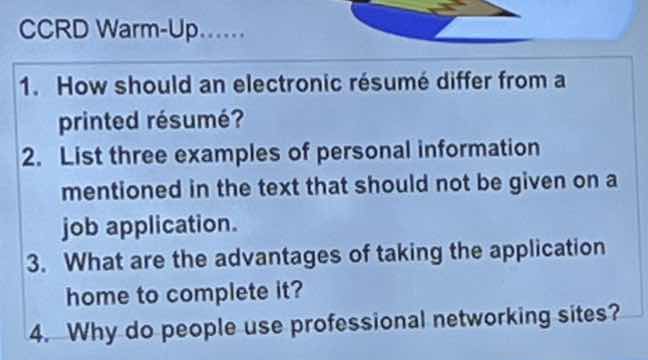
ccrd warm-up......
- how should an electronic résumé differ from a printed résumé?
- list three examples of personal information mentioned in the text that should not be given on a job application.
- what are the advantages of taking the application home to complete it?
- why do people use professional networking sites?
1. How should an electronic résumé differ from a printed résumé?
Electronic résumés are often formatted for digital readability (e.g., plain text, ATS - friendly), use keywords for applicant tracking systems, and may be shorter or more concise. Printed résumés focus on visual appeal (e.g., fonts, spacing) and can have more design elements.
Common personal info to exclude: age (to avoid age discrimination), marital status (irrelevant to job performance), social security number (unless required for official hiring - related tax/legal processes at later stages, not initial app), or religious affiliation (to avoid bias). Assuming text - related common exclusions.
Taking an application home allows for: time to research the company and tailor responses, access to personal documents (e.g., references, work history details) not available on - site, and a calm environment to avoid on - the - spot mistakes or rushed answers.

Snap & solve any problem in the app
Get step-by-step solutions on Sovi AI
Photo-based solutions with guided steps
Explore more problems and detailed explanations
- Format: Electronic résumés may use plain text/ATS - compatible formats; printed résumés use formatted, visually appealing layouts (e.g., with fonts, margins).
- Keywords: Electronic résumés include keywords for ATS; printed résumés don't need this.
- Length/Detail: Electronic résumés can be more concise; printed résumés may have more elaborate formatting - related details.