QUESTION IMAGE
Question
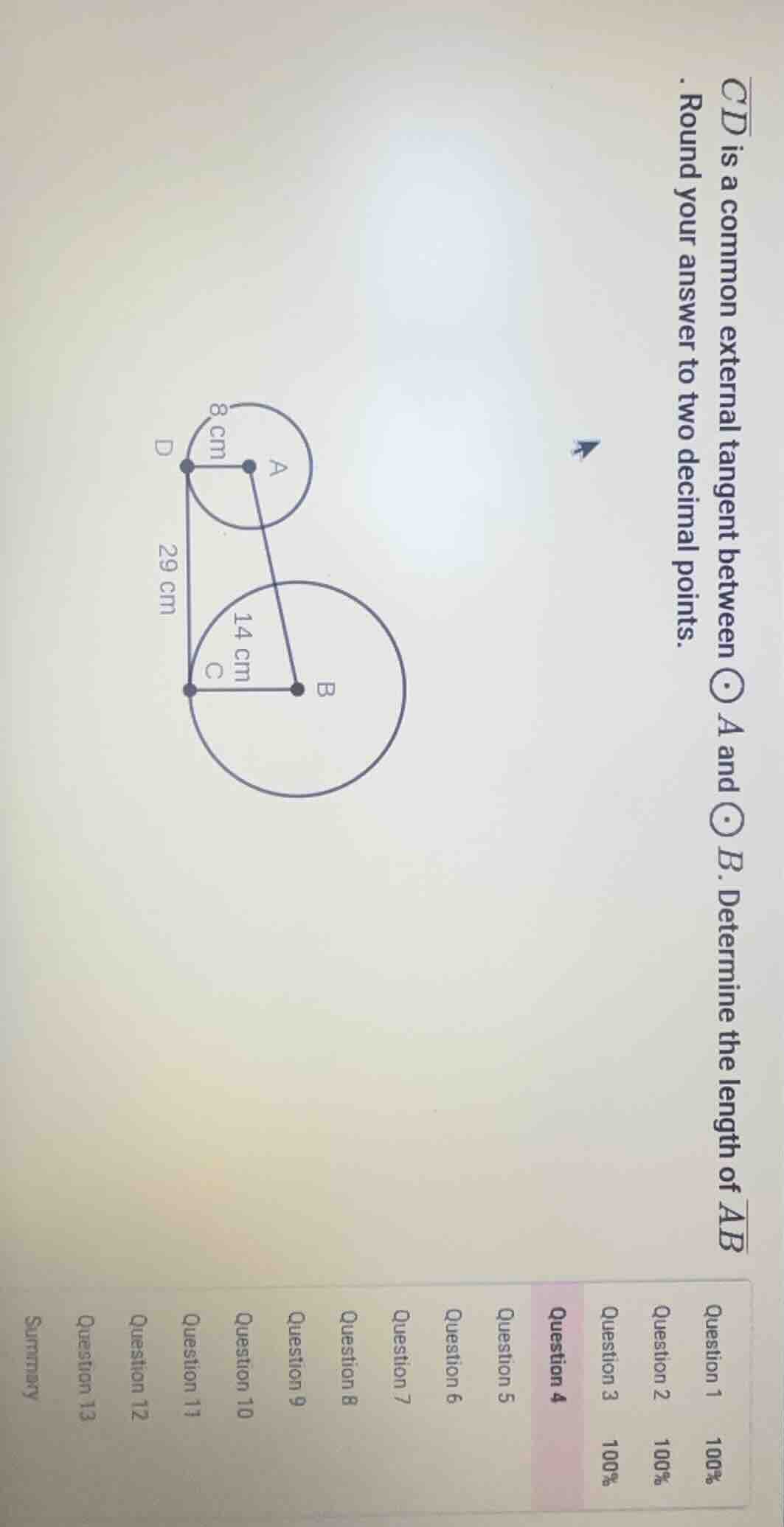
cd is a common external tangent between ⊙a and ⊙b. determine the length of ab. round your answer to two decimal points.
Step1: Analyze the right triangle
We can form a right triangle with \( AB \) as the hypotenuse, the horizontal leg being the difference in radii (\( 14 - 8 = 6 \) cm) and the vertical leg being the length of the external tangent \( CD = 29 \) cm. Wait, no, actually, for external tangent, the distance between the centers horizontally is the difference in radii? Wait, no, external tangent: the line connecting the centers, the length of the external tangent, and the difference in radii form a right triangle. Wait, the length of the external tangent \( CD = 29 \) cm, the radii are \( AD = 8 \) cm and \( BC = 14 \) cm. So the horizontal distance between the centers is \( 14 - 8 = 6 \) cm? No, wait, external tangent: the segment connecting the centers, the external tangent, and the segment parallel to the tangent connecting the radii (which is the difference in radii) form a right triangle. Wait, actually, the length of the external tangent between two circles with radii \( r \) and \( R \) ( \( R>r \)) is \( \sqrt{d^2 - (R - r)^2} \), but here we need to find \( d = AB \), given the external tangent length \( CD = 29 \) and radii \( 8 \) and \( 14 \). So we have a right triangle where one leg is \( CD = 29 \), the other leg is \( 14 - 8 = 6 \), and hypotenuse is \( AB \). Wait, no, wait: the external tangent length formula is \( \sqrt{d^2 - (R - r)^2} \), so we can rearrange to find \( d \): \( d=\sqrt{(\text{tangent length})^2+(R - r)^2} \).
Step2: Calculate the length of \( AB \)
Given \( R = 14 \), \( r = 8 \), tangent length \( CD = 29 \). Then the difference in radii is \( 14 - 8 = 6 \) cm. So using Pythagoras: \( AB=\sqrt{29^2 + 6^2} \). Calculate \( 29^2 = 841 \), \( 6^2 = 36 \), sum is \( 841+36 = 877 \). Then \( AB=\sqrt{877}\approx29.61 \) cm. Wait, no, wait, I think I mixed up internal and external tangent. Wait, external tangent: the formula is \( \sqrt{d^2 - (R - r)^2} \), so if \( CD \) is the external tangent, then \( CD=\sqrt{AB^2 - (R - r)^2} \), so we need to solve for \( AB \). So \( AB=\sqrt{CD^2+(R - r)^2} \). Wait, \( CD = 29 \), \( R - r = 14 - 8 = 6 \). So \( AB=\sqrt{29^2 + 6^2}=\sqrt{841 + 36}=\sqrt{877}\approx29.61 \)? Wait, no, that can't be, because 29 squared is 841, 6 squared is 36, sum is 877, square root of 877 is approximately 29.61? Wait, maybe I made a mistake. Wait, the external tangent length formula is \( \sqrt{d^2 - (R - r)^2} \), where \( d \) is the distance between centers. So if \( CD \) is the external tangent, then \( CD = \sqrt{AB^2 - (R - r)^2} \), so \( AB = \sqrt{CD^2 + (R - r)^2} \). So plugging in \( CD = 29 \), \( R - r = 14 - 8 = 6 \), so \( AB=\sqrt{29^2 + 6^2}=\sqrt{841 + 36}=\sqrt{877}\approx29.61 \) cm. Wait, but let's check again. The radii are 8 and 14, so the vertical distance between the centers (if we consider the tangent horizontal) would be the difference in radii? No, wait, external tangent: the two radii are perpendicular to the tangent, so \( AD \) and \( BC \) are both perpendicular to \( CD \), so \( AD \parallel BC \), and the distance between \( A \) and \( B \) horizontally is \( 14 - 8 = 6 \) (since \( AD = 8 \), \( BC = 14 \), so the horizontal segment between the centers is \( 14 - 8 \)), and vertically is \( CD = 29 \). So the right triangle has legs 29 and 6, hypotenuse \( AB \). So \( AB=\sqrt{29^2 + 6^2}=\sqrt{841 + 36}=\sqrt{877}\approx29.61 \) cm.

Snap & solve any problem in the app
Get step-by-step solutions on Sovi AI
Photo-based solutions with guided steps
Explore more problems and detailed explanations
\( \approx 29.61 \) cm