QUESTION IMAGE
Question
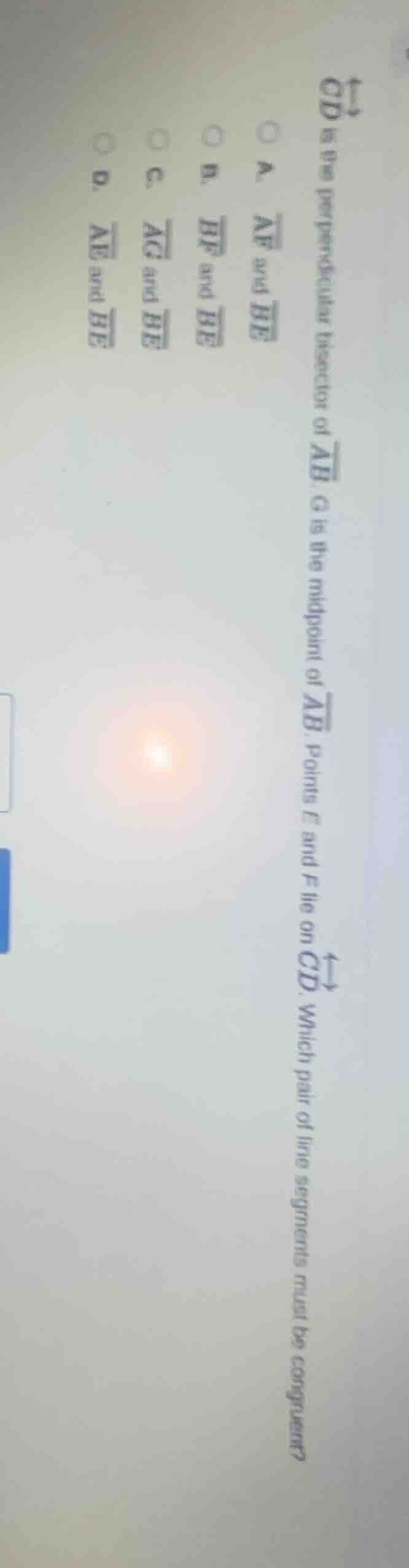
cd is the perpendicular bisector of ab. g is the midpoint of ab. points e and f lie on cd. which pair of line segments must be congruent? a. af and be b. bf and be c. ag and be d. ae and be
Step1: Recall Perpendicular Bisector Theorem
The perpendicular bisector theorem states that any point on the perpendicular bisector of a segment is equidistant from the endpoints of the segment. Here, \( \overleftrightarrow{CD} \) is the perpendicular bisector of \( \overline{AB} \), and \( G \) is the midpoint of \( \overline{AB} \). Points \( E \) and \( F \) lie on \( \overleftrightarrow{CD} \). For point \( E \) (or \( F \)) on the perpendicular bisector, the distances from \( E \) (or \( F \)) to \( A \) and \( B \) should be equal. But let's check the options. Wait, option D is \( \overline{AE} \) and \( \overline{BE} \)? No, wait, let's re - examine. Wait, the perpendicular bisector is \( CD \), so any point on \( CD \) is equidistant from \( A \) and \( B \). So for point \( E \) on \( CD \), \( AE = BE \) (by perpendicular bisector theorem: \( E \) is on \( CD \), the perpendicular bisector of \( AB \), so \( EA=EB \)). Similarly, for \( F \), \( FA = FB \), but let's check the options. The options are:
A. \( \overline{AF} \) and \( \overline{BE} \) – not necessarily equal.
B. \( \overline{BF} \) and \( \overline{BE} \) – \( BF = AF \) and \( BE=AE \), not necessarily equal.
C. \( \overline{AG} \) and \( \overline{BE} \) – \( AG \) is half of \( AB \), \( BE \) is equal to \( AE \), not necessarily equal.
D. \( \overline{AE} \) and \( \overline{BE} \) – Since \( E \) is on the perpendicular bisector \( CD \) of \( AB \), by the perpendicular bisector theorem, \( AE = BE \).

Snap & solve any problem in the app
Get step-by-step solutions on Sovi AI
Photo-based solutions with guided steps
Explore more problems and detailed explanations
D. \( \overline{AE} \) and \( \overline{BE} \)