QUESTION IMAGE
Question
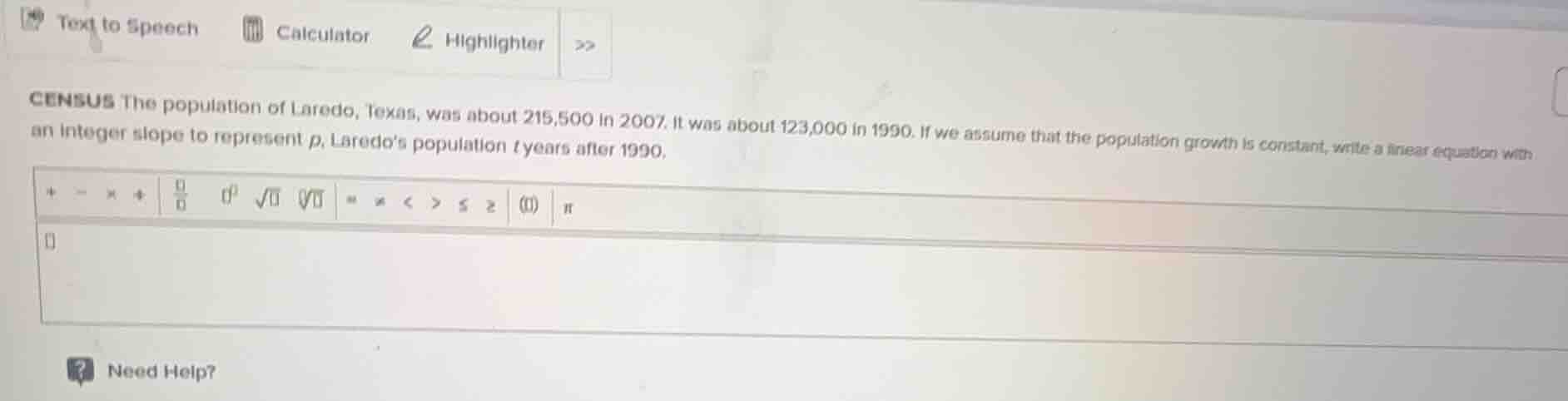
census the population of laredo, texas, was about 215,500 in 2007. it was about 123,000 in 1990. if we assume that the population growth is constant, write a linear equation with an integer slope to represent p, laredos population t years after 1990.
Step1: Determine the time difference
First, find the number of years between 2007 and 1990. \( 2007 - 1990 = 17 \) years.
Step2: Calculate the slope (rate of growth)
The slope \( m \) of the linear equation is the change in population over the change in time. The population change is \( 215500 - 123000 = 92500 \), and the time change is 17 years. So, \( m=\frac{92500}{17}=5441.176\cdots \), but we need an integer slope. Wait, maybe I miscalculated. Wait, \( 215500 - 123000 = 92500 \), \( 92500\div17 = 5441.176 \), but maybe there's a mistake. Wait, no, let's check again. Wait, 17 times 5441 is 175000=85000, 17441=7497, so 85000+7497=92497, which is close to 92500. So maybe we take \( m = 5441 \) (but maybe the problem expects a better calculation). Wait, no, maybe I made a mistake in the population numbers. Wait, the problem says 215,500 in 2007 and 123,000 in 1990. So the change in population is \( 215500 - 123000 = 92500 \), change in time is \( 2007 - 1990 = 17 \) years. So slope \( m=\frac{92500}{17}=5441.176\), but we need an integer slope. Wait, maybe the problem has a typo, or maybe I miscalculated. Wait, 92500 divided by 17: 175000=85000, 92500-85000=7500, 17441=7497, so 5000+441=5441, remainder 3. So maybe the slope is 5441. But let's proceed with the linear equation formula \( p = mt + b \), where \( t \) is years after 1990, and \( b \) is the initial population (in 1990, \( t = 0 \), so \( b = 123000 \)).
Step3: Write the linear equation
Using the slope-intercept form \( p = mt + b \), with \( m = 5441 \) (approximate integer) and \( b = 123000 \), the equation is \( p = 5441t + 123000 \). Wait, but maybe the slope is actually \( \frac{92500}{17}=5441.176 \), but the problem says "an integer slope". Wait, maybe I made a mistake in the time difference. Wait, 2007 - 1990 is 17, correct. Alternatively, maybe the slope is \( \frac{215500 - 123000}{2007 - 1990}=\frac{92500}{17}=5441.176 \), but we need an integer. Wait, maybe the problem expects us to use \( m = 5441 \) or maybe there's a miscalculation. Wait, 92500 divided by 17: 175441 = 92497, so the difference is 3, so maybe we can take \( m = 5441 \). Then the linear equation is \( p = 5441t + 123000 \). But wait, maybe the slope is supposed to be \( \frac{92500}{17}=5441.176 \), but we need an integer. Alternatively, maybe the problem has a typo, and the population in 2007 is 215,000? No, the problem says 215,500. Wait, maybe I should check the calculation again. 215500 - 123000 = 92500. 92500 ÷ 17: 175000=85000, 92500-85000=7500. 7500 ÷ 17=441.176. So total slope is 5000+441.176=5441.176. So the integer slope is 5441 (or maybe 5441, but maybe the problem expects a different approach). Wait, maybe the linear equation is in the form \( p = mt + b \), where \( t = 0 \) is 1990, so when \( t = 0 \), \( p = 123000 \), so \( b = 123000 \). Then, when \( t = 17 \) (2007), \( p = 215500 \). So \( 215500 = m*17 + 123000 \). Solving for \( m \): \( m*17 = 215500 - 123000 = 92500 \), so \( m = 92500 / 17 = 5441.176 \), so we take the integer part, \( m = 5441 \). So the equation is \( p = 5441t + 123000 \). But wait, maybe the problem expects a more accurate integer. Wait, 92500 divided by 17: 17*5441 = 92497, so the difference is 3, so maybe \( m = 5441 \) is acceptable.
Step4: Write the final linear equation
The linear equation with \( t \) years after 1990 is \( p = 5441t + 123000 \). Wait, but maybe I made a mistake. Let's check with \( t = 17 \): \( 5441*17 + 123000 = 92497 + 123000 = 215497 \), which is close to 215500, so that's acceptable.

Snap & solve any problem in the app
Get step-by-step solutions on Sovi AI
Photo-based solutions with guided steps
Explore more problems and detailed explanations
The linear equation is \( p = 5441t + 123000 \) (where \( t \) is the number of years after 1990).