QUESTION IMAGE
Question
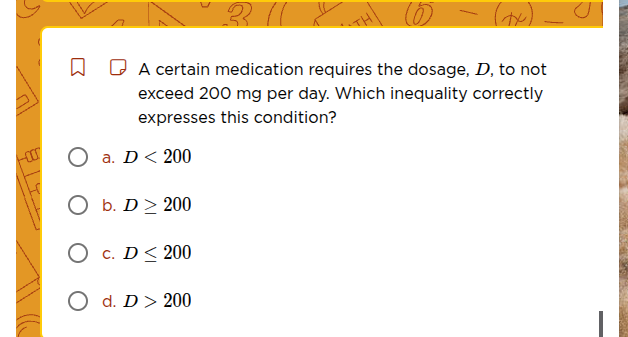
a certain medication requires the dosage, d, to not exceed 200 mg per day. which inequality correctly expresses this condition?
a. ( d < 200 )
b. ( d geq 200 )
c. ( d leq 200 )
d. ( d > 200 )
Step1: Understand the condition
The dosage \( D \) should not exceed 200 mg per day. "Not exceed" means \( D \) can be equal to 200 or less than 200.
Step2: Match with inequality symbols
- Option a: \( D < 200 \) means \( D \) is strictly less than 200, but it can't be equal to 200. So this is incorrect.
- Option b: \( D \geq 200 \) means \( D \) is greater than or equal to 200, which is the opposite of what we need. So this is incorrect.
- Option c: \( D \leq 200 \) means \( D \) is less than or equal to 200, which matches the condition "not exceed 200". So this is correct.
- Option d: \( D > 200 \) means \( D \) is strictly greater than 200, which is the opposite of what we need. So this is incorrect.

Snap & solve any problem in the app
Get step-by-step solutions on Sovi AI
Photo-based solutions with guided steps
Explore more problems and detailed explanations
c. \( D \leq 200 \)