QUESTION IMAGE
Question
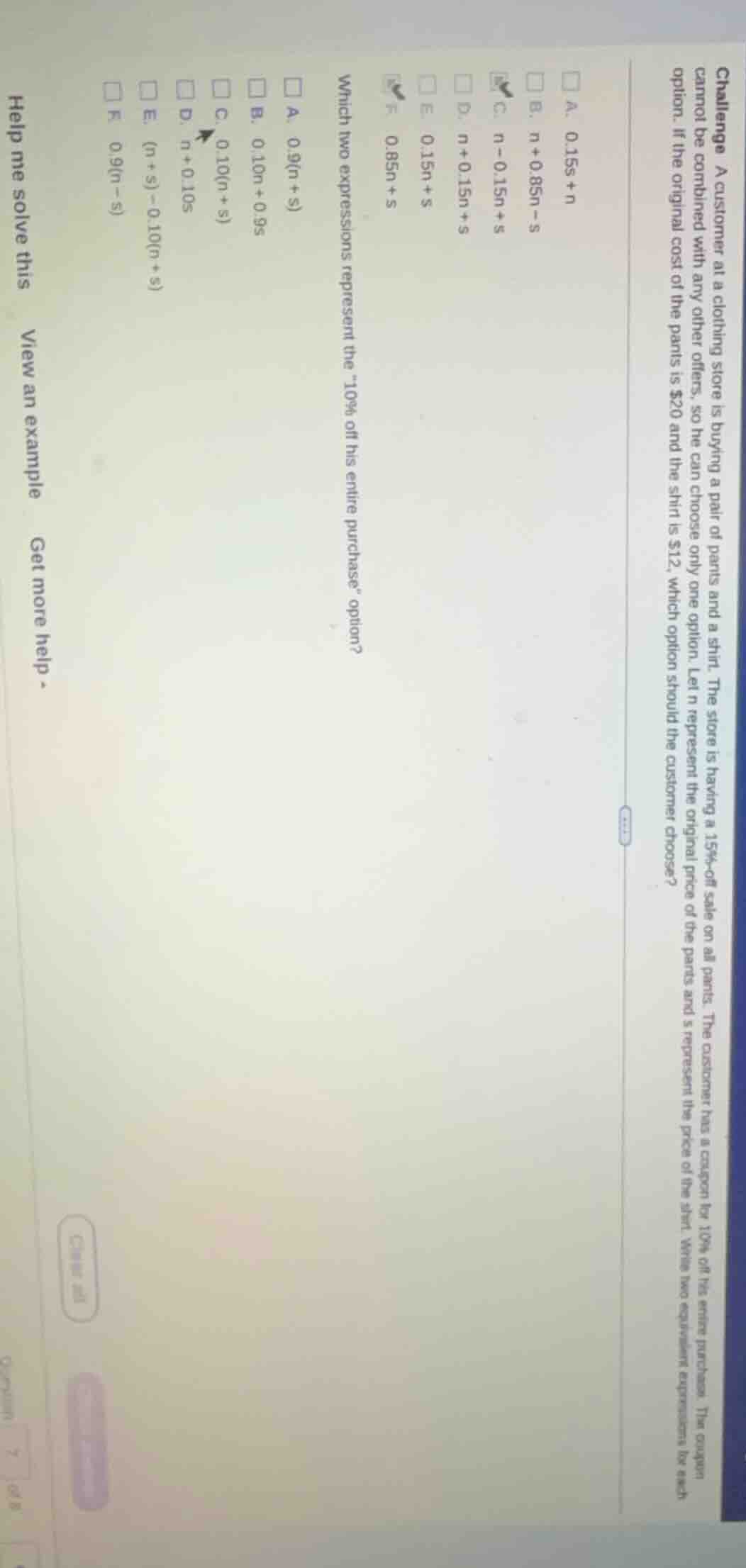
challenge a customer at a clothing store is buying a pair of pants and a shirt. the store is having a 15%-off sale on all pants. the customer has a coupon for 10% off his entire purchase. the coupon cannot be combined with any other offers, so he can choose only one option. let n represent the original price of the pants and s represent the price of the shirt. write two equivalent expressions for each option. if the original cost of the pants is $20 and the shirt is $12, which option should the customer choose? a. 0.15s + n b. n + 0.85n - s c. n - 0.15n + s d. n + 0.15n + s e. 0.15n + s f. 0.85n + s which two expressions represent the \10% off his entire purchase\ option? a. 0.9(n + s) b. 0.10n + 0.9s c. 0.10(n + s) d. n + 0.10s e. (n + s) - 0.10(n + s) f. 0.9(n - s)
Part 1: Determine the two expressions for "10% off the entire purchase"
Step 1: Understand the total cost before discount
The total cost before any discount is the sum of the original price of pants (\(n\)) and the price of the shirt (\(s\)), so the total is \(n + s\).
Step 2: Calculate the discounted price (10% off)
A 10% discount means the customer pays 90% of the total cost (since \(100\% - 10\% = 90\%\), and \(90\% = 0.9\)). So the first expression is \(0.9(n + s)\) (which is option A).
Step 3: Expand the first expression to find an equivalent form
Using the distributive property, \(0.9(n + s)=0.9n + 0.9s\)? Wait, no, wait. Wait, actually, another way: the discount amount is \(10\%\) of \((n + s)\), so the amount paid is \((n + s)-0.10(n + s)\). Let's simplify this:
\[
\]
Wait, but also, let's look at option E: \((n + s)-0.10(n + s)\). Let's expand option E:
\[
\]
Wait, but option A is \(0.9(n + s)\) which is equal to \(0.9n + 0.9s\) (by distributive property: \(0.9\times n+0.9\times s = 0.9n + 0.9s\)). And option E is \((n + s)-0.10(n + s)\) which simplifies to \(0.9(n + s)\) as we saw. Wait, but let's check the options again. Wait, the second part of the question (the first part was about the 10% off entire purchase, the options for that are A, B, C, D, E, F? Wait no, the first question (the challenge) has two parts: first, write two expressions for the coupon (10% off entire purchase), and then choose between the two offers (15% off pants or 10% off entire) when \(n = 20\), \(s = 12\).
Wait, let's first solve the "which two expressions represent the 10% off entire purchase" part.
So:
- Expression 1: \(0.9(n + s)\) (option A)
- Expression 2: \((n + s)-0.10(n + s)\) (option E)
Let's verify:
For option A: \(0.9(n + s)\) is 90% of total, correct.
For option E: \((n + s)-0.10(n + s)\) is total minus 10% of total, correct.
Now, let's check the other options:
Option B: \(0.10n + 0.9s\) – that would be a 90% discount on shirt and 10% discount on pants, which is not the case.
Option C: \(0.10(n + s)\) – that's the discount amount, not the amount paid.
Option D: \(n + 0.10s\) – no, that's not related.
So the two expressions for 10% off entire purchase are A (\(0.9(n + s)\)) and E (\((n + s)-0.10(n + s)\)).
Part 2: Choose between the two offers (15% off pants or 10% off entire) when \(n = 20\), \(s = 12\)
Step 1: Calculate the cost for the 15% off pants offer
The store has a 15% off on all pants. So the price of pants after discount is \(n - 0.15n=0.85n\) (since 15% off means paying 85% of \(n\)). The shirt price is \(s\) (no discount on shirt). So the total cost for this offer is \(0.85n + s\) (which is option F). Let's plug in \(n = 20\), \(s = 12\):
\[
0.85(20)+12 = 17 + 12 = 29
\]
Step 2: Calculate the cost for the 10% off entire purchase offer
Using the expression \(0.9(n + s)\) (option A), plug in \(n = 20\), \(s = 12\):
\[
0.9(20 + 12)=0.9(32)=28.8
\]
Step 3: Compare the two costs
The cost for the 15% off pants offer is \(29\), and the cost for the 10% off entire purchase offer is \(28.8\). Since \(28.8 < 29\), the customer should choose the 10% off entire purchase option (the coupon option).
Final Answers
For "Which two expressions represent the '10% off his entire purchase' option?":
The two expressions are:
- A. \(0.9(n + s)\)
- E. \((n + s)-0.10(n + s)\)
For "Wh…

Snap & solve any problem in the app
Get step-by-step solutions on Sovi AI
Photo-based solutions with guided steps
Explore more problems and detailed explanations
Part 1: Determine the two expressions for "10% off the entire purchase"
Step 1: Understand the total cost before discount
The total cost before any discount is the sum of the original price of pants (\(n\)) and the price of the shirt (\(s\)), so the total is \(n + s\).
Step 2: Calculate the discounted price (10% off)
A 10% discount means the customer pays 90% of the total cost (since \(100\% - 10\% = 90\%\), and \(90\% = 0.9\)). So the first expression is \(0.9(n + s)\) (which is option A).
Step 3: Expand the first expression to find an equivalent form
Using the distributive property, \(0.9(n + s)=0.9n + 0.9s\)? Wait, no, wait. Wait, actually, another way: the discount amount is \(10\%\) of \((n + s)\), so the amount paid is \((n + s)-0.10(n + s)\). Let's simplify this:
\[
\]
Wait, but also, let's look at option E: \((n + s)-0.10(n + s)\). Let's expand option E:
\[
\]
Wait, but option A is \(0.9(n + s)\) which is equal to \(0.9n + 0.9s\) (by distributive property: \(0.9\times n+0.9\times s = 0.9n + 0.9s\)). And option E is \((n + s)-0.10(n + s)\) which simplifies to \(0.9(n + s)\) as we saw. Wait, but let's check the options again. Wait, the second part of the question (the first part was about the 10% off entire purchase, the options for that are A, B, C, D, E, F? Wait no, the first question (the challenge) has two parts: first, write two expressions for the coupon (10% off entire purchase), and then choose between the two offers (15% off pants or 10% off entire) when \(n = 20\), \(s = 12\).
Wait, let's first solve the "which two expressions represent the 10% off entire purchase" part.
So:
- Expression 1: \(0.9(n + s)\) (option A)
- Expression 2: \((n + s)-0.10(n + s)\) (option E)
Let's verify:
For option A: \(0.9(n + s)\) is 90% of total, correct.
For option E: \((n + s)-0.10(n + s)\) is total minus 10% of total, correct.
Now, let's check the other options:
Option B: \(0.10n + 0.9s\) – that would be a 90% discount on shirt and 10% discount on pants, which is not the case.
Option C: \(0.10(n + s)\) – that's the discount amount, not the amount paid.
Option D: \(n + 0.10s\) – no, that's not related.
So the two expressions for 10% off entire purchase are A (\(0.9(n + s)\)) and E (\((n + s)-0.10(n + s)\)).
Part 2: Choose between the two offers (15% off pants or 10% off entire) when \(n = 20\), \(s = 12\)
Step 1: Calculate the cost for the 15% off pants offer
The store has a 15% off on all pants. So the price of pants after discount is \(n - 0.15n=0.85n\) (since 15% off means paying 85% of \(n\)). The shirt price is \(s\) (no discount on shirt). So the total cost for this offer is \(0.85n + s\) (which is option F). Let's plug in \(n = 20\), \(s = 12\):
\[
0.85(20)+12 = 17 + 12 = 29
\]
Step 2: Calculate the cost for the 10% off entire purchase offer
Using the expression \(0.9(n + s)\) (option A), plug in \(n = 20\), \(s = 12\):
\[
0.9(20 + 12)=0.9(32)=28.8
\]
Step 3: Compare the two costs
The cost for the 15% off pants offer is \(29\), and the cost for the 10% off entire purchase offer is \(28.8\). Since \(28.8 < 29\), the customer should choose the 10% off entire purchase option (the coupon option).
Final Answers
For "Which two expressions represent the '10% off his entire purchase' option?":
The two expressions are:
- A. \(0.9(n + s)\)
- E. \((n + s)-0.10(n + s)\)
For "Which option should the customer choose?":
The customer should choose the 10% off entire purchase option (the coupon) because it costs \(28.8\) dollars, which is less than the \(29\) dollars for the 15% off pants option.