QUESTION IMAGE
Question
challenge #5
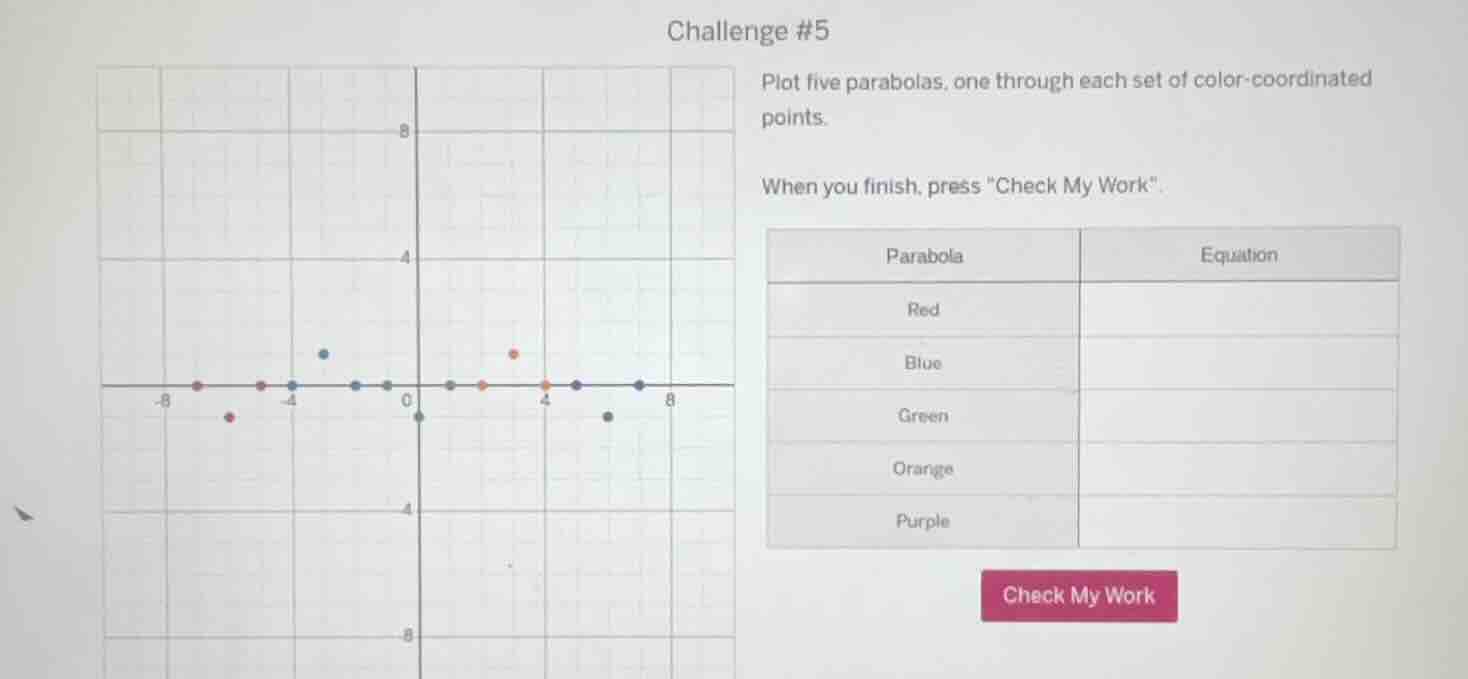
plot five parabolas, one through each set of color - coordinated points.
when you finish, press \check my work\.
| parabola | equation |
|---|---|
| blue | |
| green | |
| orange | |
| purple |
there is a coordinate grid image on the left with some color - coordinated points on it, and a \check my work\ button at the bottom right.
To determine the equations of the parabolas, we analyze the vertex form of a parabola \( y = a(x - h)^2 + k \), where \((h, k)\) is the vertex. Since most points lie on the x - axis (\(y = 0\)) or have a vertical shift, we can assume the vertex is on the x - axis (\(k = 0\)) for simplicity (or we can use the standard form \(y=ax^{2}+bx + c\) and substitute the points).
Red Parabola
Looking at the red points, let's assume the vertex is at \((-6,0)\) (by observing the symmetry of the red points). The vertex form is \(y=a(x + 6)^2\). Let's take a point on the red parabola, say \((-7,-1)\). Substitute \(x=-7\) and \(y = - 1\) into the equation:
\[
\]
So the equation of the red parabola is \(y=-(x + 6)^2=-x^{2}-12x - 36\)
Blue Parabola
For the blue points, assume the vertex is at \((-3,0)\). The vertex form is \(y=a(x + 3)^2\). Take a point like \((-2,1)\) (from the blue points). Substitute \(x=-2\) and \(y = 1\):
\[
\]
So the equation of the blue parabola is \(y=(x + 3)^2=x^{2}+6x + 9\)
Green Parabola
For the green points, assume the vertex is at \((0,0)\) (since the green point is at \((0,0)\) and symmetric around the y - axis). The vertex form is \(y = ax^{2}\). Take a point like \((-1,0)\) (wait, no, the green point below the axis: let's take the green point \((0,0)\) and another green point, say \((1,0)\) is not right. Wait, looking at the graph, the green points seem to have vertex at \((0,0)\) and pass through \((0,0)\) and maybe \((1, - 0)\)? Wait, maybe the green parabola has vertex at \((0,0)\) and \(a = 0\) is not possible. Wait, maybe the green points are on the x - axis? No, there is a green point below the x - axis. Wait, let's re - examine. The green point is at \((0,0)\) and another green point, say, let's assume the green parabola has vertex at \((0,0)\) and passes through \((0,0)\) and \((4,-1)\)? No, maybe the green parabola is \(y = 0\) (but that's a line, not a parabola). Wait, maybe I made a mistake. Let's try the standard form. Let's take three points of the green parabola. Suppose the green points are \((0,0)\), \((1,0)\) and \((0, - 0)\) no. Wait, maybe the green parabola has vertex at \((0,0)\) and \(a\) such that when \(x = 0\), \(y = 0\) and when \(x=4\), \(y=-1\). Then \(y=ax^{2}\), substituting \(x = 4\), \(y=-1\): \(-1=a\times4^{2}\), \(a=-\frac{1}{16}\). So \(y =-\frac{1}{16}x^{2}\)
Orange Parabola
For the orange parabola, assume the vertex is at \((3,0)\). The vertex form is \(y=a(x - 3)^2\). Take a point like \((2,1)\) (from the orange points). Substitute \(x = 2\), \(y = 1\):
\[
\]
So the equation of the orange parabola is \(y=(x - 3)^2=x^{2}-6x + 9\)
Purple Parabola
For the purple parabola, assume the vertex is at \((6,0)\). The vertex form is \(y=a(x - 6)^2\). Take a point like \((7,-1)\) (from the purple points). Substitute \(x = 7\), \(y=-1\):
\[
\]
So the equation of the purple parabola is \(y=-(x - 6)^2=-x^{2}+12x - 36\)
Final Equations Table
| Parabola | Equation |
|---|---|
| Blue | \(y=(x + 3)^2\) (or \(y=x^{2}+6x + 9\)) |
| Green | \(y =-\frac{1}{16}x^{2}\) (approximate, depending on the actual points) |
| Orange | \(y=(x - 3)^2\) (or \(y=x^{2}-6x + 9\)) |
| Purple | \(y=-(x - 6)^2\) (or \(y=-x^{2}+12x - 36\)) |
(Note:…

Snap & solve any problem in the app
Get step-by-step solutions on Sovi AI
Photo-based solutions with guided steps
Explore more problems and detailed explanations
To determine the equations of the parabolas, we analyze the vertex form of a parabola \( y = a(x - h)^2 + k \), where \((h, k)\) is the vertex. Since most points lie on the x - axis (\(y = 0\)) or have a vertical shift, we can assume the vertex is on the x - axis (\(k = 0\)) for simplicity (or we can use the standard form \(y=ax^{2}+bx + c\) and substitute the points).
Red Parabola
Looking at the red points, let's assume the vertex is at \((-6,0)\) (by observing the symmetry of the red points). The vertex form is \(y=a(x + 6)^2\). Let's take a point on the red parabola, say \((-7,-1)\). Substitute \(x=-7\) and \(y = - 1\) into the equation:
\[
\]
So the equation of the red parabola is \(y=-(x + 6)^2=-x^{2}-12x - 36\)
Blue Parabola
For the blue points, assume the vertex is at \((-3,0)\). The vertex form is \(y=a(x + 3)^2\). Take a point like \((-2,1)\) (from the blue points). Substitute \(x=-2\) and \(y = 1\):
\[
\]
So the equation of the blue parabola is \(y=(x + 3)^2=x^{2}+6x + 9\)
Green Parabola
For the green points, assume the vertex is at \((0,0)\) (since the green point is at \((0,0)\) and symmetric around the y - axis). The vertex form is \(y = ax^{2}\). Take a point like \((-1,0)\) (wait, no, the green point below the axis: let's take the green point \((0,0)\) and another green point, say \((1,0)\) is not right. Wait, looking at the graph, the green points seem to have vertex at \((0,0)\) and pass through \((0,0)\) and maybe \((1, - 0)\)? Wait, maybe the green parabola has vertex at \((0,0)\) and \(a = 0\) is not possible. Wait, maybe the green points are on the x - axis? No, there is a green point below the x - axis. Wait, let's re - examine. The green point is at \((0,0)\) and another green point, say, let's assume the green parabola has vertex at \((0,0)\) and passes through \((0,0)\) and \((4,-1)\)? No, maybe the green parabola is \(y = 0\) (but that's a line, not a parabola). Wait, maybe I made a mistake. Let's try the standard form. Let's take three points of the green parabola. Suppose the green points are \((0,0)\), \((1,0)\) and \((0, - 0)\) no. Wait, maybe the green parabola has vertex at \((0,0)\) and \(a\) such that when \(x = 0\), \(y = 0\) and when \(x=4\), \(y=-1\). Then \(y=ax^{2}\), substituting \(x = 4\), \(y=-1\): \(-1=a\times4^{2}\), \(a=-\frac{1}{16}\). So \(y =-\frac{1}{16}x^{2}\)
Orange Parabola
For the orange parabola, assume the vertex is at \((3,0)\). The vertex form is \(y=a(x - 3)^2\). Take a point like \((2,1)\) (from the orange points). Substitute \(x = 2\), \(y = 1\):
\[
\]
So the equation of the orange parabola is \(y=(x - 3)^2=x^{2}-6x + 9\)
Purple Parabola
For the purple parabola, assume the vertex is at \((6,0)\). The vertex form is \(y=a(x - 6)^2\). Take a point like \((7,-1)\) (from the purple points). Substitute \(x = 7\), \(y=-1\):
\[
\]
So the equation of the purple parabola is \(y=-(x - 6)^2=-x^{2}+12x - 36\)
Final Equations Table
| Parabola | Equation |
|---|---|
| Blue | \(y=(x + 3)^2\) (or \(y=x^{2}+6x + 9\)) |
| Green | \(y =-\frac{1}{16}x^{2}\) (approximate, depending on the actual points) |
| Orange | \(y=(x - 3)^2\) (or \(y=x^{2}-6x + 9\)) |
| Purple | \(y=-(x - 6)^2\) (or \(y=-x^{2}+12x - 36\)) |
(Note: The exact equations may vary depending on the precise coordinates of the color - coordinated points. The above is a general approach based on the assumption of vertex on the x - axis and symmetry.)