QUESTION IMAGE
Question
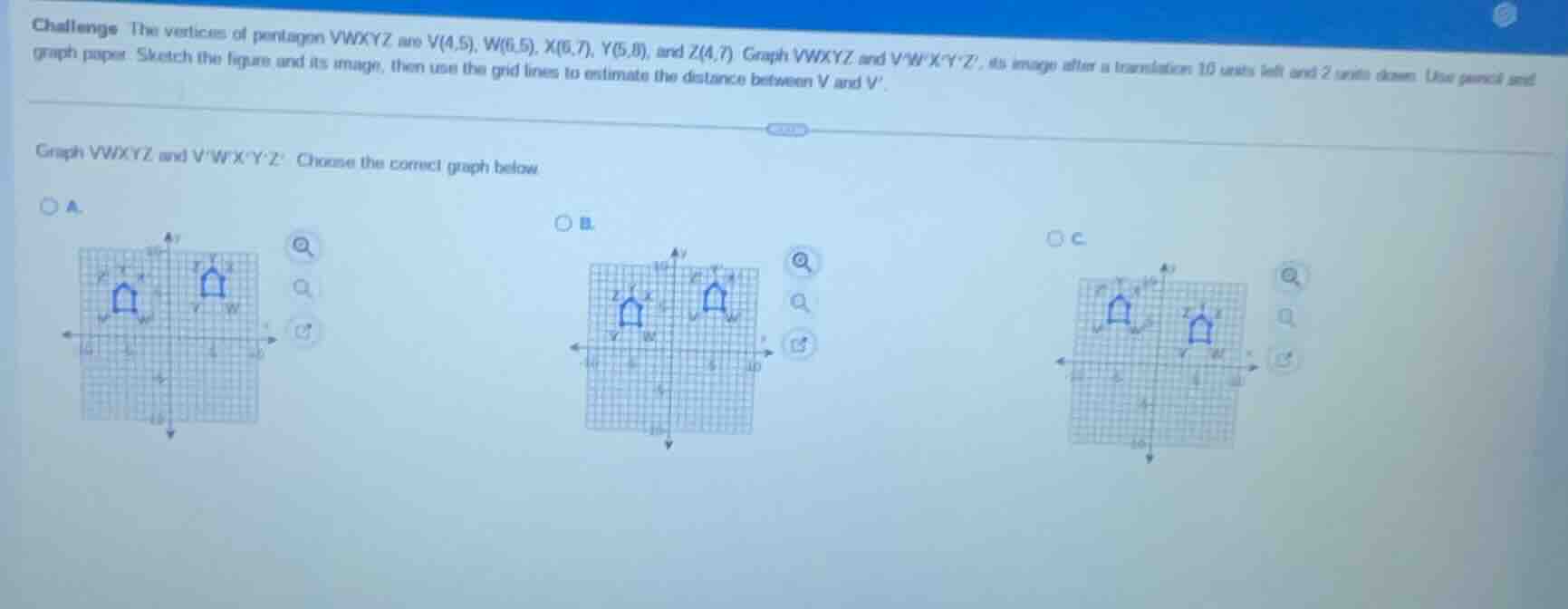
challenge the vertices of pentagon vwxyz are v(4,5), w(6,5), x(6,7), y(5,8), and z(4,7). graph vwxyz and vwxyz, its image after a translation 10 units left and 2 units down. use pencil and graph paper. sketch the figure and its image, then use the grid lines to estimate the distance between v and v. graph vwxyz and vwxyz. choose the correct graph below: a. graph a b. graph b c. graph c
Part 1: Translating Point \( V \)
Step 1: Recall Translation Rules
A translation 10 units left means subtracting 10 from the \( x \)-coordinate, and 2 units down means subtracting 2 from the \( y \)-coordinate. For a point \( (x, y) \), the new coordinates after translation are \( (x - 10, y - 2) \).
Step 2: Apply Translation to \( V(4, 5) \)
For \( V(4, 5) \):
- New \( x \)-coordinate: \( 4 - 10 = -6 \)
- New \( y \)-coordinate: \( 5 - 2 = 3 \)
So, \( V'(-6, 3) \).
Part 2: Estimating Distance Between \( V \) and \( V' \)
Step 1: Use Distance Formula (or Grid Estimation)
The distance \( d \) between two points \( (x_1, y_1) \) and \( (x_2, y_2) \) is given by \( d=\sqrt{(x_2 - x_1)^2+(y_2 - y_1)^2} \).
For \( V(4, 5) \) and \( V'(-6, 3) \):
- \( x_2 - x_1=-6 - 4=-10 \)
- \( y_2 - y_1=3 - 5=-2 \)
Then, \( d = \sqrt{(-10)^2+(-2)^2}=\sqrt{100 + 4}=\sqrt{104}\approx10.2 \) (using grid lines, we can also estimate by considering the horizontal change is 10 units and vertical change is 2 units, and using the Pythagorean theorem: \( \sqrt{10^2 + 2^2}=\sqrt{104}\approx10 \) (approximate estimate from grid)).
Part 3: Choosing the Correct Graph
To determine the correct graph, we analyze the translation of all vertices:
- \( V(4,5)\to V'(-6,3) \)
- \( W(6,5)\to W'(6 - 10,5 - 2)=(-4,3) \)
- \( X(8,7)\to X'(8 - 10,7 - 2)=(-2,5) \)
- \( Y(5,8)\to Y'(5 - 10,8 - 2)=(-5,6) \)
- \( Z(4,7)\to Z'(4 - 10,7 - 2)=(-6,5) \)
Looking at the graphs, we check the position of the original pentagon (with vertices in positive \( x \)-region) and the translated pentagon (with vertices in negative \( x \)-region, shifted left 10 and down 2). Graph A should show the original pentagon on the right and the translated on the left with the correct coordinate shifts.
Final Answers:
- Correct Graph: A (assuming the graph A has the original pentagon at \( x>0 \) and translated at \( x<0 \) with the correct vertex positions)
- Distance between \( V \) and \( V' \): Approximately \( \sqrt{104}\approx10.2 \) (or 10 when estimated from grid lines)
(Note: For the graph choice, without seeing the exact grid details, we base it on the translation of vertices. The key is that translating 10 left and 2 down moves the pentagon from \( x\approx4 - 8 \) to \( x\approx - 6-(-2) \), which matches the left - shifted position in graph A.)

Snap & solve any problem in the app
Get step-by-step solutions on Sovi AI
Photo-based solutions with guided steps
Explore more problems and detailed explanations
Part 1: Translating Point \( V \)
Step 1: Recall Translation Rules
A translation 10 units left means subtracting 10 from the \( x \)-coordinate, and 2 units down means subtracting 2 from the \( y \)-coordinate. For a point \( (x, y) \), the new coordinates after translation are \( (x - 10, y - 2) \).
Step 2: Apply Translation to \( V(4, 5) \)
For \( V(4, 5) \):
- New \( x \)-coordinate: \( 4 - 10 = -6 \)
- New \( y \)-coordinate: \( 5 - 2 = 3 \)
So, \( V'(-6, 3) \).
Part 2: Estimating Distance Between \( V \) and \( V' \)
Step 1: Use Distance Formula (or Grid Estimation)
The distance \( d \) between two points \( (x_1, y_1) \) and \( (x_2, y_2) \) is given by \( d=\sqrt{(x_2 - x_1)^2+(y_2 - y_1)^2} \).
For \( V(4, 5) \) and \( V'(-6, 3) \):
- \( x_2 - x_1=-6 - 4=-10 \)
- \( y_2 - y_1=3 - 5=-2 \)
Then, \( d = \sqrt{(-10)^2+(-2)^2}=\sqrt{100 + 4}=\sqrt{104}\approx10.2 \) (using grid lines, we can also estimate by considering the horizontal change is 10 units and vertical change is 2 units, and using the Pythagorean theorem: \( \sqrt{10^2 + 2^2}=\sqrt{104}\approx10 \) (approximate estimate from grid)).
Part 3: Choosing the Correct Graph
To determine the correct graph, we analyze the translation of all vertices:
- \( V(4,5)\to V'(-6,3) \)
- \( W(6,5)\to W'(6 - 10,5 - 2)=(-4,3) \)
- \( X(8,7)\to X'(8 - 10,7 - 2)=(-2,5) \)
- \( Y(5,8)\to Y'(5 - 10,8 - 2)=(-5,6) \)
- \( Z(4,7)\to Z'(4 - 10,7 - 2)=(-6,5) \)
Looking at the graphs, we check the position of the original pentagon (with vertices in positive \( x \)-region) and the translated pentagon (with vertices in negative \( x \)-region, shifted left 10 and down 2). Graph A should show the original pentagon on the right and the translated on the left with the correct coordinate shifts.
Final Answers:
- Correct Graph: A (assuming the graph A has the original pentagon at \( x>0 \) and translated at \( x<0 \) with the correct vertex positions)
- Distance between \( V \) and \( V' \): Approximately \( \sqrt{104}\approx10.2 \) (or 10 when estimated from grid lines)
(Note: For the graph choice, without seeing the exact grid details, we base it on the translation of vertices. The key is that translating 10 left and 2 down moves the pentagon from \( x\approx4 - 8 \) to \( x\approx - 6-(-2) \), which matches the left - shifted position in graph A.)