QUESTION IMAGE
Question
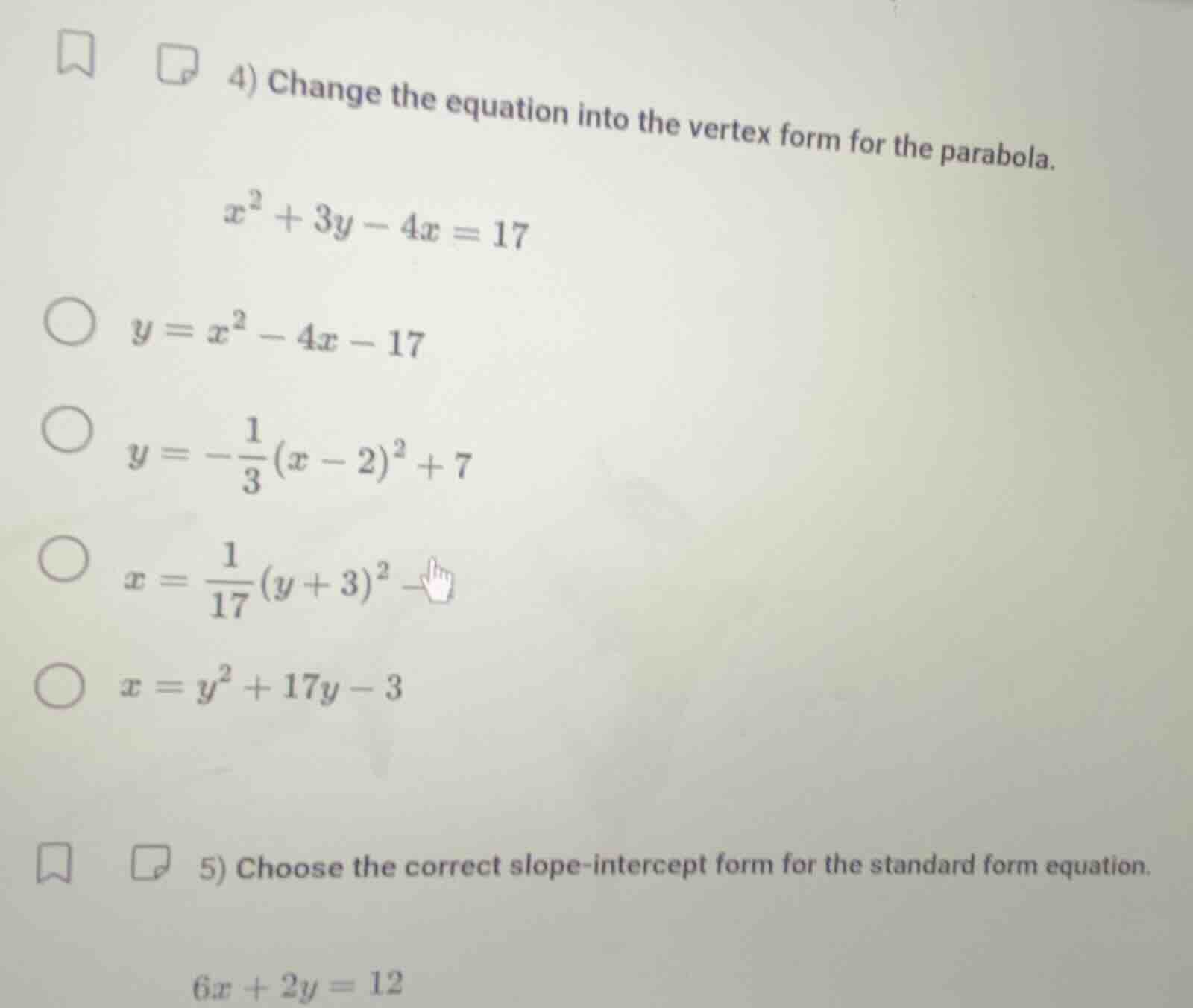
- change the equation into the vertex form for the parabola.
$x^2 + 3y - 4x = 17$
$y = x^2 - 4x - 17$
$y = -\frac{1}{3}(x - 2)^2 + 7$
$x = \frac{1}{17}(y + 3)^2 - $
$x = y^2 + 17y - 3$
- choose the correct slope - intercept form for the standard form equation.
$6x + 2y = 12$
Question 4
Step1: Isolate the y - term
Start with the equation \(x^{2}+3y - 4x=17\). First, we want to get the terms with \(x\) on one side and the term with \(y\) on the other. So, we can rewrite the equation as:
\(3y=-x^{2}+4x + 17\)
Step2: Solve for y
Divide each term by 3 to solve for \(y\):
\(y=-\frac{1}{3}x^{2}+\frac{4}{3}x+\frac{17}{3}\)
Step3: Complete the square for the x - terms
For the quadratic in \(x\) (\(-\frac{1}{3}x^{2}+\frac{4}{3}x\)), factor out the coefficient of \(x^{2}\) from the first two terms. The coefficient of \(x^{2}\) is \(-\frac{1}{3}\), so we have:
\(y =-\frac{1}{3}(x^{2}-4x)+\frac{17}{3}\)
To complete the square inside the parentheses, we take half of the coefficient of \(x\) (which is \(- 4\)), square it. Half of \(-4\) is \(-2\), and \((-2)^{2}=4\). We add and subtract 4 inside the parentheses (but we have to be careful with the factored out \(-\frac{1}{3}\)):
\(y=-\frac{1}{3}(x^{2}-4x + 4-4)+\frac{17}{3}\)
Rewrite the expression inside the parentheses as a perfect square and a constant:
\(y=-\frac{1}{3}((x - 2)^{2}-4)+\frac{17}{3}\)
Step4: Distribute and simplify
Distribute the \(-\frac{1}{3}\) into the parentheses:
\(y=-\frac{1}{3}(x - 2)^{2}+\frac{4}{3}+\frac{17}{3}\)
Combine the constant terms: \(\frac{4 + 17}{3}=\frac{21}{3}=7\)
So, \(y=-\frac{1}{3}(x - 2)^{2}+7\)
Step1: Recall the slope - intercept form
The slope - intercept form of a linear equation is \(y=mx + b\), where \(m\) is the slope and \(b\) is the y - intercept. We start with the standard form equation \(6x + 2y=12\).
Step2: Isolate the y - term
Subtract \(6x\) from both sides of the equation:
\(2y=-6x + 12\)
Step3: Solve for y
Divide each term by 2:
\(y=-3x + 6\)

Snap & solve any problem in the app
Get step-by-step solutions on Sovi AI
Photo-based solutions with guided steps
Explore more problems and detailed explanations
\(y =-\frac{1}{3}(x - 2)^{2}+7\) (the second option)