QUESTION IMAGE
Question
and a changing society, 1865–1914 (continued)
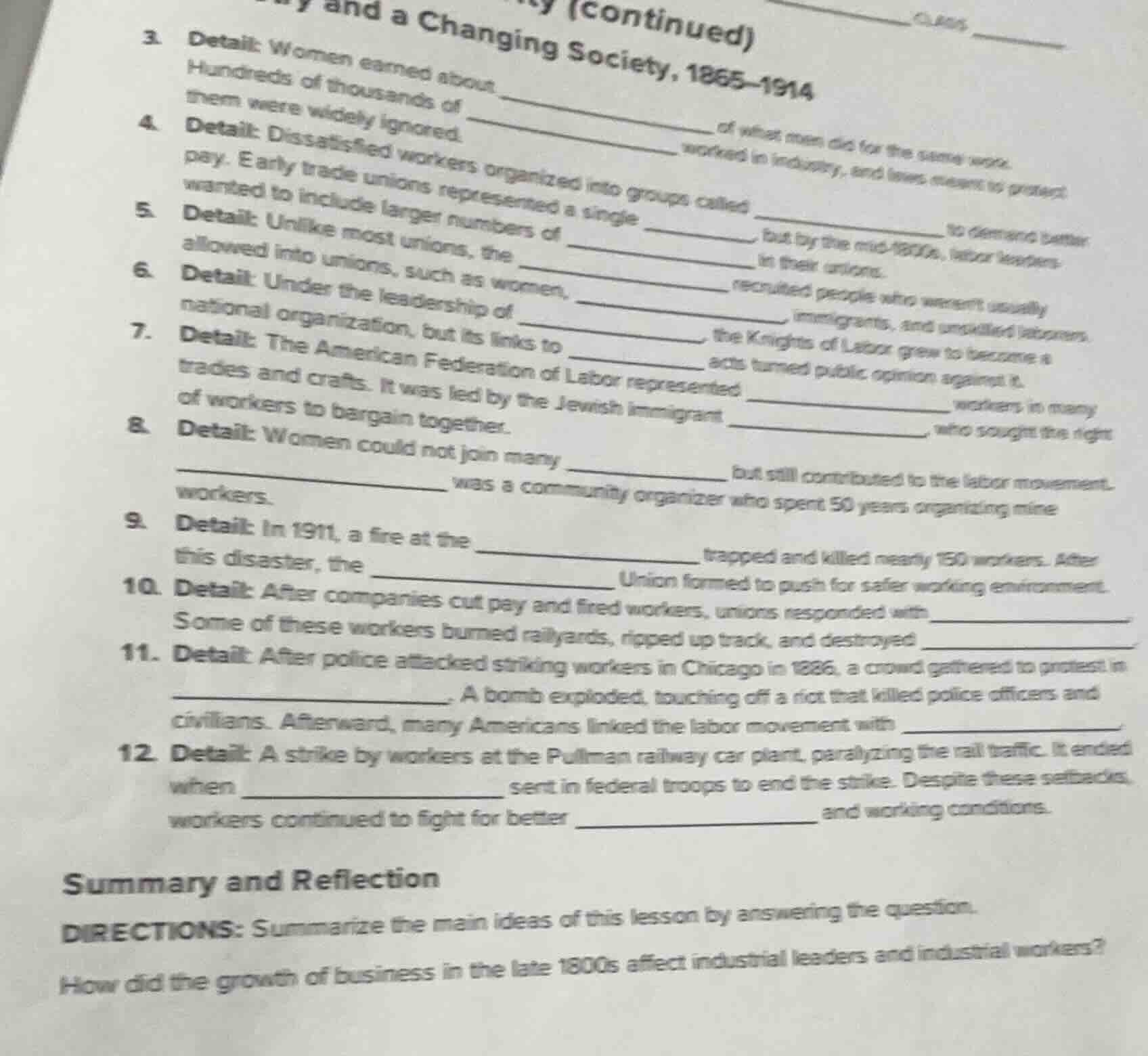
- detail: women earned about ____________ of what men did for the same work. hundreds of thousands of ____________ worked in industry, and laws meant to protect them were widely ignored.
- detail: dissatisfied workers organized into groups called ____________ to demand better pay. early trade unions represented a single __________, but by the mid-1800s, labor leaders wanted to include larger numbers of ____________ in their unions.
- detail: unlike most unions, the ____________ recruited people who weren’t usually allowed into unions, such as women, ____________, immigrants, and unskilled laborers.
- detail: under the leadership of ____________, the knights of labor grew to become a national organization, but its links to ____________ acts turned public opinion against it.
- detail: the american federation of labor represented ____________ workers in many trades and crafts. it was led by the jewish immigrant ____________, who sought the right of workers to bargain together.
- detail: women could not join many ____________ but still contributed to the labor movement. ____________ was a community organizer who spent 50 years organizing mine workers.
- detail: in 1911, a fire at the ____________ trapped and killed nearly 150 workers. after this disaster, the ____________ union formed to push for safer working environment.
- detail: after companies cut pay and fired workers, unions responded with ____________. some of these workers burned railyards, ripped up track, and destroyed ____________.
- detail: after police attacked striking workers in chicago in 1886, a crowd gathered to protest in ____________. a bomb exploded, touching off a riot that killed police officers and civilians. afterward, many americans linked the labor movement with ____________.
- detail: a strike by workers at the pullman railway car plant, paralyzing the rail traffic. it ended when ____________ sent in federal troops to end the strike. despite these setbacks, workers continued to fight for better ____________ and working conditions.
summary and reflection
directions: summarize the main ideas of this lesson by answering the question.
how did the growth of business in the late 1800s affect industrial leaders and industrial workers?
To solve these fill - in - the - blank questions, we need to recall the historical knowledge about the labor movement and social changes in the United States from 1865 to 1914. Here are the answers to each question:
Question 3
- Explanation: During the period from 1865 to 1914, women's wages were generally about half of what men earned for the same work. And hundreds of thousands of women worked in industry, but laws to protect them were often ignored.
- Answer: half; women
Question 4
- Explanation: Dissatisfied workers organized into trade unions to demand better pay. Early trade unions usually represented a single trade or craft. By the mid - 1800s, labor leaders wanted to include more workers, especially unskilled workers, in their unions.
- Answer: trade unions; trade (or craft); unskilled workers
Question 5
- Explanation: The Knights of Labor was different from most unions at that time. It recruited people who were not usually allowed into unions, such as women, African Americans, immigrants, and unskilled laborers.
- Answer: Knights of Labor; African Americans
Question 6
- Explanation: Under the leadership of Terence V. Powderly, the Knights of Labor grew into a national organization. However, its links to violent acts (such as the Haymarket Riot - related activities) turned public opinion against it.
- Answer: Terence V. Powderly; violent
Question 7
- Explanation: The American Federation of Labor (AFL) represented skilled workers in many trades and crafts. It was led by Samuel Gompers, who advocated for the right of workers to bargain collectively.
- Answer: skilled; Samuel Gompers
Question 8
- Explanation: Women were often excluded from many unions. But Mother Jones was a famous community organizer who spent 50 years organizing mine workers.
- Answer: unions; Mother Jones
Question 9
- Explanation: In 1911, a fire at the Triangle Shirtwaist Factory trapped and killed nearly 150 workers. After this disaster, the International Ladies' Garment Workers' Union was formed to push for a safer working environment.
- Answer: Triangle Shirtwaist Factory; International Ladies' Garment Workers'
Question 10
- Explanation: When companies cut pay and fired workers, unions often responded with strikes. Some workers, in their frustration, resorted to violent acts like burning railyards, ripping up tracks, and destroying property.
- Answer: strikes; property
Question 11
- Explanation: In 1886, after police attacked striking workers in Chicago, a crowd gathered in Haymarket Square to protest. A bomb exploded, leading to a riot that killed police officers and civilians. After this incident, many Americans associated the labor movement with anarchism.
- Answer: Haymarket Square; anarchism
Question 12
- Explanation: The Pullman Strike was ended when President Grover Cleveland sent in federal troops. Despite setbacks, workers continued to fight for better wages and working conditions.
- Answer: President Grover Cleveland; wages
Summary and Reflection
- Explanation: The growth of business in the late 1800s had different impacts on industrial leaders and workers. For industrial leaders, business growth brought great wealth and power. They could expand their enterprises, use new technologies, and take advantage of a large labor force (including low - paid workers, especially women and immigrants) to increase profits. For industrial workers, while there were more job opportunities as industries grew, they often faced…

Snap & solve any problem in the app
Get step-by-step solutions on Sovi AI
Photo-based solutions with guided steps
Explore more problems and detailed explanations
To solve these fill - in - the - blank questions, we need to recall the historical knowledge about the labor movement and social changes in the United States from 1865 to 1914. Here are the answers to each question:
Question 3
- Explanation: During the period from 1865 to 1914, women's wages were generally about half of what men earned for the same work. And hundreds of thousands of women worked in industry, but laws to protect them were often ignored.
- Answer: half; women
Question 4
- Explanation: Dissatisfied workers organized into trade unions to demand better pay. Early trade unions usually represented a single trade or craft. By the mid - 1800s, labor leaders wanted to include more workers, especially unskilled workers, in their unions.
- Answer: trade unions; trade (or craft); unskilled workers
Question 5
- Explanation: The Knights of Labor was different from most unions at that time. It recruited people who were not usually allowed into unions, such as women, African Americans, immigrants, and unskilled laborers.
- Answer: Knights of Labor; African Americans
Question 6
- Explanation: Under the leadership of Terence V. Powderly, the Knights of Labor grew into a national organization. However, its links to violent acts (such as the Haymarket Riot - related activities) turned public opinion against it.
- Answer: Terence V. Powderly; violent
Question 7
- Explanation: The American Federation of Labor (AFL) represented skilled workers in many trades and crafts. It was led by Samuel Gompers, who advocated for the right of workers to bargain collectively.
- Answer: skilled; Samuel Gompers
Question 8
- Explanation: Women were often excluded from many unions. But Mother Jones was a famous community organizer who spent 50 years organizing mine workers.
- Answer: unions; Mother Jones
Question 9
- Explanation: In 1911, a fire at the Triangle Shirtwaist Factory trapped and killed nearly 150 workers. After this disaster, the International Ladies' Garment Workers' Union was formed to push for a safer working environment.
- Answer: Triangle Shirtwaist Factory; International Ladies' Garment Workers'
Question 10
- Explanation: When companies cut pay and fired workers, unions often responded with strikes. Some workers, in their frustration, resorted to violent acts like burning railyards, ripping up tracks, and destroying property.
- Answer: strikes; property
Question 11
- Explanation: In 1886, after police attacked striking workers in Chicago, a crowd gathered in Haymarket Square to protest. A bomb exploded, leading to a riot that killed police officers and civilians. After this incident, many Americans associated the labor movement with anarchism.
- Answer: Haymarket Square; anarchism
Question 12
- Explanation: The Pullman Strike was ended when President Grover Cleveland sent in federal troops. Despite setbacks, workers continued to fight for better wages and working conditions.
- Answer: President Grover Cleveland; wages
Summary and Reflection
- Explanation: The growth of business in the late 1800s had different impacts on industrial leaders and workers. For industrial leaders, business growth brought great wealth and power. They could expand their enterprises, use new technologies, and take advantage of a large labor force (including low - paid workers, especially women and immigrants) to increase profits. For industrial workers, while there were more job opportunities as industries grew, they often faced low wages, long working hours, poor working conditions, and lack of job security. This led to the rise of the labor movement, with workers organizing into unions to fight for better pay, shorter working hours, and safer working environments. However, the labor movement also faced strong opposition from business leaders and sometimes negative public opinion due to incidents of violence associated with some labor actions.
- Answer: For industrial leaders, business growth in the late 1800s brought wealth and power as they expanded operations, utilized new technology, and exploited a large, low - paid labor force (including women and immigrants) to maximize profits. For industrial workers, while job opportunities increased, they endured low wages, long hours, poor working conditions, and job insecurity. This spurred the labor movement, with workers forming unions to demand better pay, shorter hours, and safer workplaces, though the movement faced opposition from business leaders and public backlash over violent incidents tied to some labor actions.