QUESTION IMAGE
Question
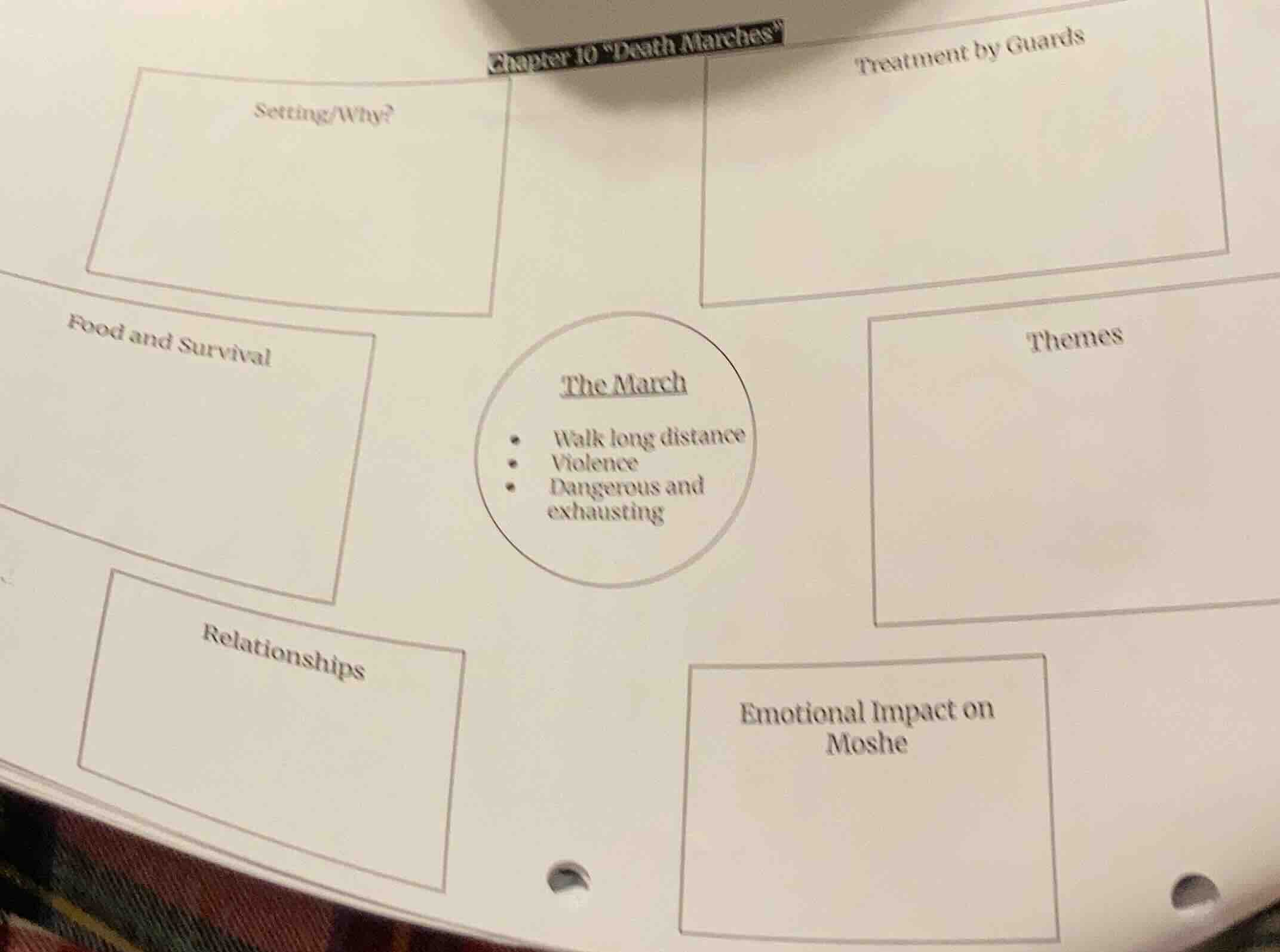
chapter 10 \death marches\
the march
- walk long distance
- violence
- dangerous and exhausting
setting/why?
treatment by guards
food and survival
themes
relationships
emotional impact on moshe
To fill out this graphic organizer for "Chapter 10: Death Marches" (likely from Night by Elie Wiesel), we analyze each section based on the novel's content:
1. Setting/Why?
The death marches occur as the Soviet army advances on Nazi concentration camps (e.g., Buna). Nazis force prisoners to march to avoid leaving them for liberation, to hide evidence of the Holocaust, and to use prisoners for labor or extermination.
2. Treatment by Guards
Guards are brutal: they shoot prisoners who fall behind, whip them, and use violence to force them to keep moving. They dehumanize prisoners, treating them as disposable.
3. Themes
Key themes include dehumanization (prisoners are reduced to animals fighting for survival), survival vs. morality (prisoners must choose between self-preservation and compassion), and the fragility of humanity (violence erodes empathy, but bonds like Elie and his father’s persist).
4. Emotional Impact on Moshe (Elie’s Father)
Elie’s father grows weaker and more desperate. Elie struggles with guilt over prioritizing his own survival, but their bond remains. The march exacerbates his father’s illness and despair, leading to his eventual death (or near-death) shortly after.
5. Relationships
- Elie and his father: Their bond strengthens as they rely on each other, but Elie also grapples with internal conflict (e.g., feeling relief when his father dies, then guilt).
- Prisoners with each other: Some help (e.g., sharing food), others compete for survival (e.g., stealing rations), highlighting both cruelty and fleeting humanity.
6. Food and Survival
Food is scarce (e.g., a crust of bread, a few potatoes). Prisoners fight over scraps, and survival depends on hoarding energy, sharing (rarely), and outlasting others. The body’s limits (exhaustion, hunger) are pushed to the brink.
These details align with the novel’s portrayal of the death marches as a test of humanity, survival, and the bonds between prisoners.

Snap & solve any problem in the app
Get step-by-step solutions on Sovi AI
Photo-based solutions with guided steps
Explore more problems and detailed explanations
To fill out this graphic organizer for "Chapter 10: Death Marches" (likely from Night by Elie Wiesel), we analyze each section based on the novel's content:
1. Setting/Why?
The death marches occur as the Soviet army advances on Nazi concentration camps (e.g., Buna). Nazis force prisoners to march to avoid leaving them for liberation, to hide evidence of the Holocaust, and to use prisoners for labor or extermination.
2. Treatment by Guards
Guards are brutal: they shoot prisoners who fall behind, whip them, and use violence to force them to keep moving. They dehumanize prisoners, treating them as disposable.
3. Themes
Key themes include dehumanization (prisoners are reduced to animals fighting for survival), survival vs. morality (prisoners must choose between self-preservation and compassion), and the fragility of humanity (violence erodes empathy, but bonds like Elie and his father’s persist).
4. Emotional Impact on Moshe (Elie’s Father)
Elie’s father grows weaker and more desperate. Elie struggles with guilt over prioritizing his own survival, but their bond remains. The march exacerbates his father’s illness and despair, leading to his eventual death (or near-death) shortly after.
5. Relationships
- Elie and his father: Their bond strengthens as they rely on each other, but Elie also grapples with internal conflict (e.g., feeling relief when his father dies, then guilt).
- Prisoners with each other: Some help (e.g., sharing food), others compete for survival (e.g., stealing rations), highlighting both cruelty and fleeting humanity.
6. Food and Survival
Food is scarce (e.g., a crust of bread, a few potatoes). Prisoners fight over scraps, and survival depends on hoarding energy, sharing (rarely), and outlasting others. The body’s limits (exhaustion, hunger) are pushed to the brink.
These details align with the novel’s portrayal of the death marches as a test of humanity, survival, and the bonds between prisoners.