QUESTION IMAGE
Question
chapter 3
40
1 exercises
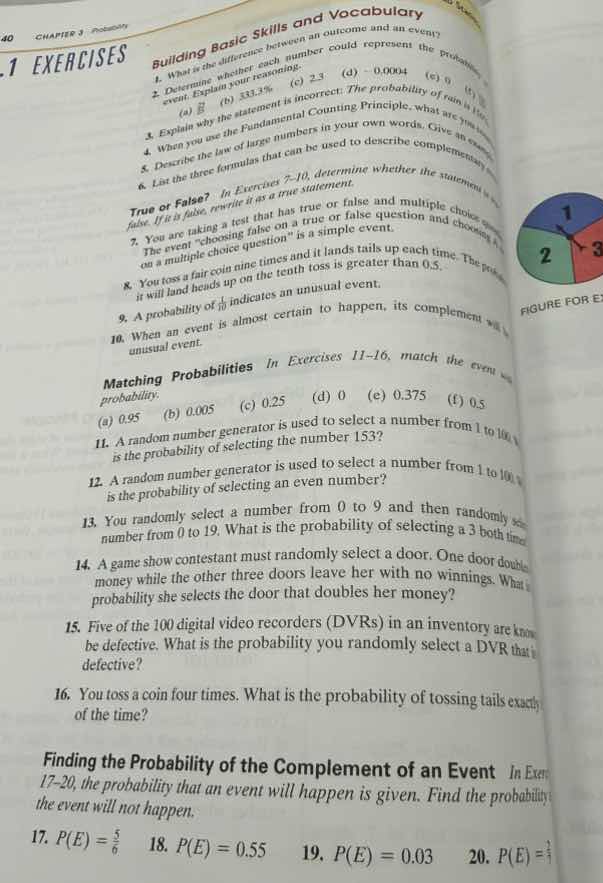
building basic skills and vocabulary
- what is the difference between an outcome and an event?
- determine whether each number can represent the probability of an event.
explain your reasoning.
(a) 0 (b) 33.3% (c) 2.3 (d) -0.0004 (e) 0 (f) 150%
- explain why the statement is incorrect.
the probability of rain tomorrow is 150%.
- when you use the fundamental counting principle, what are you counting?
- describe the law of large numbers in your own words. give an example.
- list the three formulas that can be used to describe complementary events.
true or false? in exercises 7–10, determine whether the statement is true or false. if it is false, rewrite it as a true statement.
- if you are “taking a test” on a true or false question and choosing “true,” the multiple choice question is a simple event.
- you toss a fair coin three times and it lands tails up each time. the probability it will land heads up on the tenth toss is greater than 0.5.
- a probability of \\(\frac{1}{10}\\) indicates an unusual event.
- when an event is almost certain to happen, its complement will be an unusual event.
matching probabilities in exercises 11–16, match the event with its probability.
(a) 0.95 (b) 0.005 (c) 0.25 (d) 0 (e) 0.375 (f) 0.5
- a random number generator is used to select a number from 1 to 1000. what is the probability of selecting the number 153?
- a random number generator is used to select a number from 1 to 100. what is the probability of selecting an even number?
- you randomly select a number from 0 to 9 and then randomly select a number from 0 to 19. what is the probability of selecting a 3 both times?
- a game show contestant must randomly select a door. one door doubles her money while the other three doors leave her with no winnings. what is the probability she selects the door that doubles her money?
- five of the 100 digital video recorders (dvrs) in an inventory are known to be defective. what is the probability you randomly select a dvr that is not defective?
- you toss a coin four times. what is the probability of tossing tails exactly three of the time?
finding the probability of the complement of an event in exercises 17–20, the probability that an event will happen is given. find the probability that the event will not happen.
- \\(p(e) = \frac{5}{6}\\)
- \\(p(e) = 0.55\\)
- \\(p(e) = 0.03\\)
- \\(p(e) = \frac{3}{4}\\)
figure for e
For Exercises 17-20 (Finding the Probability of the Complement of an Event)
Step1: Recall complement rule
For any event $E$, the probability that $E$ does not happen, denoted $P(E')$, is $P(E') = 1 - P(E)$.
---
Exercise 17:
Step1: Substitute $P(E)=\frac{5}{6}$
$P(E') = 1 - \frac{5}{6}$
Step2: Compute the difference
$P(E') = \frac{6}{6} - \frac{5}{6} = \frac{1}{6}$
---
Exercise 18:
Step1: Substitute $P(E)=0.55$
$P(E') = 1 - 0.55$
Step2: Compute the difference
$P(E') = 0.45$
---
Exercise 19:
Step1: Substitute $P(E)=0.03$
$P(E') = 1 - 0.03$
Step2: Compute the difference
$P(E') = 0.97$
---
Exercise 20:
Step1: Substitute $P(E)=\frac{3}{4}$
$P(E') = 1 - \frac{3}{4}$
Step2: Compute the difference
$P(E') = \frac{4}{4} - \frac{3}{4} = \frac{1}{4}$
Step1: Identify total and defective counts
Total DVRs = 100, Defective DVRs = 5
Step2: Calculate probability
Probability = $\frac{\text{Defective Count}}{\text{Total Count}}$
$P(\text{defective}) = \frac{5}{100}$
Step3: Simplify the fraction
$P(\text{defective}) = 0.05$
Step1: Use binomial probability formula
For $n$ trials, probability of $k$ successes: $P(k) = \binom{n}{k}p^k(1-p)^{n-k}$, where $n=4$, $k=2$, $p=0.5$
Step2: Calculate combination
$\binom{4}{2} = \frac{4!}{2!(4-2)!} = \frac{4\times3}{2\times1} = 6$
Step3: Substitute values
$P(2) = 6 \times (0.5)^2 \times (0.5)^{2}$
Step4: Compute the product
$P(2) = 6 \times 0.25 \times 0.25 = 6 \times 0.0625 = 0.375$

Snap & solve any problem in the app
Get step-by-step solutions on Sovi AI
Photo-based solutions with guided steps
Explore more problems and detailed explanations
- $\frac{1}{6}$
- $0.45$
- $0.97$
- $\frac{1}{4}$
---