QUESTION IMAGE
Question
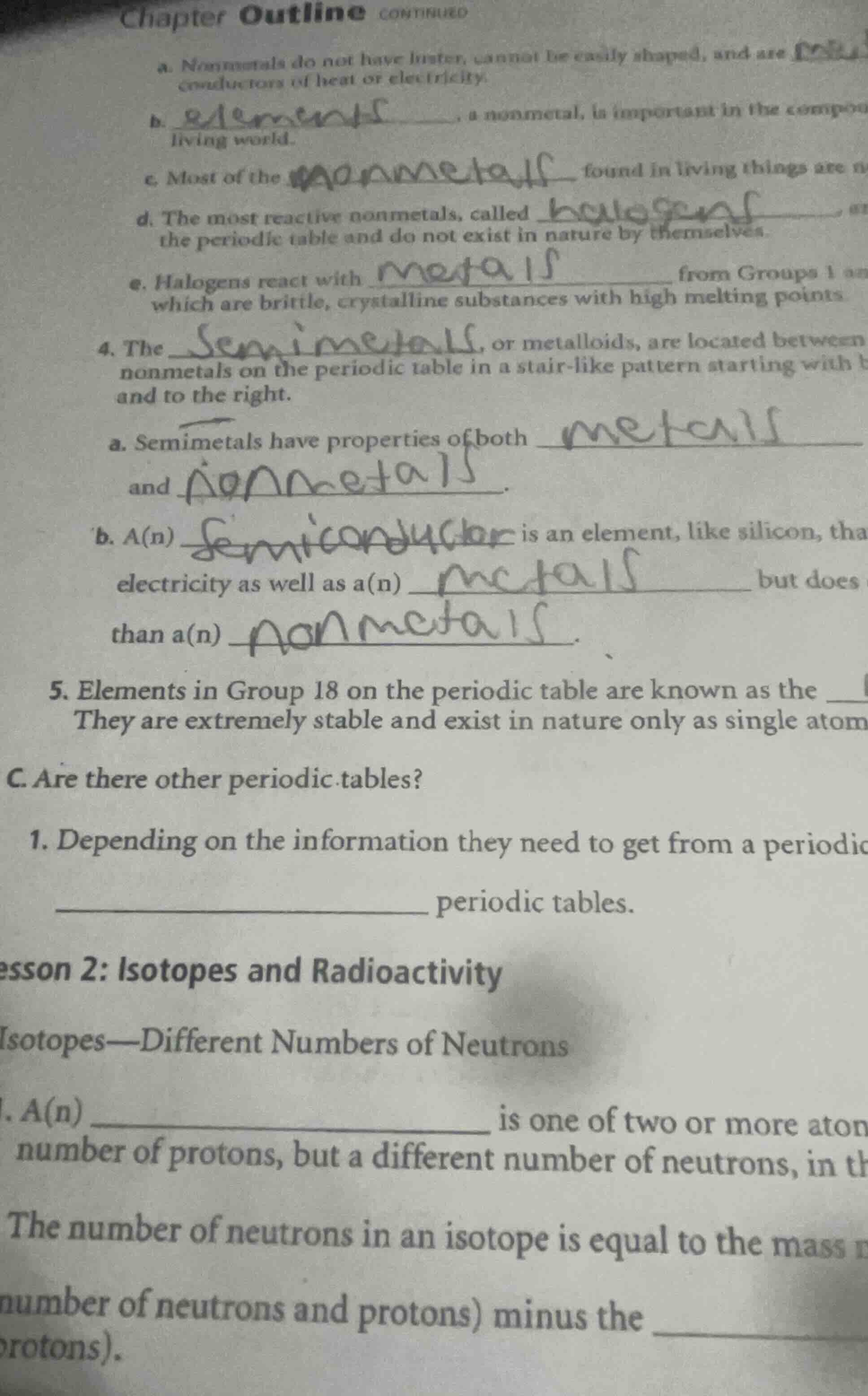
chapter outline continued
a. nonmetals do not have luster, cannot be easily shaped, and are poor conductors of heat or electricity.
b. ____, a nonmetal, is important in the composition of the living world.
c. most of the ____ found in living things are nonmetals.
d. the most reactive nonmetals, called ____, are in group 17 of the periodic table and do not exist in nature by themselves.
e. halogens react with __ from groups 1 and 2 to form __, which are brittle, crystalline substances with high melting points.
- the ____, or metalloids, are located between metals and nonmetals on the periodic table in a stair - like pattern starting with boron and to the right.
a. semimetals have properties of both __ and __.
b. a(n) __ is an element, like silicon, that conducts electricity as well as a(n) but does not conduct as well as a(n) __.
- elements in group 18 on the periodic table are known as the ____. they are extremely stable and exist in nature only as single atoms.
c. are there other periodic tables?
- depending on the information they need to get from a periodic table, scientists use ____ periodic tables.
lesson 2: isotopes and radioactivity
isotopes—different numbers of neutrons
- a(n) ____ is one of two or more atoms of the same element that have the same number of protons, but a different number of neutrons, in their nuclei.
the number of neutrons in an isotope is equal to the mass number (the total number of neutrons and protons) minus the ____ (the number of protons).
To solve these fill - in - the - blank questions, we rely on the knowledge of Chemistry (a subfield of Natural Science), specifically the concepts related to the periodic table, elements, and isotopes.
Question b (under the non - metal section)
Step 1: Recall the important non - metal in living organisms
Carbon is a non - metal and is of utmost importance in the composition of the living world. It is the basis of organic chemistry and is a key element in all living things, from simple single - celled organisms to complex multicellular organisms.
So the answer for b is Carbon.
Question c (most of the... found in living things)
Step 1: Recall the elements in living things
Most of the elements found in living things are non - metals (along with some metals and metalloids, but non - metals are in the majority in terms of the types of elements that make up the biomolecules and structures of living organisms).
So the answer for c is elements.
Question d (most reactive non - metals)
Step 1: Recall the group of most reactive non - metals
The most reactive non - metals are called halogens. Halogens are in Group 17 of the periodic table. They are highly reactive because they have 7 valence electrons and tend to gain one electron to achieve a stable octet configuration. And they do not exist in nature by themselves (they exist as diatomic molecules or in compounds).
So the answer for d is halogens.
Question e (halogens react with...)
Step 1: Recall the reaction of halogens
Halogens react with metals from Groups 1 and 2 (alkali metals and alkaline earth metals). These metals have 1 and 2 valence electrons respectively and tend to lose these electrons to achieve a stable octet. When halogens (which gain electrons) react with these metals (which lose electrons), they form ionic compounds (salts) which are brittle, crystalline substances with high melting points.
So the answer for e is metals.
Question 4 (the... or metalloids)
Step 1: Recall the name of metalloids
The semimetals, or metalloids, are located between metals and non - metals on the periodic table in a stair - like pattern starting with boron and to the right.
So the answer for 4 is semimetals.
Question 4a (semimetals have properties of both...)
Step 1: Recall the properties of semimetals
Semimetals have properties of both metals and non - metals. For example, they can conduct electricity (like metals) but not as well, and they can also have some non - metallic properties like being brittle in some cases.
So the answers for 4a are metals and non - metals.
Question 4b (a(n)... is an element like silicon)
Step 1: Recall the properties of silicon - like elements
A semiconductor is an element, like silicon, that conducts electricity as well as a non - metal but does not conduct as well as a metal. Silicon is a well - known semiconductor. It has electrical conductivity between that of a metal (good conductor) and a non - metal (poor conductor).
So the first blank in 4b is semiconductor, the second blank is non - metal, and the third blank is metal.
Question 5 (elements in Group 18)
Step 1: Recall Group 18 elements
Elements in Group 18 on the periodic table are known as the noble gases. They are extremely stable because they have a full valence electron shell (8 valence electrons, except helium which has 2). And they exist in nature only as single atoms (monatomic gases) because they do not need to form bonds with other atoms to achieve stability.
So the answer for 5 is noble gases.
Question about isotopes (A…

Snap & solve any problem in the app
Get step-by-step solutions on Sovi AI
Photo-based solutions with guided steps
Explore more problems and detailed explanations
To solve these fill - in - the - blank questions, we rely on the knowledge of Chemistry (a subfield of Natural Science), specifically the concepts related to the periodic table, elements, and isotopes.
Question b (under the non - metal section)
Step 1: Recall the important non - metal in living organisms
Carbon is a non - metal and is of utmost importance in the composition of the living world. It is the basis of organic chemistry and is a key element in all living things, from simple single - celled organisms to complex multicellular organisms.
So the answer for b is Carbon.
Question c (most of the... found in living things)
Step 1: Recall the elements in living things
Most of the elements found in living things are non - metals (along with some metals and metalloids, but non - metals are in the majority in terms of the types of elements that make up the biomolecules and structures of living organisms).
So the answer for c is elements.
Question d (most reactive non - metals)
Step 1: Recall the group of most reactive non - metals
The most reactive non - metals are called halogens. Halogens are in Group 17 of the periodic table. They are highly reactive because they have 7 valence electrons and tend to gain one electron to achieve a stable octet configuration. And they do not exist in nature by themselves (they exist as diatomic molecules or in compounds).
So the answer for d is halogens.
Question e (halogens react with...)
Step 1: Recall the reaction of halogens
Halogens react with metals from Groups 1 and 2 (alkali metals and alkaline earth metals). These metals have 1 and 2 valence electrons respectively and tend to lose these electrons to achieve a stable octet. When halogens (which gain electrons) react with these metals (which lose electrons), they form ionic compounds (salts) which are brittle, crystalline substances with high melting points.
So the answer for e is metals.
Question 4 (the... or metalloids)
Step 1: Recall the name of metalloids
The semimetals, or metalloids, are located between metals and non - metals on the periodic table in a stair - like pattern starting with boron and to the right.
So the answer for 4 is semimetals.
Question 4a (semimetals have properties of both...)
Step 1: Recall the properties of semimetals
Semimetals have properties of both metals and non - metals. For example, they can conduct electricity (like metals) but not as well, and they can also have some non - metallic properties like being brittle in some cases.
So the answers for 4a are metals and non - metals.
Question 4b (a(n)... is an element like silicon)
Step 1: Recall the properties of silicon - like elements
A semiconductor is an element, like silicon, that conducts electricity as well as a non - metal but does not conduct as well as a metal. Silicon is a well - known semiconductor. It has electrical conductivity between that of a metal (good conductor) and a non - metal (poor conductor).
So the first blank in 4b is semiconductor, the second blank is non - metal, and the third blank is metal.
Question 5 (elements in Group 18)
Step 1: Recall Group 18 elements
Elements in Group 18 on the periodic table are known as the noble gases. They are extremely stable because they have a full valence electron shell (8 valence electrons, except helium which has 2). And they exist in nature only as single atoms (monatomic gases) because they do not need to form bonds with other atoms to achieve stability.
So the answer for 5 is noble gases.
Question about isotopes (A(n)... is one of two or more atoms)
Step 1: Recall the definition of isotope
A(n) isotope is one of two or more atoms of the same element with the same number of protons, but a different number of neutrons, in the nucleus.
So the answer for the isotope question is isotope.
Question about the number of neutrons in an isotope
Step 1: Recall the formula for the number of neutrons
The number of neutrons in an isotope is equal to the mass number (number of neutrons and protons) minus the atomic number (number of protons).
So the answer for the last blank (in the neutron number formula) is atomic number.
Final Answers:
b. Carbon
c. elements
d. halogens
e. metals
- semimetals
4a. metals, non - metals
4b. semiconductor, non - metal, metal
- noble gases
Isotope question: isotope
Neutron number formula: atomic number