QUESTION IMAGE
Question
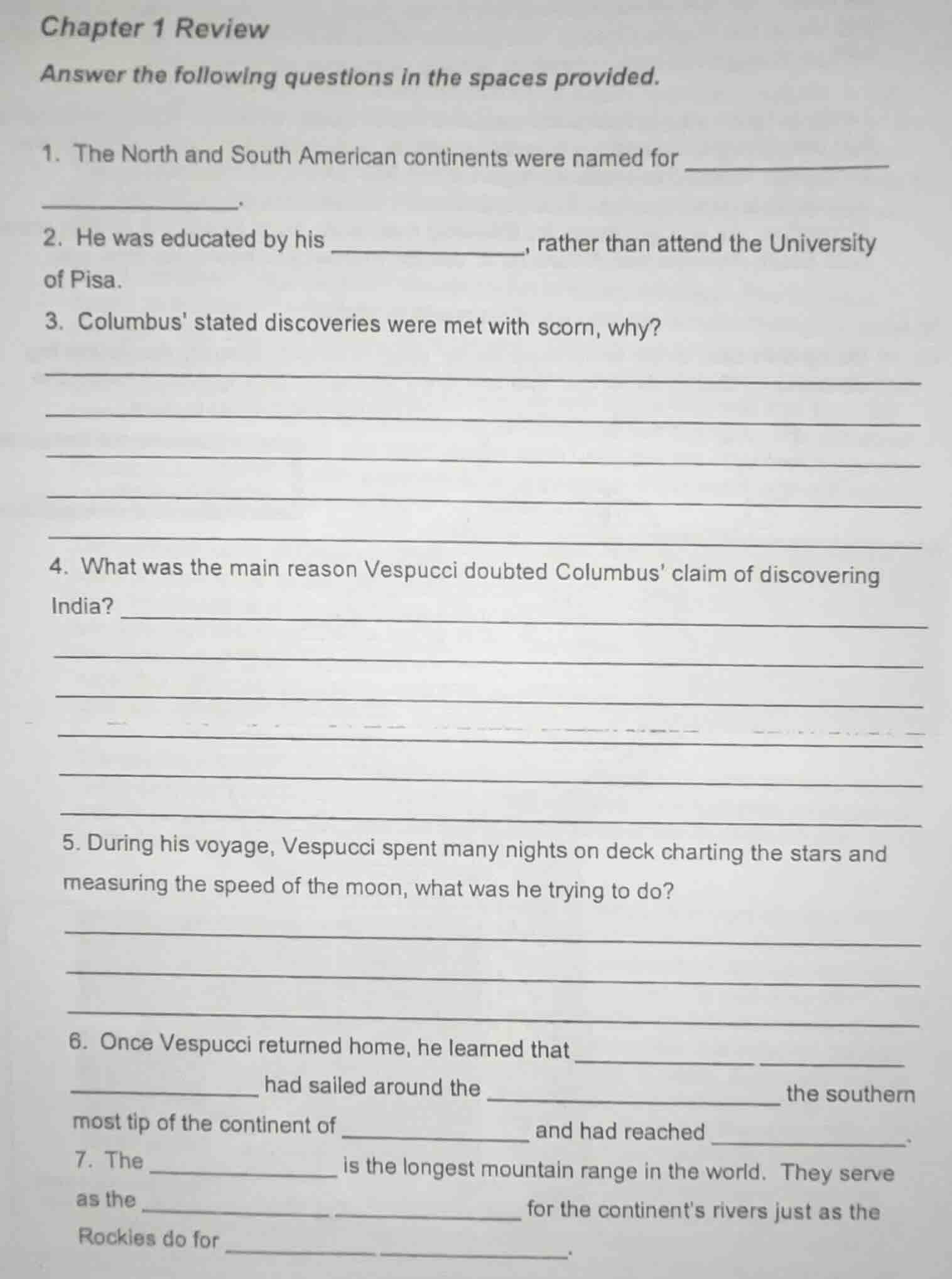
chapter 1 review
answer the following questions in the spaces provided.
- the north and south american continents were named for ____________ ____________.
- he was educated by his ______________, rather than attend the university of pisa.
- columbus stated discoveries were met with scorn, why?
_________________________________________________________________________
_________________________________________________________________________
_________________________________________________________________________
_________________________________________________________________________
- what was the main reason vespucci doubted columbus claim of discovering india? _________________________________________________________________________
_________________________________________________________________________
_________________________________________________________________________
_________________________________________________________________________
- during his voyage, vespucci spent many nights on deck charting the stars and measuring the speed of the moon, what was he trying to do?
_________________________________________________________________________
_________________________________________________________________________
_________________________________________________________________________
- once vespucci returned home, he learned that ____________ __________ __________ had sailed around the __________ __________ the southern most tip of the continent of __________ and had reached ____________.
- the ____________ is the longest mountain range in the world. they serve as the __________ __________ for the continents rivers just as the rockies do for __________ ____________.
- The Americas were named after the Italian explorer Amerigo Vespucci, who was the first to recognize the landmasses as a new continent separate from Asia.
- Galileo Galilei was educated by his father, Vincenzo Galilei, a musician and scholar, instead of attending the University of Pisa initially.
- Columbus claimed he had reached Asia, but the land, people, and resources he described did not match the known accounts of Asia from travelers like Marco Polo, leading scholars and elites to dismiss his claims.
- Vespucci observed that the geography, plants, animals, and indigenous peoples of the lands he explored did not match the descriptions of India that were widely known from existing travel literature, leading him to conclude it was a previously unknown continent.
- Vespucci was attempting to calculate his longitudinal position (east-west location) using celestial observations, as accurate longitude measurement was a major challenge for 15th-century navigators.
- After Vespucci's voyages, he learned that Ferdinand Magellan had sailed around Cape Horn, the southern tip of South America, and reached the Pacific Ocean.
- The Andes are the world's longest mountain range. They act as the continental divide for South America's rivers, meaning they separate river systems that flow to different oceans, just as the Rocky Mountains serve as the continental divide for North America.

Snap & solve any problem in the app
Get step-by-step solutions on Sovi AI
Photo-based solutions with guided steps
Explore more problems and detailed explanations
- Amerigo Vespucci
- father (Vincenzo Galilei)
- Because the lands and people he described did not match the known details of Asia, so his claim of reaching Asia was disbelieved.
- The flora, fauna, and people he encountered did not align with the established descriptions of India.
- He was trying to determine his ship's longitude (east-west position) using celestial navigation.
- Ferdinand Magellan; Cape Horn; South America; the Pacific Ocean
- Andes; continental divide; North America