QUESTION IMAGE
Question
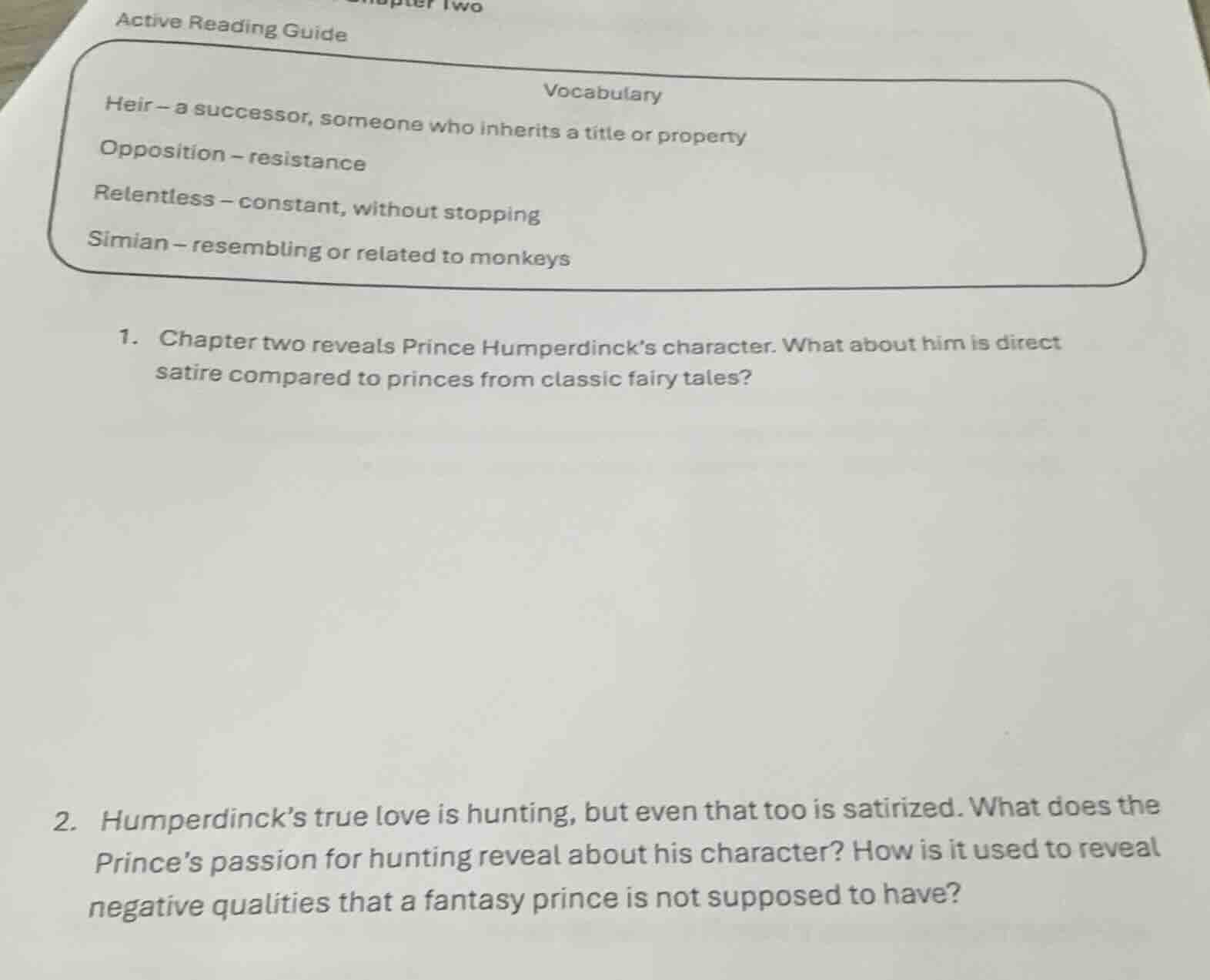
chapter two
active reading guide
vocabulary
heir -- a successor, someone who inherits a title or property
opposition -- resistance
relentless -- constant, without stopping
simian -- resembling or related to monkeys
- chapter two reveals prince humperdinck’s character. what about him is direct satire compared to princes from classic fairy tales?
- humperdinck’s true love is hunting, but even that too is satirized. what does the prince’s passion for hunting reveal about his character? how is it used to reveal negative qualities that a fantasy prince is not supposed to have?
Question 1
In classic fairy tales, princes are often heroic, kind, and focused on love (e.g., rescuing princesses). Prince Humperdinck is a satire: he’s self - centered, his “love” is hunting (not romance), and he’s power - hungry. Unlike noble fairy - tale princes, he’s ruthless and uses his position for personal (hunting) goals, mocking the idealized fairy - tale prince archetype.
- Character Revealed by Hunting Passion: His passion for hunting shows obsession, selfishness, and a lack of empathy. He prioritizes his hunting (e.g., building a Zoo of Death for rare prey) over royal duties or kindness.
- Revealing Negative Qualities: Fantasy princes are supposed to be chivalrous, loving, and just. Humperdinck’s hunting is a metaphor for his predatory, controlling nature (he “hunts” people, like planning to kill Westley). His relentless hunting (and the cruel Zoo of Death) shows arrogance, cruelty, and a lack of the compassion or nobility fantasy princes have. It satirizes the idea of a “good” prince by making his “love” (hunting) a symbol of his villainy.

Snap & solve any problem in the app
Get step-by-step solutions on Sovi AI
Photo-based solutions with guided steps
Explore more problems and detailed explanations
Classic fairy - tale princes are heroic, romantic, and noble (e.g., rescuing princesses out of love). Prince Humperdinck is direct satire: he is self - centered, his “love” is hunting (not romantic love), he is power - hungry, and ruthless. He mocks the idealized, noble fairy - tale prince archetype by being self - serving and lacking the romantic, heroic traits associated with classic fairy - tale princes.