QUESTION IMAGE
Question
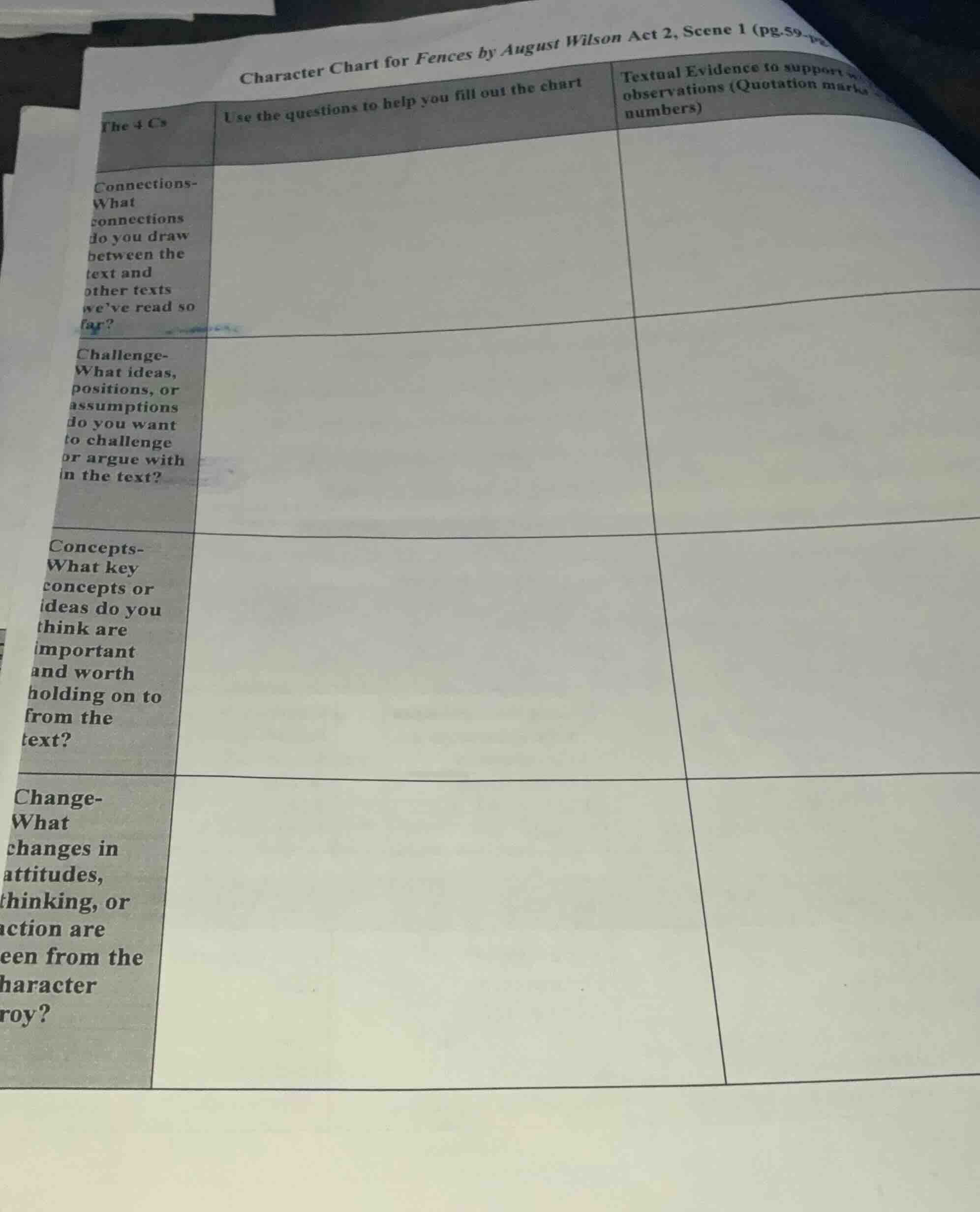
character chart for fences by august wilson act 2, scene 1 (pg.59-the 4 csuse the questions to help you fill out the charttextual evidence to support observations (quotation marks numbers)connections-what connections do you draw between the text and other texts weve read so far?challenge-what ideas, positions, or assumptions do you want to challenge or argue with in the text?concepts-what key concepts or ideas do you think are important and worth holding on to from the text?change-what changes in attitudes, thinking, or action are seen from the character troy?
This chart analyzes Fences Act 2, Scene 1 using the 4 Cs framework, with textual evidence tied to the play's text (pg.59+):
- Connections: Links Troy's tragic, repressive father-son dynamic to the cycle of intergenerational trauma seen in other African American literary works (e.g., Native Son's focus on systemic pressure shaping harmful family patterns).
- Challenge: Questions the assumption that Troy's cruelty to Cory is only personal; his actions stem from both unhealed trauma and systemic barriers that crushed his own dreams, framing his behavior as a product of circumstance as much as choice.
- Concepts: Centers on the "fence" as a dual symbol—Troy builds it to protect his family, but it also traps them in his cycle of grief and control, representing the tension between security and confinement in marginalized lives.
- Change: Troy shows rare vulnerability when he admits his fear of losing Cory, a shift from his usual harsh, defensive demeanor, hinting at underlying regret beneath his tough exterior.

Snap & solve any problem in the app
Get step-by-step solutions on Sovi AI
Photo-based solutions with guided steps
Explore more problems and detailed explanations
| The 4 Cs | Use the questions to help you fill out the chart | Textual Evidence to support observations (Quotation marks + numbers) |
|---|---|---|
| Challenge | Question Troy's "unfeeling" framing | His anger stems from crushed dreams, not just cruelty, pg.68: "I done learned my lesson. I don't want Cory to go through what I went through." |
| Concepts | The "fence" as a dual symbol | Represents protection and entrapment, pg.61: "I'm gonna build this fence... keep what's mine in and what's not mine out." |
| Change | Troy's vulnerable shift with Cory | Shows rare regret, pg.72: "I don't want to see you make the same mistakes I made." |