QUESTION IMAGE
Question
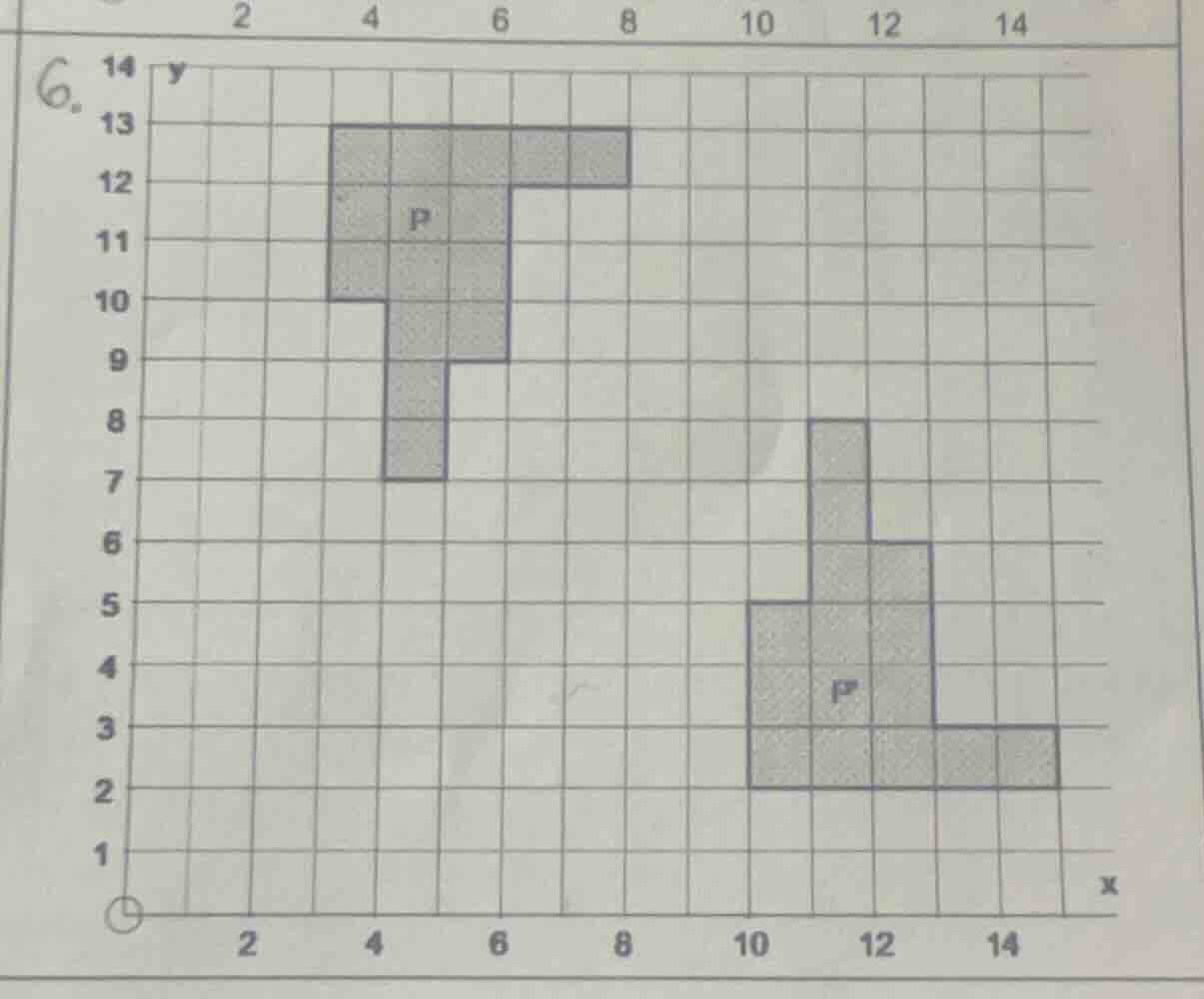
- (the chart is a coordinate grid with two gray figures labeled p and p. the x - axis is from 0 to 14, and the y - axis is from 1 to 14. the figure p is on the left - upper part of the grid, and the figure p is on the right - lower part of the grid.)
Assuming the problem is to find the transformation (translation) from figure \( P \) to \( P' \), here's the step - by - step solution:
Step 1: Identify a reference point
Let's take the top - left corner of figure \( P \). For figure \( P \), let's assume the coordinates of this reference point are \((3,13)\) (by looking at the grid, where \( x = 3\) and \( y = 13\)). For figure \( P' \), the corresponding reference point (the top - left corner of the part that aligns with the reference of \( P \)) has coordinates \((10,8)\).
Step 2: Calculate the horizontal (x - direction) translation
The change in the \( x \) - coordinate (\(\Delta x\)) is given by the formula \(\Delta x=x_{new}-x_{old}\). Substituting the values, we get \(\Delta x = 10 - 3=7\). This means we move 7 units to the right in the \( x \) - direction.
Step 3: Calculate the vertical (y - direction) translation
The change in the \( y \) - coordinate (\(\Delta y\)) is given by the formula \(\Delta y=y_{new}-y_{old}\). Substituting the values, we get \(\Delta y=8 - 13=- 5\). A negative value for \(\Delta y\) means we move 5 units down in the \( y \) - direction.

Snap & solve any problem in the app
Get step-by-step solutions on Sovi AI
Photo-based solutions with guided steps
Explore more problems and detailed explanations
To transform figure \( P \) to \( P' \), we translate it 7 units to the right and 5 units down. (If the problem was about area, we can count the number of unit squares. For \( P \): Let's count the squares. The top row has 5 squares, then 3, 2, 2, 2. Wait, actually a better way: Let's divide \( P \) into parts. The horizontal part at the top: 5 squares (from \( x = 3\) to \( x = 7\), \( y = 12 - 13\)). Then the vertical part on the left: from \( x = 3\) to \( x = 4\), \( y = 7 - 12\) (that's 5 squares), and the middle part: from \( x = 4\) to \( x = 5\), \( y = 9 - 12\) (3 squares), and from \( x = 5\) to \( x = 6\), \( y = 9 - 12\) (3 squares)? Wait, maybe a simpler way: count all the unit squares. For \( P \):
- Row \( y = 13\): 5 squares (x from 3 to 7)
- Row \( y = 12\): 3 squares (x from 3 to 5)
- Row \( y = 11\): 3 squares (x from 3 to 5)
- Row \( y = 10\): 2 squares (x from 4 to 5)
- Row \( y = 9\): 2 squares (x from 4 to 5)
- Row \( y = 8\): 1 square (x from 4 to 5)
- Row \( y = 7\): 1 square (x from 4 to 5)
Wait, this is getting complicated. Let's do it properly. Let's use the grid:
For figure \( P \):
- The top horizontal segment: \( x\): 3 - 7, \( y\): 12 - 13. Number of squares: \( (7 - 3 + 1)\times(13 - 12+1)=5\times1 = 5\)
- The middle left vertical segment: \( x\): 3 - 4, \( y\): 7 - 12. Number of squares: \( (4 - 3 + 1)\times(12 - 7 + 1)=2\times5 = 10\)? No, that's wrong. Wait, \( y\) from 7 to 12 is \( 12 - 7+1 = 6\) units? Wait \( y = 7,8,9,10,11,12\) that's 6 values. So \( 2\times6 = 12\)? No, this is a mistake. Let's look at the figure again. The figure \( P \) has:
- Top row (y = 13): 5 squares (x = 3,4,5,6,7)
- Second row (y = 12): 3 squares (x = 3,4,5)
- Third row (y = 11): 3 squares (x = 3,4,5)
- Fourth row (y = 10): 2 squares (x = 4,5)
- Fifth row (y = 9): 2 squares (x = 4,5)
- Sixth row (y = 8): 1 square (x = 4)
- Seventh row (y = 7): 1 square (x = 4)
Now sum these up: \( 5 + 3+3 + 2+2 + 1+1=17\).
For figure \( P' \):
- Bottom row (y = 2): 5 squares (x = 10,11,12,13,14)
- Second row (y = 3): 3 squares (x = 10,11,12)
- Third row (y = 4): 3 squares (x = 10,11,12)
- Fourth row (y = 5): 2 squares (x = 11,12)
- Fifth row (y = 6): 2 squares (x = 11,12)
- Sixth row (y = 7): 1 square (x = 11)
- Seventh row (y = 8): 1 square (x = 11)
Summing these: \( 5 + 3+3 + 2+2 + 1+1 = 17\). So the area of both figures is 17 square units.
If the problem was about translation, the translation vector is \( (7,- 5) \) (7 units right, 5 units down). If it was about area, the area of both \( P \) and \( P' \) is 17 square units.
Since the problem was not clearly stated, but from the grid, if it's a translation problem, the answer is a translation of 7 units right and 5 units down. If it's area, the area is 17.