QUESTION IMAGE
Question
check your understanding 7.3 – absolutely valuable (absolute value)
completing these questions is an opportunity for you to see whether you have understood what happened in your group today.
try them as best as you can first, and ill post the worked out solutions in a few days for you to check your work.
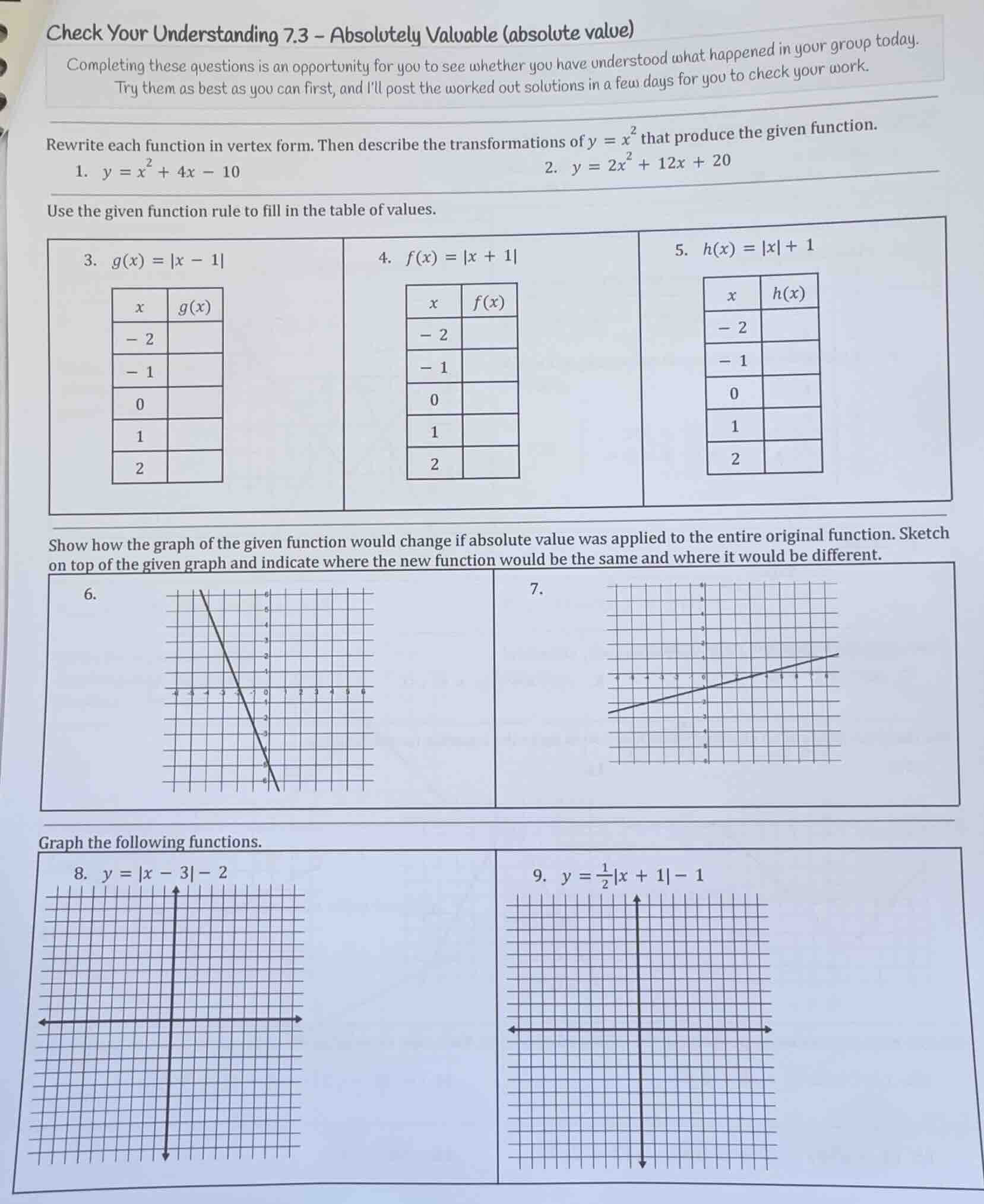
rewrite each function in vertex form. then describe the transformations of ( y = x^2 ) that produce the given function.
- ( y = x^2 + 4x - 10 )
- ( y = 2x^2 + 12x + 20 )
use the given function rule to fill in the table of values.
- ( g(x) = |x - 1| )
| ( x ) | ( g(x) ) |
|---|---|
| ( -1 ) | |
| ( 0 ) | |
| ( 1 ) | |
| ( 2 ) |
- ( f(x) = |x + 1| )
| ( x ) | ( f(x) ) |
|---|---|
| ( -1 ) | |
| ( 0 ) | |
| ( 1 ) | |
| ( 2 ) |
- ( h(x) = |x| + 1 )
| ( x ) | ( h(x) ) |
|---|---|
| ( -1 ) | |
| ( 0 ) | |
| ( 1 ) | |
| ( 2 ) |
show how the graph of the given function would change if absolute value was applied to the entire original function. sketch on top of the given graph and indicate where the new function would be the same and where it would be different.
- graph
- graph
graph the following functions.
- ( y = |x - 3| - 2 ) graph
- ( y = \frac{1}{2}|x + 1| - 1 ) graph
Problem 1: Rewrite \( y = x^2 + 4x - 10 \) in vertex form and describe transformations.
Step 1: Complete the square for \( x^2 + 4x \)
To complete the square, take half of the coefficient of \( x \) (which is \( 4 \)), square it (\( (\frac{4}{2})^2 = 4 \)), and add/subtract it.
\( y = (x^2 + 4x + 4) - 4 - 10 \)
Step 2: Rewrite as a perfect square
\( x^2 + 4x + 4 = (x + 2)^2 \), so:
\( y = (x + 2)^2 - 14 \)
Step 3: Describe transformations from \( y = x^2 \)
- The vertex form \( y = (x - h)^2 + k \) has vertex \( (h, k) \). Here, \( h = -2 \), \( k = -14 \).
- Transformation: Horizontal shift left 2 units, vertical shift down 14 units.
Problem 2: Rewrite \( y = 2x^2 + 12x + 20 \) in vertex form and describe transformations.
Step 1: Factor out the coefficient of \( x^2 \) from the first two terms
\( y = 2(x^2 + 6x) + 20 \)
Step 2: Complete the square inside the parentheses
Half of \( 6 \) is \( 3 \), square it: \( 3^2 = 9 \). Add and subtract \( 9 \) (but multiply the subtracted \( 9 \) by \( 2 \) because of the factored \( 2 \)):
\( y = 2[(x^2 + 6x + 9) - 9] + 20 \)
Step 3: Rewrite as a perfect square and simplify
\( x^2 + 6x + 9 = (x + 3)^2 \), so:
\( y = 2(x + 3)^2 - 18 + 20 \)
\( y = 2(x + 3)^2 + 2 \)
Step 4: Describe transformations from \( y = x^2 \)
- Factor \( 2 \) causes a vertical stretch by a factor of \( 2 \).
- Vertex \( (h, k) = (-3, 2) \), so horizontal shift left 3 units, vertical shift up 2 units.
Problem 3: Fill in the table for \( g(x) = |x - 1| \)
For each \( x \), substitute into \( g(x) = |x - 1| \):
- \( x = -2 \): \( |-2 - 1| = |-3| = 3 \)
- \( x = -1 \): \( |-1 - 1| = |-2| = 2 \)
- \( x = 0 \): \( |0 - 1| = |-1| = 1 \)
- \( x = 1 \): \( |1 - 1| = |0| = 0 \)
- \( x = 2 \): \( |2 - 1| = |1| = 1 \)
Problem 4: Fill in the table for \( f(x) = |x + 1| \)

Snap & solve any problem in the app
Get step-by-step solutions on Sovi AI
Photo-based solutions with guided steps
Explore more problems and detailed explanations
- Parent function \( y = |x| \) (vertex \( (0, 0) \), V-shape).
- Transformation:
- \( |x + 1| \): Horizontal shift left 1 unit (vertex at \( (-1, 0) \)).
- \( \frac{1}{2}|x + 1| \): Vertical compression by a factor of \( \frac{1}{2} \) (arms become "flatter").
- \( \frac{1}{2}|x + 1| - 1 \): Vertical shift down 1 unit (vertex at \( (-1, -1) \)).
- Plot vertex \( (-1, -1) \), then draw arms: for \( x \geq -1 \), \( y = \frac{1}{2}(x + 1) - 1 = \frac{1}{2}x - \frac{1}{2} \); for \( x < -1 \), \( y = \frac{1}{2}(-x - 1) - 1 = -\frac{1}{2}x - \frac{3}{2} \).
Final Answers (Key Results):
- Vertex form: \( \boldsymbol{y = (x + 2)^2 - 14} \); Transformations: Left 2, Down 14.
- Vertex form: \( \boldsymbol{y = 2(x + 3)^2 + 2} \); Transformations: Stretch (2x), Left 3, Up 2.
- \( g(x) \) table: \( 3, 2, 1, 0, 1 \) (for \( x = -2, -1, 0, 1, 2 \)).
- \( f(x) \) table: \( 1, 0, 1, 2, 3 \) (for \( x = -2, -1, 0, 1, 2 \)).
- \( h(x) \) table: \( 3, 2, 1, 2, 3 \) (for \( x = -2, -1, 0, 1, 2 \)).
6-7: Reflect below-x-axis parts to above.
- Graph: Vertex \( (3, -2) \), V-shape right 3, down 2.
- Graph: Vertex \( (-1, -1) \), V-shape left 1, compressed (1/2), down 1.