QUESTION IMAGE
Question
check my work
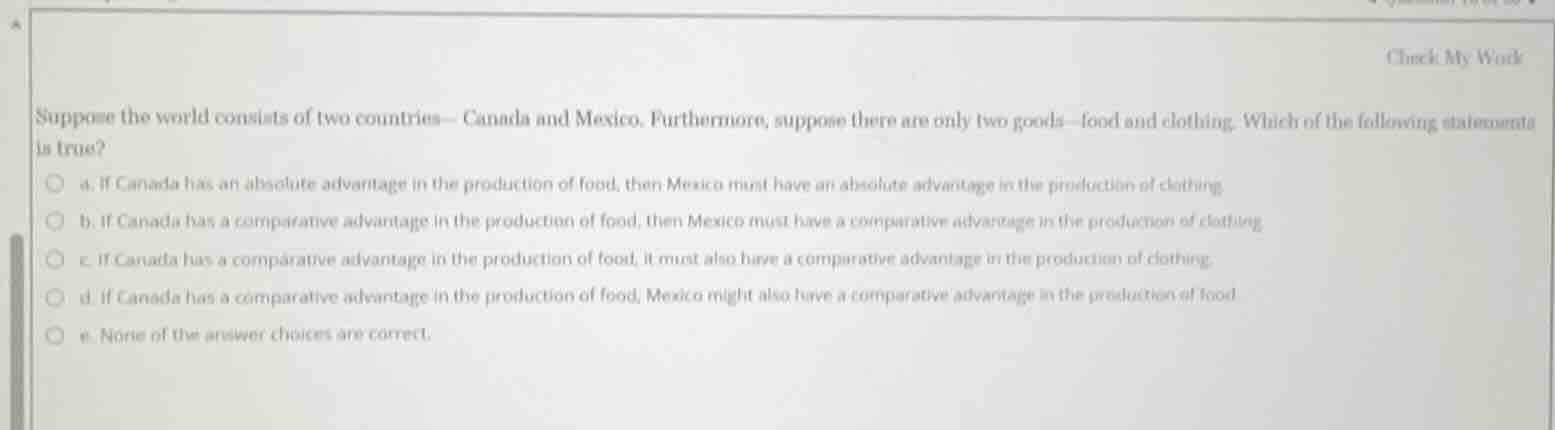
suppose the world consists of two countries— canada and mexico. furthermore, suppose there are only two goods—food and clothing. which of the following statements is true?
a. if canada has an absolute advantage in the production of food, then mexico must have an absolute advantage in the production of clothing
b. if canada has a comparative advantage in the production of food, then mexico must have a comparative advantage in the production of clothing
c. if canada has a comparative advantage in the production of food, it must also have a comparative advantage in the production of clothing
d. if canada has a comparative advantage in the production of food, mexico might also have a comparative advantage in the production of food
e. none of the answer choices are correct.
- Absolute advantage means a country can produce a good with fewer resources, but one country could have an absolute advantage in both goods, so option a is false.
- Comparative advantage is based on lower opportunity cost. With two countries and two goods, if one country has a comparative advantage in one good, the other must have a comparative advantage in the remaining good—this is a core principle of trade theory.
- Option c is false because a country cannot have a comparative advantage in both goods (opportunity costs are reciprocal).
- Option d is false because comparative advantage in a single good cannot be shared between two countries in a two-good, two-country model.

Snap & solve any problem in the app
Get step-by-step solutions on Sovi AI
Photo-based solutions with guided steps
Explore more problems and detailed explanations
b. If Canada has a comparative advantage in the production of food, then Mexico must have a comparative advantage in the production of clothing