QUESTION IMAGE
Question
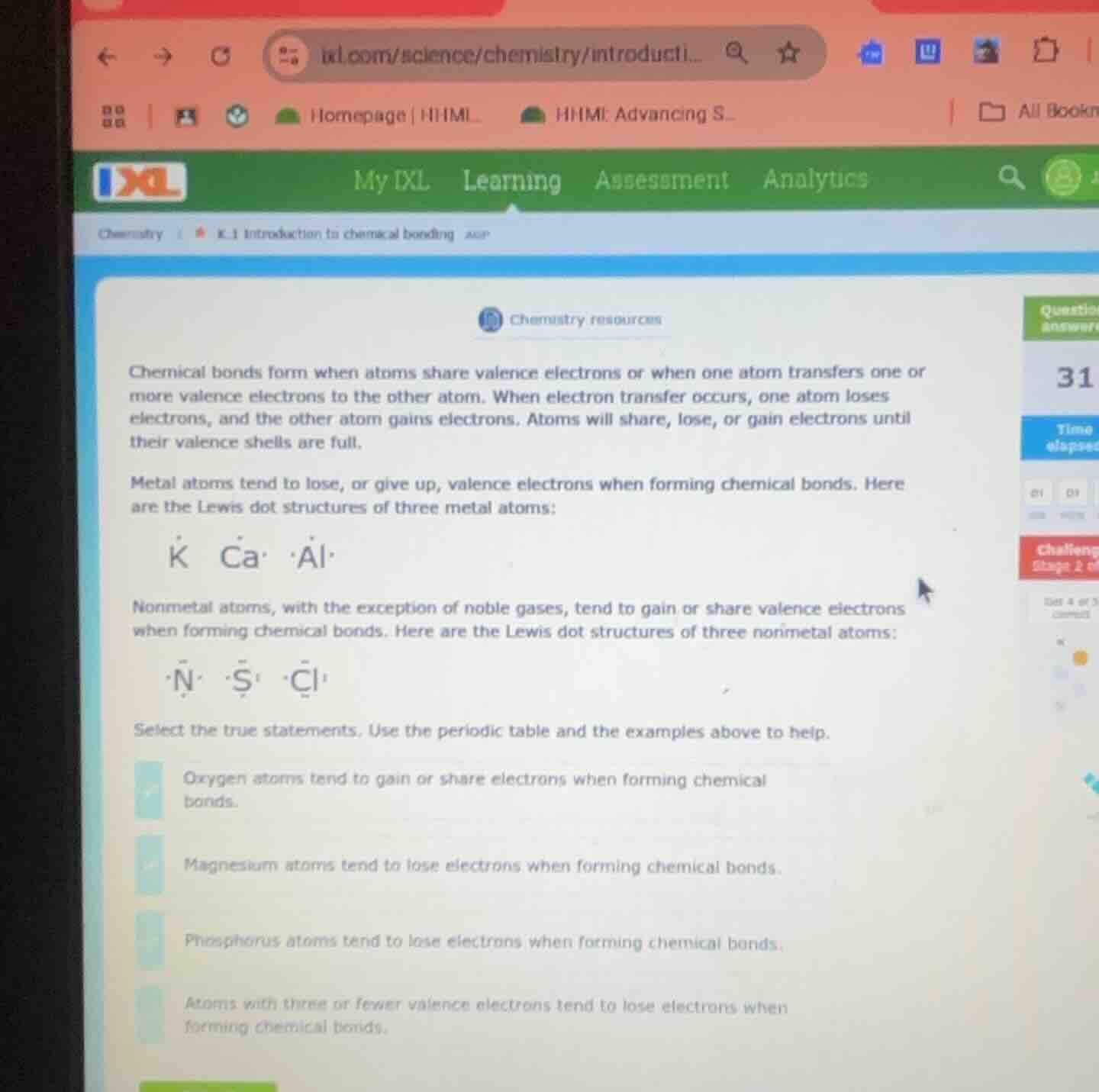
chemical bonds form when atoms share valence electrons or when one atom transfers one or more valence electrons to the other atom. when electron transfer occurs, one atom loses electrons, and the other atom gains electrons. atoms will share, lose, or gain electrons until their valence shells are full.metal atoms tend to lose, or give up, valence electrons when forming chemical bonds. here are the lewis dot structures of three metal atoms:$dot{k}$ $dot{ca}cdot$ $cdotdot{al}cdot$nonmetal atoms, with the exception of noble gases, tend to gain or share valence electrons when forming chemical bonds. here are the lewis dot structures of three nonmetal atoms:$cdotddot{n}cdot$ $cdotddot{s}cdot$ $cdotddot{cl}:$select the true statements. use the periodic table and the examples above to help.oxygen atoms tend to gain or share electrons when forming chemical bonds.magnesium atoms tend to lose electrons when forming chemical bonds.phosphorus atoms tend to lose electrons when forming chemical bonds.atoms with three or fewer valence electrons tend to lose electrons when forming chemical bonds.
- Oxygen is a nonmetal; nonmetals (except noble gases) gain/share electrons.
- Magnesium is a metal; metals lose valence electrons when bonding.
- Phosphorus is a nonmetal (has 5 valence electrons), so it gains/shares, not loses, electrons.
- Metals (with ≤3 valence electrons) tend to lose electrons to fill valence shells.

Snap & solve any problem in the app
Get step-by-step solutions on Sovi AI
Photo-based solutions with guided steps
Explore more problems and detailed explanations
- Oxygen atoms tend to gain or share electrons when forming chemical bonds.
- Magnesium atoms tend to lose electrons when forming chemical bonds.
- Atoms with three or fewer valence electrons tend to lose electrons when forming chemical bonds.