QUESTION IMAGE
Question
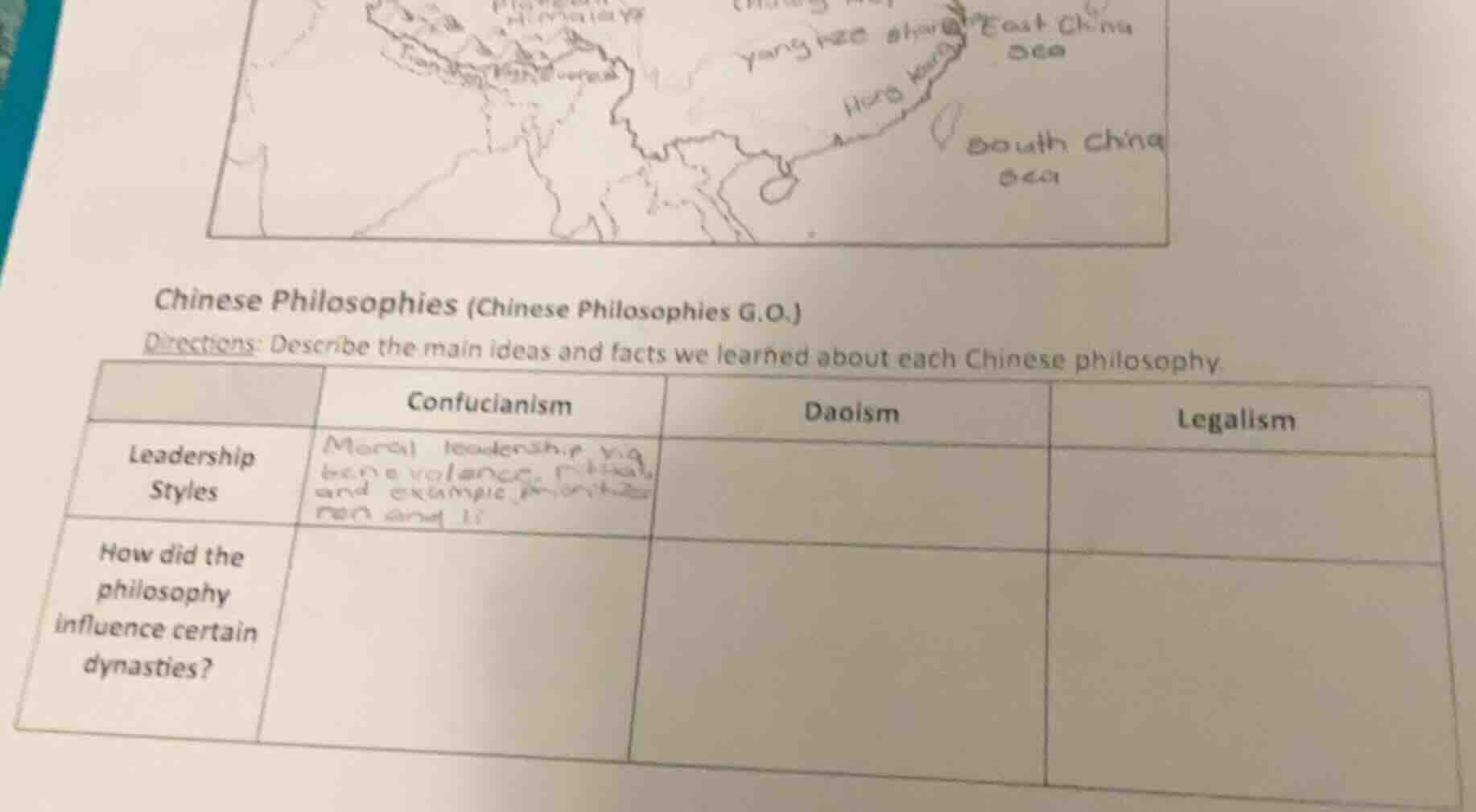
chinese philosophies (chinese philosophies g.o.)
directions: describe the main ideas and facts we learned about each chinese philosophy.
| confucianism | daoism | legalism | |
| leadership styles | moral leadership via benevolence, ritual and example (monarchs men and li? | ||
| how did the philosophy influence certain dynasties? |
Brief Explanations
For each philosophy, key core ideas about leadership and dynastic influence are summarized below:
- Confucianism: Focuses on moral example and hierarchical respect for leadership. It was embraced by the Han Dynasty, which made it the state ideology, shaping bureaucratic systems and social order for millennia.
- Daoism: Advocates for leaders to follow the natural way (Dao), acting with minimal interference. It influenced the early Han Dynasty's "Wu Wei" (non-action) policies, which helped restore stability after the Qin Dynasty's harsh rule.
- Legalism: Emphasizes strict laws, harsh punishments, and centralized control. It was the official philosophy of the Qin Dynasty, enabling rapid unification of China but also leading to rebellion due to its severity.

Snap & solve any problem in the app
Get step-by-step solutions on Sovi AI
Photo-based solutions with guided steps
Explore more problems and detailed explanations
| Category | Confucianism | Daoism | Legalism |
|---|---|---|---|
| How did the philosophy influence certain dynasties? | Adopted as state ideology by the Han Dynasty; shaped imperial bureaucracy, education, and social norms for most of imperial China | Guided early Han Dynasty's restorative, low-interference policies; later became a complementary philosophy to Confucianism across dynasties | Became the official philosophy of the Qin Dynasty, enabling rapid unification but contributing to its quick collapse due to excessive harshness; influenced later imperial legal systems |