QUESTION IMAGE
Question
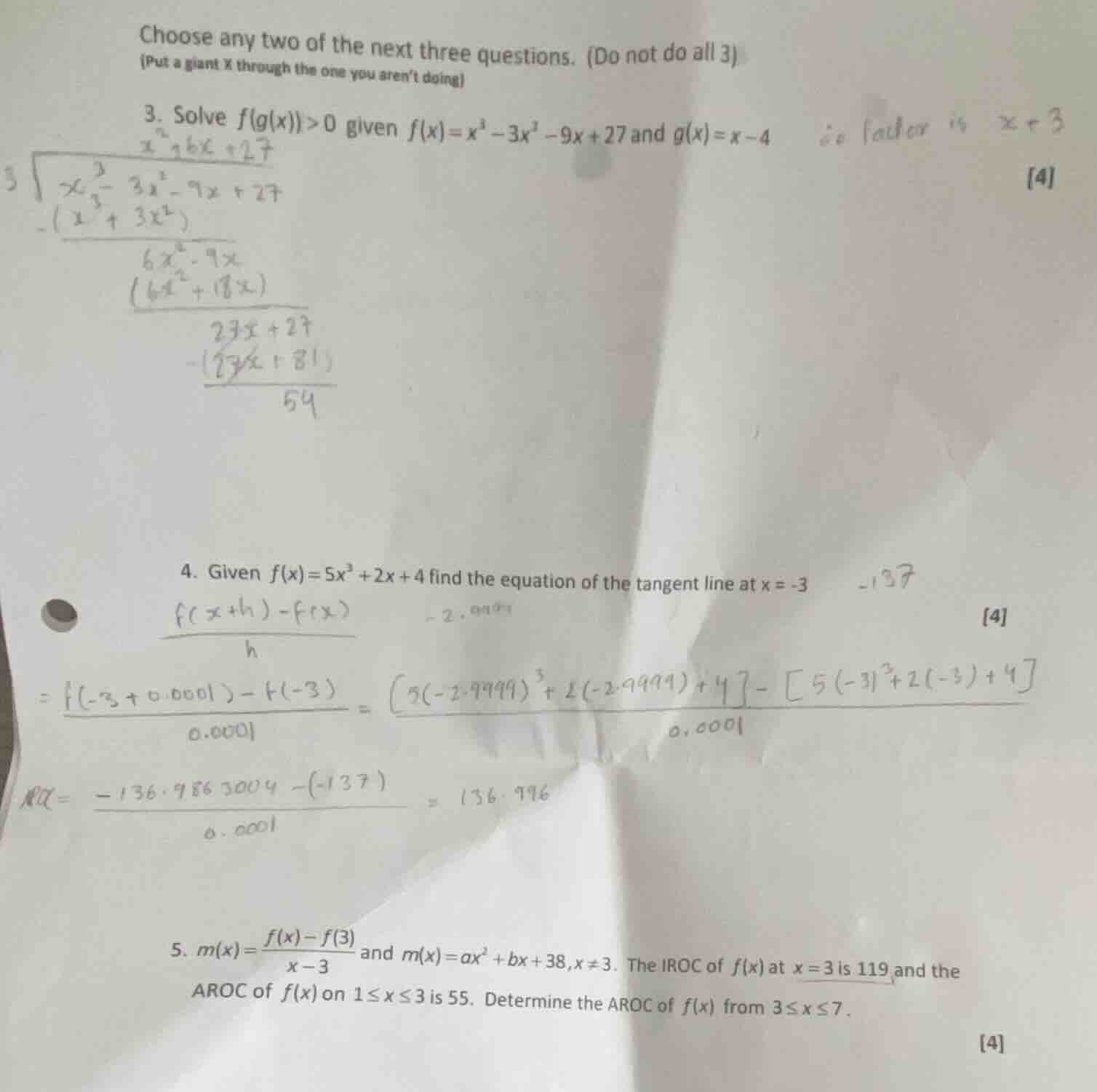
choose any two of the next three questions. (do not do all 3)
(put a giant x through the one you arent doing)
- solve ( f(g(x)) > 0 ) given ( f(x) = x^3 - 3x^2 - 9x + 27 ) and ( g(x) = x - 4 ) 4
- given ( f(x) = 5x^3 + 2x + 4 ) find the equation of the tangent line at ( x = -3 ) 4
- ( m(x) = \frac{f(x) - f(3)}{x - 3} ) and ( m(x) = ax^2 + bx + 38, x
eq 3 ). the iroc of ( f(x) ) at ( x = 3 ) is 119, and the aroc of ( f(x) ) on ( 1 leq x leq 3 ) is 55. determine the aroc of ( f(x) ) from ( 3 leq x leq 7 ). 4
Solving Question 3: \( f(g(x)) > 0 \)
Step 1: Find \( f(g(x)) \)
Given \( f(x) = x^3 - 3x^2 - 9x + 27 \) and \( g(x) = x - 4 \), substitute \( g(x) \) into \( f(x) \):
\( f(g(x)) = (x - 4)^3 - 3(x - 4)^2 - 9(x - 4) + 27 \)
Step 2: Simplify \( f(g(x)) \)
First, expand each term:
- \( (x - 4)^3 = x^3 - 12x^2 + 48x - 64 \)
- \( -3(x - 4)^2 = -3(x^2 - 8x + 16) = -3x^2 + 24x - 48 \)
- \( -9(x - 4) = -9x + 36 \)
Now combine all terms:
\[
\]
Alternatively, factor \( f(x) \) first (simpler):
\( f(x) = x^3 - 3x^2 - 9x + 27 \) can be factored by grouping:
\( x^2(x - 3) - 9(x - 3) = (x^2 - 9)(x - 3) = (x - 3)(x - 3)(x + 3) = (x - 3)^2(x + 3) \)
Thus, \( f(g(x)) = f(x - 4) = (x - 4 - 3)^2(x - 4 + 3) = (x - 7)^2(x - 1) \)
Step 3: Solve \( (x - 7)^2(x - 1) > 0 \)
- \( (x - 7)^2 \geq 0 \) for all \( x \), and \( (x - 7)^2 = 0 \) only when \( x = 7 \).
- The sign of \( (x - 7)^2(x - 1) \) depends on \( (x - 1) \) (since \( (x - 7)^2 \) is non-negative).
Analyze intervals:
- For \( x < 1 \): \( (x - 1) < 0 \), so \( (x - 7)^2(x - 1) < 0 \) (since \( (x - 7)^2 > 0 \)).
- For \( 1 < x < 7 \): \( (x - 1) > 0 \), so \( (x - 7)^2(x - 1) > 0 \) (since \( (x - 7)^2 > 0 \)).
- For \( x > 7 \): \( (x - 1) > 0 \), so \( (x - 7)^2(x - 1) > 0 \) (since \( (x - 7)^2 > 0 \)).
- At \( x = 7 \): \( (x - 7)^2(x - 1) = 0 \), so inequality fails.
Step 4: Combine results
The inequality \( (x - 7)^2(x - 1) > 0 \) holds when \( x > 1 \) and \( x
eq 7 \).
Solving Question 4: Tangent Line at \( x = -3 \)
Step 1: Find \( f(-3) \)
Given \( f(x) = 5x^3 + 2x + 4 \):
\( f(-3) = 5(-3)^3 + 2(-3) + 4 = 5(-27) - 6 + 4 = -135 - 2 = -137 \)
Step 2: Find the derivative \( f'(x) \) (slope of tangent)
\( f'(x) = 15x^2 + 2 \) (using power rule: \( \frac{d}{dx}(x^n) = nx^{n-1} \)).
At \( x = -3 \):
\( f'(-3) = 15(-3)^2 + 2 = 15(9) + 2 = 135 + 2 = 137 \)
Step 3: Equation of tangent line
Use point-slope form: \( y - y_1 = m(x - x_1) \), where \( (x_1, y_1) = (-3, -137) \) and \( m = 137 \):
\( y - (-137) = 137(x - (-3)) \)
\( y + 137 = 137(x + 3) \)
\( y = 137x + 411 - 137 \)
\( y = 137x + 274 \)
Solving Question 5: AROC from \( 3 \leq x \leq 7 \)
Step 1: Recall AROC and IROC
- AROC (Average Rate of Change) on \( [a, b] \): \( \frac{f(b) - f(a)}{b - a} \)
- IROC (Instantaneous Rate of Change) at \( x = 3 \): \( f'(3) = 119 \) (given).
Step 2: Analyze \( m(x) = \frac{f(x) - f(3)}{x - 3} \)
\( m(x) \) is the AROC of \( f(x) \) on \( [3, x] \) (or \( [x, 3] \) if \( x < 3 \)). Also, \( m(x) = ax^2 + bx + 38 \).
- At \( x = 3 \), \( m(x) \) approaches \( f'(3) = 119 \) (by definition of derivative). Thus, \( \lim_{x \to 3} m(x) = 119 \).
- Substitute \( x = 3 \) into \( m(x) = ax^2 + bx + 38 \): \( 9a + 3b + 38 = 119 \implies 9a + 3b = 81 \implies 3a + b = 27 \) (Equation 1).
Step 3: Use AROC on \( [1, 3] \)
AROC on \( [1, 3] \) is \( \frac{f(3) - f(1)}{3 - 1} = 55 \implies f(3) - f(1) = 110 \implies f(1) = f(3) - 110 \).
Also, \( m(1) = \frac{f(1) - f(3)}{1 - 3} = \frac{-(f(3) - f(1))}{-2} = \frac{110}{2} = 55 \).
Substitute \( x = 1 \) into \( m(x) = ax^2 + bx + 38 \): \( a(1)^2 + b(1) + 38 = 55 \implies a + b = 17 \) (Equation 2).
Step 4: Solve for \( a \) and \( b \)
From Equation 1: \( 3a + b = 27 \)
From Equation 2: \( a + b = 17 \)
Subtract Equation 2 from Equation 1:
\( 2a = 10 \implies a = 5 \)
Then \( b = 17 - a = 12 \).
Step 5: Find \( f(7) - f(3) \)…

Snap & solve any problem in the app
Get step-by-step solutions on Sovi AI
Photo-based solutions with guided steps
Explore more problems and detailed explanations
Solving Question 3: \( f(g(x)) > 0 \)
Step 1: Find \( f(g(x)) \)
Given \( f(x) = x^3 - 3x^2 - 9x + 27 \) and \( g(x) = x - 4 \), substitute \( g(x) \) into \( f(x) \):
\( f(g(x)) = (x - 4)^3 - 3(x - 4)^2 - 9(x - 4) + 27 \)
Step 2: Simplify \( f(g(x)) \)
First, expand each term:
- \( (x - 4)^3 = x^3 - 12x^2 + 48x - 64 \)
- \( -3(x - 4)^2 = -3(x^2 - 8x + 16) = -3x^2 + 24x - 48 \)
- \( -9(x - 4) = -9x + 36 \)
Now combine all terms:
\[
\]
Alternatively, factor \( f(x) \) first (simpler):
\( f(x) = x^3 - 3x^2 - 9x + 27 \) can be factored by grouping:
\( x^2(x - 3) - 9(x - 3) = (x^2 - 9)(x - 3) = (x - 3)(x - 3)(x + 3) = (x - 3)^2(x + 3) \)
Thus, \( f(g(x)) = f(x - 4) = (x - 4 - 3)^2(x - 4 + 3) = (x - 7)^2(x - 1) \)
Step 3: Solve \( (x - 7)^2(x - 1) > 0 \)
- \( (x - 7)^2 \geq 0 \) for all \( x \), and \( (x - 7)^2 = 0 \) only when \( x = 7 \).
- The sign of \( (x - 7)^2(x - 1) \) depends on \( (x - 1) \) (since \( (x - 7)^2 \) is non-negative).
Analyze intervals:
- For \( x < 1 \): \( (x - 1) < 0 \), so \( (x - 7)^2(x - 1) < 0 \) (since \( (x - 7)^2 > 0 \)).
- For \( 1 < x < 7 \): \( (x - 1) > 0 \), so \( (x - 7)^2(x - 1) > 0 \) (since \( (x - 7)^2 > 0 \)).
- For \( x > 7 \): \( (x - 1) > 0 \), so \( (x - 7)^2(x - 1) > 0 \) (since \( (x - 7)^2 > 0 \)).
- At \( x = 7 \): \( (x - 7)^2(x - 1) = 0 \), so inequality fails.
Step 4: Combine results
The inequality \( (x - 7)^2(x - 1) > 0 \) holds when \( x > 1 \) and \( x
eq 7 \).
Solving Question 4: Tangent Line at \( x = -3 \)
Step 1: Find \( f(-3) \)
Given \( f(x) = 5x^3 + 2x + 4 \):
\( f(-3) = 5(-3)^3 + 2(-3) + 4 = 5(-27) - 6 + 4 = -135 - 2 = -137 \)
Step 2: Find the derivative \( f'(x) \) (slope of tangent)
\( f'(x) = 15x^2 + 2 \) (using power rule: \( \frac{d}{dx}(x^n) = nx^{n-1} \)).
At \( x = -3 \):
\( f'(-3) = 15(-3)^2 + 2 = 15(9) + 2 = 135 + 2 = 137 \)
Step 3: Equation of tangent line
Use point-slope form: \( y - y_1 = m(x - x_1) \), where \( (x_1, y_1) = (-3, -137) \) and \( m = 137 \):
\( y - (-137) = 137(x - (-3)) \)
\( y + 137 = 137(x + 3) \)
\( y = 137x + 411 - 137 \)
\( y = 137x + 274 \)
Solving Question 5: AROC from \( 3 \leq x \leq 7 \)
Step 1: Recall AROC and IROC
- AROC (Average Rate of Change) on \( [a, b] \): \( \frac{f(b) - f(a)}{b - a} \)
- IROC (Instantaneous Rate of Change) at \( x = 3 \): \( f'(3) = 119 \) (given).
Step 2: Analyze \( m(x) = \frac{f(x) - f(3)}{x - 3} \)
\( m(x) \) is the AROC of \( f(x) \) on \( [3, x] \) (or \( [x, 3] \) if \( x < 3 \)). Also, \( m(x) = ax^2 + bx + 38 \).
- At \( x = 3 \), \( m(x) \) approaches \( f'(3) = 119 \) (by definition of derivative). Thus, \( \lim_{x \to 3} m(x) = 119 \).
- Substitute \( x = 3 \) into \( m(x) = ax^2 + bx + 38 \): \( 9a + 3b + 38 = 119 \implies 9a + 3b = 81 \implies 3a + b = 27 \) (Equation 1).
Step 3: Use AROC on \( [1, 3] \)
AROC on \( [1, 3] \) is \( \frac{f(3) - f(1)}{3 - 1} = 55 \implies f(3) - f(1) = 110 \implies f(1) = f(3) - 110 \).
Also, \( m(1) = \frac{f(1) - f(3)}{1 - 3} = \frac{-(f(3) - f(1))}{-2} = \frac{110}{2} = 55 \).
Substitute \( x = 1 \) into \( m(x) = ax^2 + bx + 38 \): \( a(1)^2 + b(1) + 38 = 55 \implies a + b = 17 \) (Equation 2).
Step 4: Solve for \( a \) and \( b \)
From Equation 1: \( 3a + b = 27 \)
From Equation 2: \( a + b = 17 \)
Subtract Equation 2 from Equation 1:
\( 2a = 10 \implies a = 5 \)
Then \( b = 17 - a = 12 \).
Step 5: Find \( f(7) - f(3) \)
AROC on \( [3, 7] \) is \( \frac{f(7) - f(3)}{7 - 3} = \frac{f(7) - f(3)}{4} \).
First, find \( m(7) = \frac{f(7) - f(3)}{7 - 3} = \frac{f(7) - f(3)}{4} \) (which is the AROC).
Substitute \( x = 7 \) into \( m(x) = 5x^2 + 12x + 38 \):
\( m(7) = 5(49) + 12(7) + 38 = 245 + 84 + 38 = 367 \)
Step 6: AROC on \( [3, 7] \)
\( \frac{f(7) - f(3)}{4} = 367 \implies f(7) - f(3) = 1468 \)
Thus, AROC on \( [3, 7] \) is \( \frac{1468}{4} = 367 \).
Final Answers (Choose Two)
- Question 3: \( x > 1 \) and \( x
eq 7 \) (or \( (1, 7) \cup (7, \infty) \))
- Question 4: Tangent line: \( y = 137x + 274 \)
- Question 5: AROC on \( [3, 7] \) is \( \boldsymbol{367} \)