QUESTION IMAGE
Question
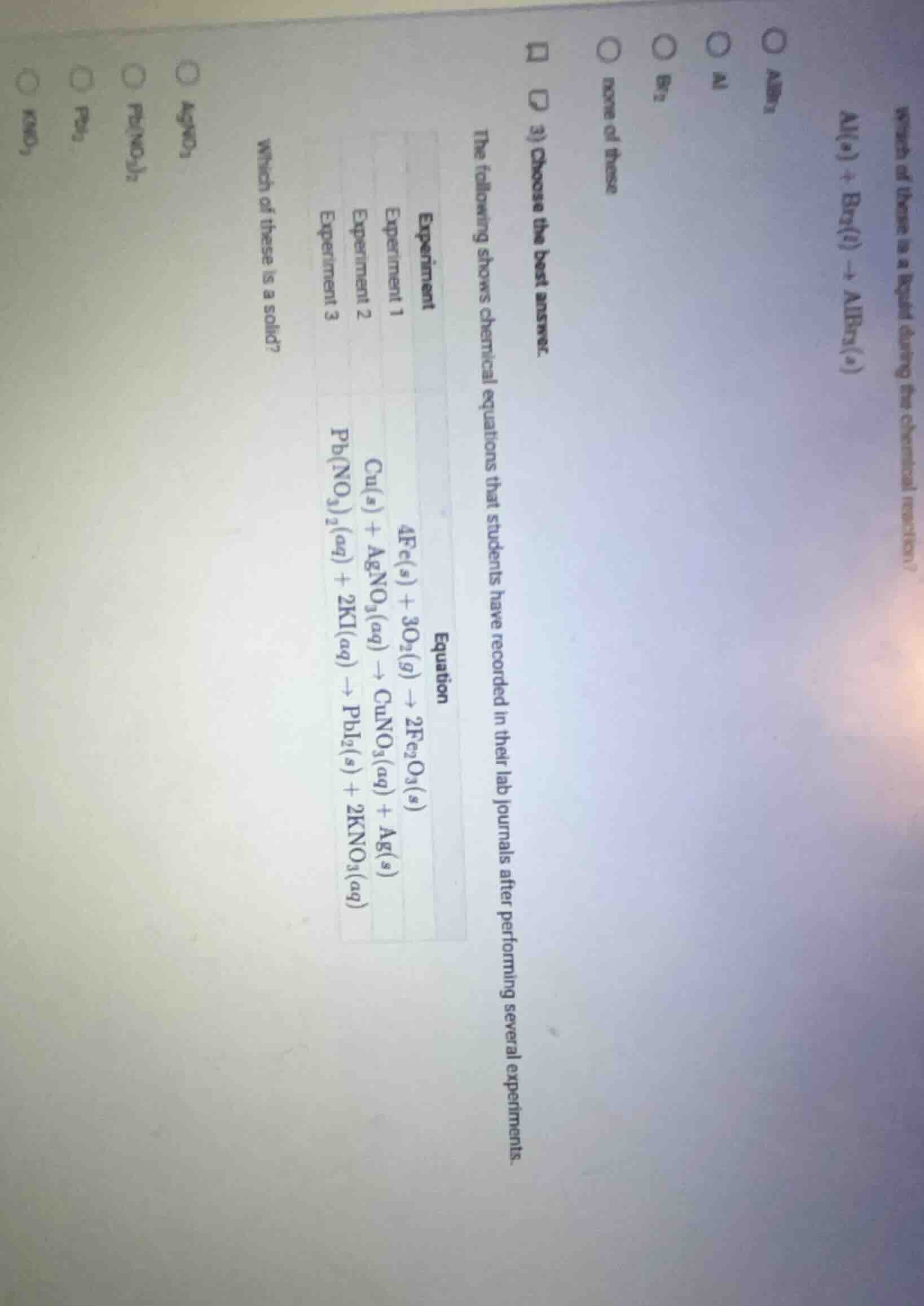
- choose the best answer. the following shows chemical equations that students have recorded in their lab journals after performing several experiments. experiment equation experiment 1 4fe(s) + 3o₂(g) → 2fe₂o₃(s) experiment 2 cu(s) + agno₃(aq) → cuno₃(aq) + ag(s) experiment 3 pb(no₃)₂(aq) + 2ki(aq) → pbi₂(s) + 2kno₃(aq) which of these is a solid? agno₃ pb(no₃)₂ pbi₂ kno₃
Step1: Analyze first question states
Identify state symbols:
- $\text{Al}(s)$: solid; $\text{Br}_2(l)$: liquid; $\text{AlBr}_3(s)$: solid
Step2: Match liquid to option
$\text{Br}_2$ is the liquid in the reaction.
Step3: Analyze second question states
Check compound states:
- $\text{AgNO}_3$: soluble (aqueous/solid, but common solid form exists, but $\text{PbI}_2$ is solid from exp3; $\text{Pb(NO}_3\text{)}_2$ is soluble, $\text{KNO}_3$ soluble. $\text{PbI}_2$ is the solid product, so $\text{PbI}_2$ is a solid.

Snap & solve any problem in the app
Get step-by-step solutions on Sovi AI
Photo-based solutions with guided steps
Explore more problems and detailed explanations
- For the first question: $\text{Br}_2$
- For the second question: $\text{PbI}_2$