QUESTION IMAGE
Question
- choose the best answer.
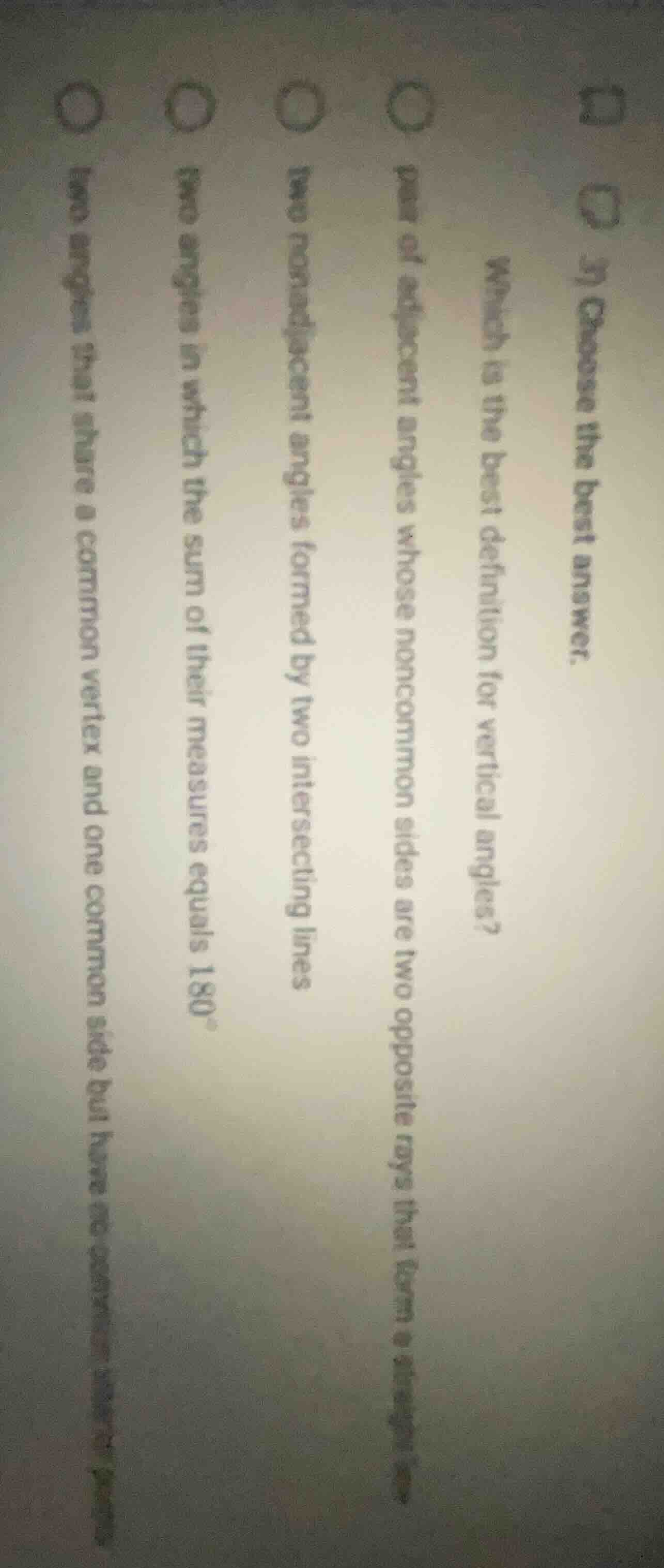
which is the best definition for vertical angles?
two of adjacent angles whose noncommon sides are two opposite rays that form a straight
two nonadjacent angles formed by two intersecting lines
two angles in which the sum of their measures equals 180°
two angles that share a common vertex and one common side but have no common interior points
To determine the best definition for vertical angles, we analyze each option:
- Option 1: Describes adjacent angles (share a common vertex and side), not vertical angles.
- Option 2: Describes supplementary angles (sum to \(180^\circ\)), not vertical angles.
- Option 3: Describes adjacent angles formed by intersecting lines, but vertical angles are non - adjacent.
- Option 4: Vertical angles are formed by two intersecting lines, and they are adjacent angles' non - common sides as two opposite rays forming a straight line? No, more accurately, vertical angles are two non - adjacent angles formed by two intersecting lines, and their non - common sides are two pairs of opposite rays. Wait, re - examining the option: "two of adjacent angles whose noncommon sides are two opposite rays that form a straight line" – when two lines intersect, the vertical angles are the non - adjacent angles, and the non - common sides of adjacent angles (formed by the intersection) are opposite rays. So this option correctly describes vertical angles. The other options are incorrect as per the definitions of different angle types.

Snap & solve any problem in the app
Get step-by-step solutions on Sovi AI
Photo-based solutions with guided steps
Explore more problems and detailed explanations
The option (let's assume the fourth option is labeled as, for example, D) D. two of adjacent angles whose noncommon sides are two opposite rays that form a straight line (the exact label depends on the original numbering, but the description matches the definition of vertical angles).