QUESTION IMAGE
Question
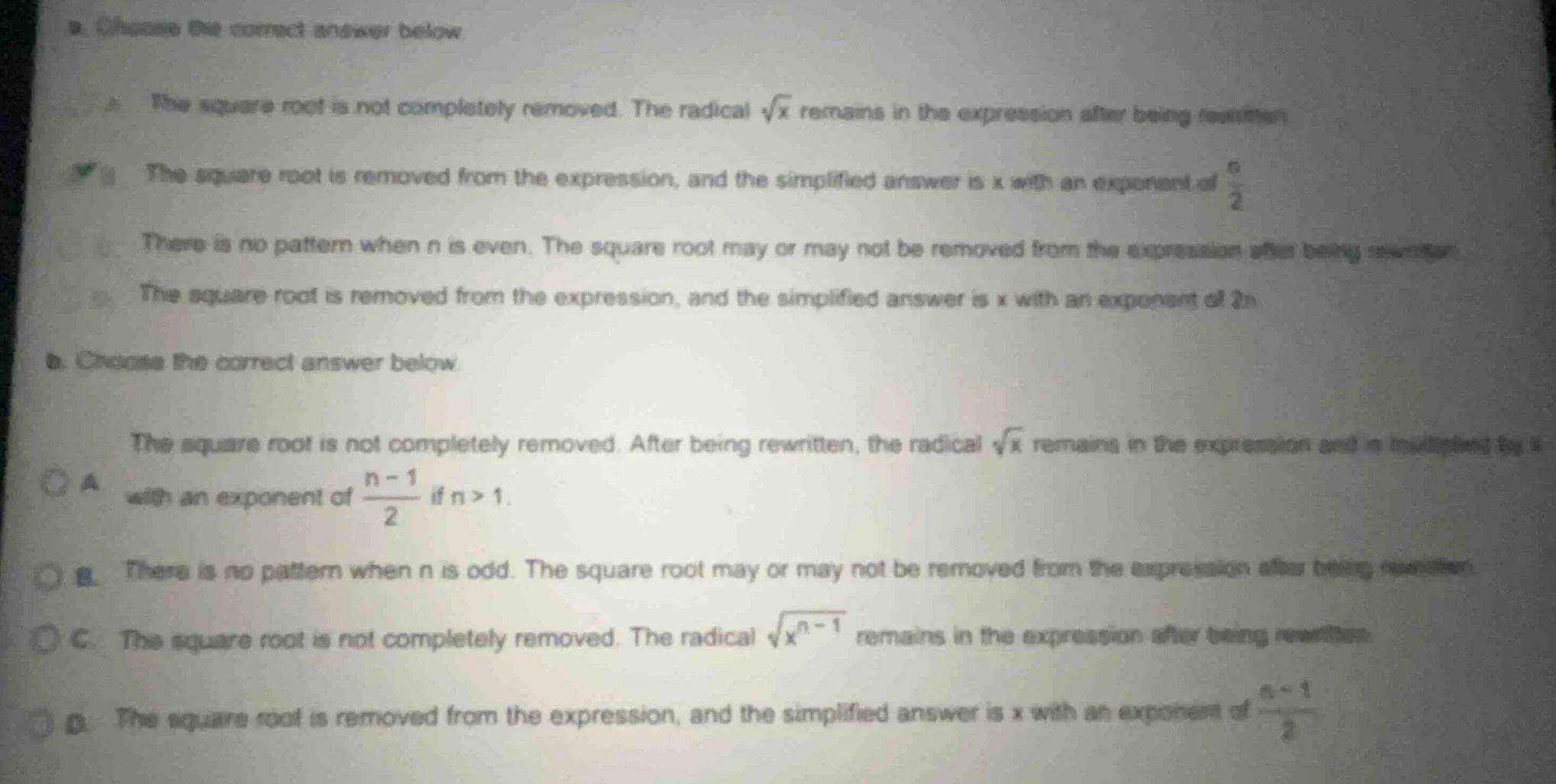
a. choose the correct answer below
a. the square root is not completely removed. the radical \\(\sqrt{x}\\) remains in the expression after being rewritten
b. the square root is removed from the expression, and the simplified answer is x with an exponent of \\(\frac{n}{2}\\)
c. there is no pattern when n is even. the square root may or may not be removed from the expression after being rewritten
d. the square root is removed from the expression, and the simplified answer is x with an exponent of 2n
b. choose the correct answer below.
a. the square root is not completely removed. after being rewritten, the radical \\(\sqrt{x}\\) remains in the expression and is multiplied by x with an exponent of \\(\frac{n - 1}{2}\\) if n > 1.
b. there is no pattern when n is odd. the square root may or may not be removed from the expression after being rewritten.
c. the square root is not completely removed. the radical \\(\sqrt{x^{n - 1}}\\) remains in the expression after being rewritten.
d. the square root is removed from the expression, and the simplified answer is x with an exponent of \\(\frac{n - 1}{2}\\)
Part a
To simplify \(\sqrt{x^n}\) when \(n\) is even, we use the property of radicals \(\sqrt{a^m}=a^{\frac{m}{2}}\) (for \(a\geq0\)). For an even \(n\), \(x^n=(x^{\frac{n}{2}})^2\), so \(\sqrt{x^n}=x^{\frac{n}{2}}\). This removes the square root, and the exponent is \(\frac{n}{2}\). Let's analyze each option:
- Option A: Incorrect. The square root is removed as shown.
- Option B: Correct. As \(\sqrt{x^n}=x^{\frac{n}{2}}\) when \(n\) is even, the square root is removed, and the exponent is \(\frac{n}{2}\).
- Option C: Incorrect. There is a pattern (using the radical - exponent property) when \(n\) is even.
- Option D: Incorrect. The exponent should be \(\frac{n}{2}\), not \(2n\).
When \(n\) is odd, we can write \(x^n = x^{n - 1}\cdot x\), where \(n-1\) is even. Then \(\sqrt{x^n}=\sqrt{x^{n - 1}\cdot x}=\sqrt{x^{n - 1}}\cdot\sqrt{x}\). Since \(n - 1\) is even, \(\sqrt{x^{n - 1}}=x^{\frac{n - 1}{2}}\), so \(\sqrt{x^n}=x^{\frac{n - 1}{2}}\cdot\sqrt{x}\). This means the square root is not completely removed (the \(\sqrt{x}\) remains) and we have \(x\) with an exponent of \(\frac{n - 1}{2}\) multiplied by \(\sqrt{x}\) (for \(n>1\)). Let's analyze each option:
- Option A: Correct. This matches our derivation.
- Option B: Incorrect. There is a pattern (using the factorization of \(x^n\) for odd \(n\)).
- Option C: Incorrect. The radical remaining is \(\sqrt{x}\), not \(\sqrt{x^{n - 1}}\).
- Option D: Incorrect. The square root is not removed (we still have \(\sqrt{x}\) in the expression).

Snap & solve any problem in the app
Get step-by-step solutions on Sovi AI
Photo-based solutions with guided steps
Explore more problems and detailed explanations
B. The square root is removed from the expression, and the simplified answer is \(x\) with an exponent of \(\frac{n}{2}\)