QUESTION IMAGE
Question
choose the correct answer.
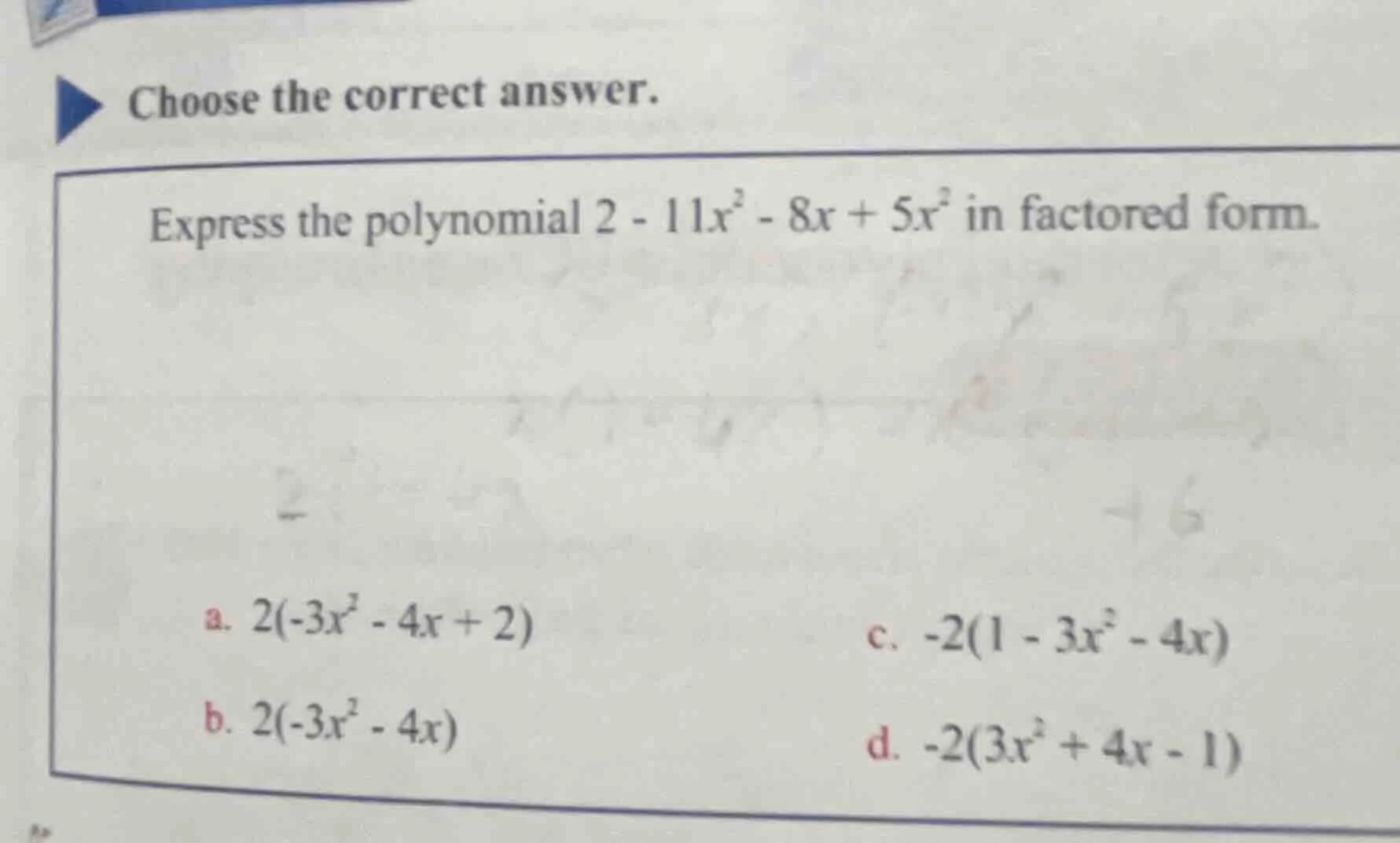
express the polynomial $2 - 11x^2 - 8x + 5x^2$ in factored form.
a. $2(-3x^2 - 4x + 2)$
b. $2(-3x^2 - 4x)$
c. $-2(1 - 3x^2 - 4x)$
d. $-2(3x^2 + 4x - 1)$
Step1: Combine like terms
First, combine the \(x^2\) terms in the polynomial \(2 - 11x^2 - 8x + 5x^2\).
\(-11x^2+5x^2=-6x^2\), so the polynomial becomes \(2 - 6x^2 - 8x\).
Step2: Factor out the greatest common factor (GCF)
The GCF of \(2\), \(-6x^2\), and \(-8x\) is \(-2\) (we can also use \(2\), but factoring out \(-2\) will make the leading coefficient of the quadratic inside the parentheses positive, which is a common practice).
Factor out \(-2\) from \(2 - 6x^2 - 8x\):
\(2 - 6x^2 - 8x=-2(-1 + 3x^2 + 4x)\) (Wait, let's do it step by step. Let's factor out \(-2\) from each term:
\(2=-2\times(-1)\), \(-6x^2=-2\times(3x^2)\), \(-8x=-2\times(4x)\). So putting it together:
\(2 - 6x^2 - 8x=-2(-1 + 3x^2 + 4x)\). But we can rearrange the terms inside the parentheses:
\(-2(3x^2 + 4x - 1)\) (because \(-1 + 3x^2 + 4x = 3x^2 + 4x - 1\)).
Let's check each option:
- Option a: \(2(-3x^2 - 4x + 2)\). If we expand this: \(2\times(-3x^2)+2\times(-4x)+2\times2=-6x^2 - 8x + 4\), which is not equal to \(2 - 6x^2 - 8x\).
- Option b: \(2(-3x^2 - 4x)\). Expanding: \(2\times(-3x^2)+2\times(-4x)=-6x^2 - 8x\), missing the constant term \(2\), so incorrect.
- Option c: \(-2(1 - 3x^2 - 4x)\). Expanding: \(-2\times1+(-2)\times(-3x^2)+(-2)\times(-4x)=-2 + 6x^2 + 8x\), which is not equal to \(2 - 6x^2 - 8x\) (signs are different).
- Option d: \(-2(3x^2 + 4x - 1)\). Expanding: \(-2\times3x^2+(-2)\times4x+(-2)\times(-1)=-6x^2 - 8x + 2\), which is equal to \(2 - 6x^2 - 8x\) (since addition is commutative, \(2 - 6x^2 - 8x=-6x^2 - 8x + 2\)).

Snap & solve any problem in the app
Get step-by-step solutions on Sovi AI
Photo-based solutions with guided steps
Explore more problems and detailed explanations
d. \(-2(3x^2 + 4x - 1)\)