QUESTION IMAGE
Question
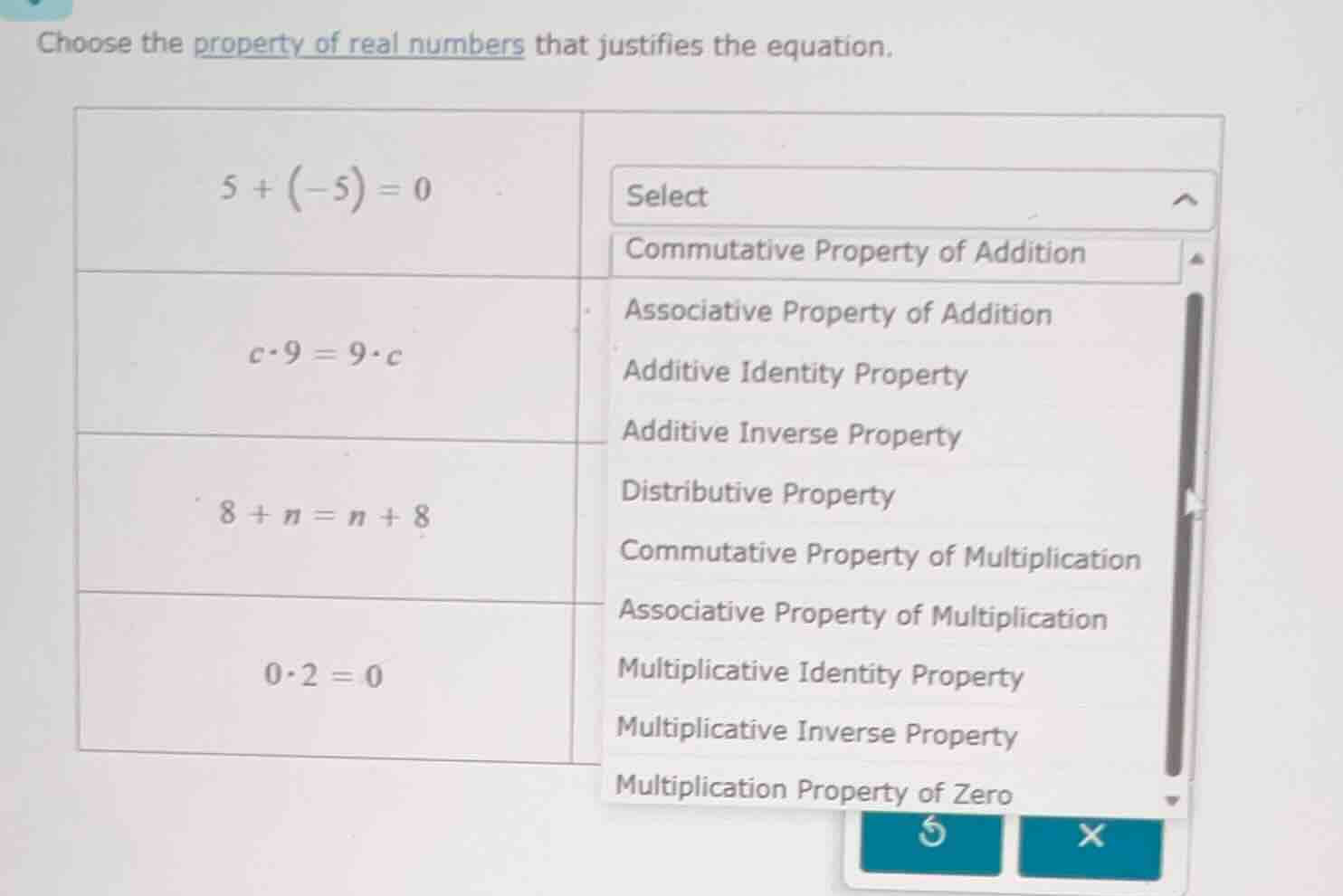
choose the property of real numbers that justifies the equation.
$5 + \left(-5\
ight) = 0$
$c\cdot 9 = 9\cdot c$
$8 + n = n + 8$
$0\cdot 2 = 0$
First Equation: \( 5 + (-5) = 0 \)
The Additive Inverse Property states that for any real number \( a \), there exists an additive inverse \( -a \) such that \( a + (-a) = 0 \). Here, \( a = 5 \) and its additive inverse is \( -5 \), so \( 5 + (-5) = 0 \) is justified by the Additive Inverse Property.
The Commutative Property of Multiplication states that for any real numbers \( a \) and \( b \), \( a \cdot b = b \cdot a \). Here, \( a = c \) and \( b = 9 \), so \( c \cdot 9 = 9 \cdot c \) is justified by the Commutative Property of Multiplication.
The Commutative Property of Addition states that for any real numbers \( a \) and \( b \), \( a + b = b + a \). Here, \( a = 8 \) and \( b = n \), so \( 8 + n = n + 8 \) is justified by the Commutative Property of Addition.

Snap & solve any problem in the app
Get step-by-step solutions on Sovi AI
Photo-based solutions with guided steps
Explore more problems and detailed explanations
Additive Inverse Property