QUESTION IMAGE
Question
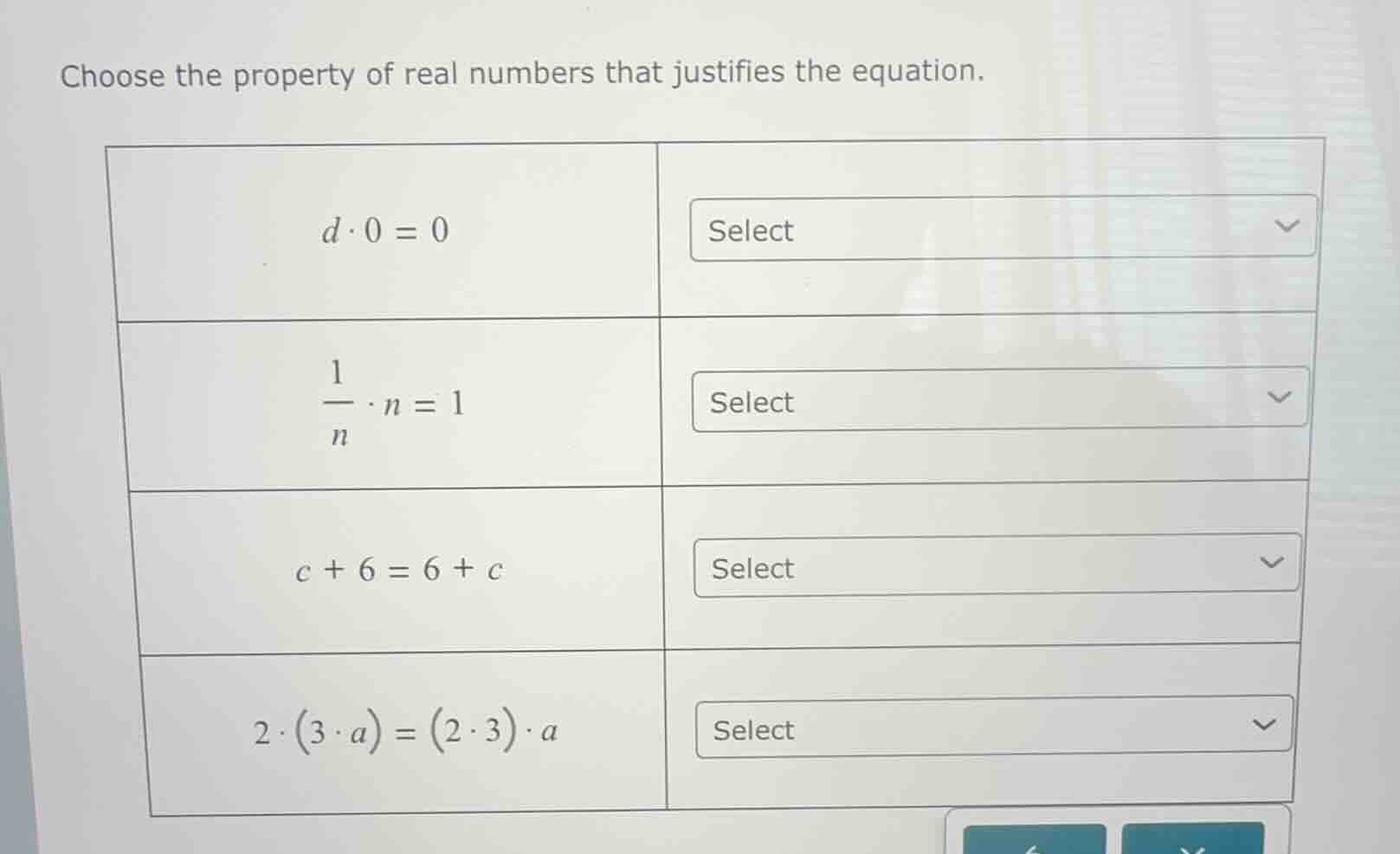
choose the property of real numbers that justifies the equation.
$d \cdot 0 = 0$
$\frac{1}{n} \cdot n = 1$
$c + 6 = 6 + c$
$2 \cdot (3 \cdot a) = (2 \cdot 3) \cdot a$
(each equation has a dropdown menu labeled select)
Brief Explanations
- For $d \cdot 0 = 0$: This rule states multiplying any real number by 0 gives 0.
- For $\frac{1}{n} \cdot n = 1$: A number times its reciprocal equals 1.
- For $c + 6 = 6 + c$: The order of addition does not change the sum.
- For $2 \cdot (3 \cdot a) = (2 \cdot 3) \cdot a$: Grouping of multiplication does not change the product.

Snap & solve any problem in the app
Get step-by-step solutions on Sovi AI
Photo-based solutions with guided steps
Explore more problems and detailed explanations
- $d \cdot 0 = 0$: Multiplicative Property of Zero
- $\frac{1}{n} \cdot n = 1$: Multiplicative Inverse Property
- $c + 6 = 6 + c$: Commutative Property of Addition
- $2 \cdot (3 \cdot a) = (2 \cdot 3) \cdot a$: Associative Property of Multiplication