QUESTION IMAGE
Question
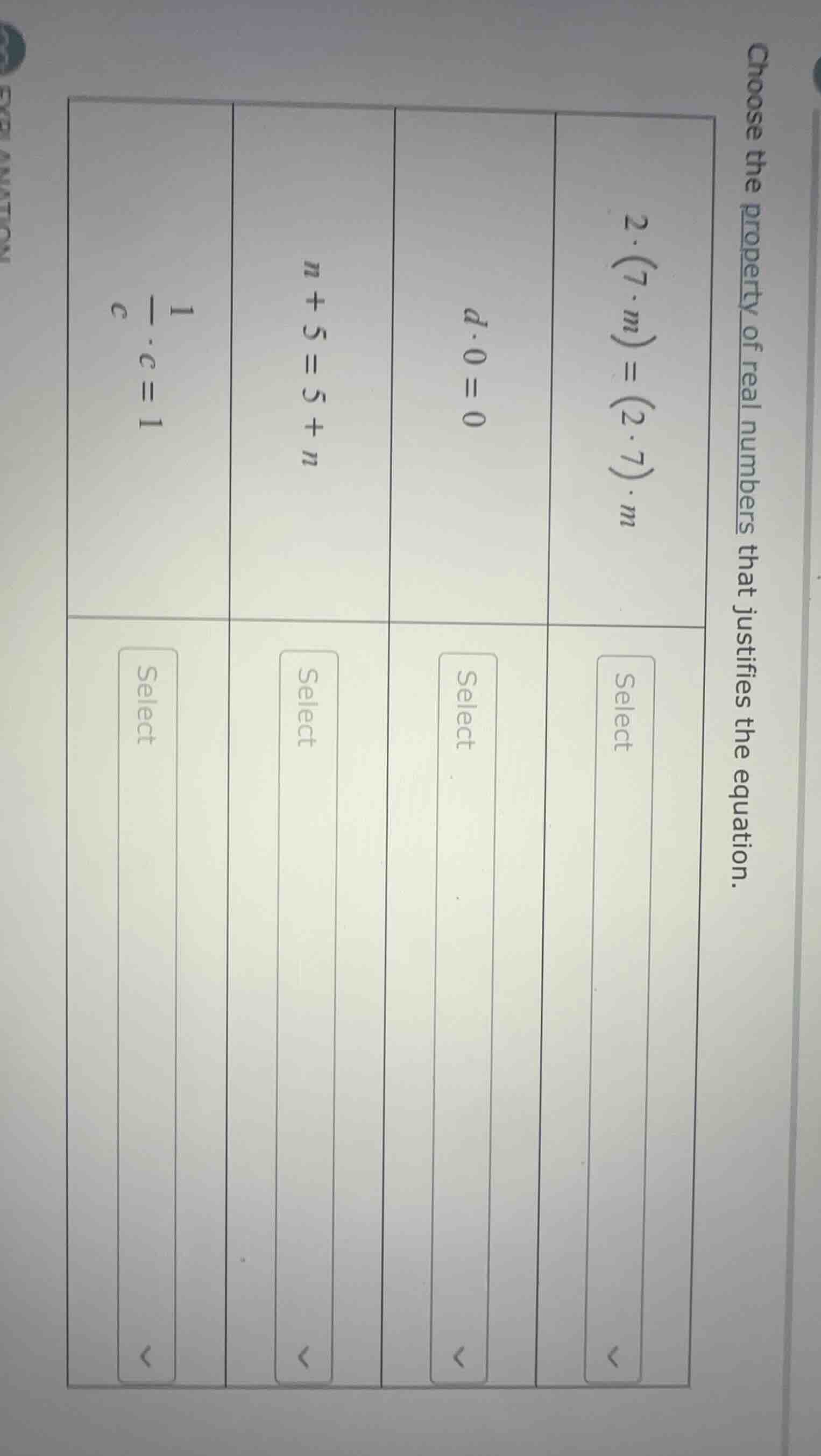
choose the property of real numbers that justifies the equation.
2·(7·m)=(2·7)·m
select
d·0=0
select
n+5=5+n
select
\frac{1}{c}·c=1
select
First Equation: \( 2 \cdot (7 \cdot m) = (2 \cdot 7) \cdot m \)
Step1: Identify the property
The equation shows that the grouping of factors is changed while multiplying. The associative property of multiplication states that for any real numbers \(a\), \(b\), and \(c\), \( (a \cdot b) \cdot c = a \cdot (b \cdot c) \). Here, \(a = 2\), \(b = 7\), and \(c = m\), so it follows the associative property of multiplication.
Second Equation: \( d \cdot 0 = 0 \)
Step1: Identify the property
The equation shows that any real number multiplied by 0 gives 0. This is the zero - product property (or the property of multiplication by zero) which states that for any real number \(a\), \(a\cdot0 = 0\). Here \(a = d\), so it follows the property of multiplication by zero.
Third Equation: \( n + 5 = 5 + n \)
Step1: Identify the property
The equation shows that the order of adding two numbers is changed. The commutative property of addition states that for any real numbers \(a\) and \(b\), \(a + b=b + a\). Here \(a = n\) and \(b = 5\), so it follows the commutative property of addition.
Fourth Equation: \( \frac{1}{c}\cdot c = 1\) (\(c
eq0\))

Snap & solve any problem in the app
Get step-by-step solutions on Sovi AI
Photo-based solutions with guided steps
Explore more problems and detailed explanations
s:
- For \(2 \cdot (7 \cdot m) = (2 \cdot 7) \cdot m\): Associative Property of Multiplication
- For \(d \cdot 0 = 0\): Multiplication by Zero Property (or Zero Product Property)
- For \(n + 5 = 5 + n\): Commutative Property of Addition
- For \(\frac{1}{c}\cdot c = 1\) (\(c
eq0\)): Multiplicative Inverse Property