QUESTION IMAGE
Question
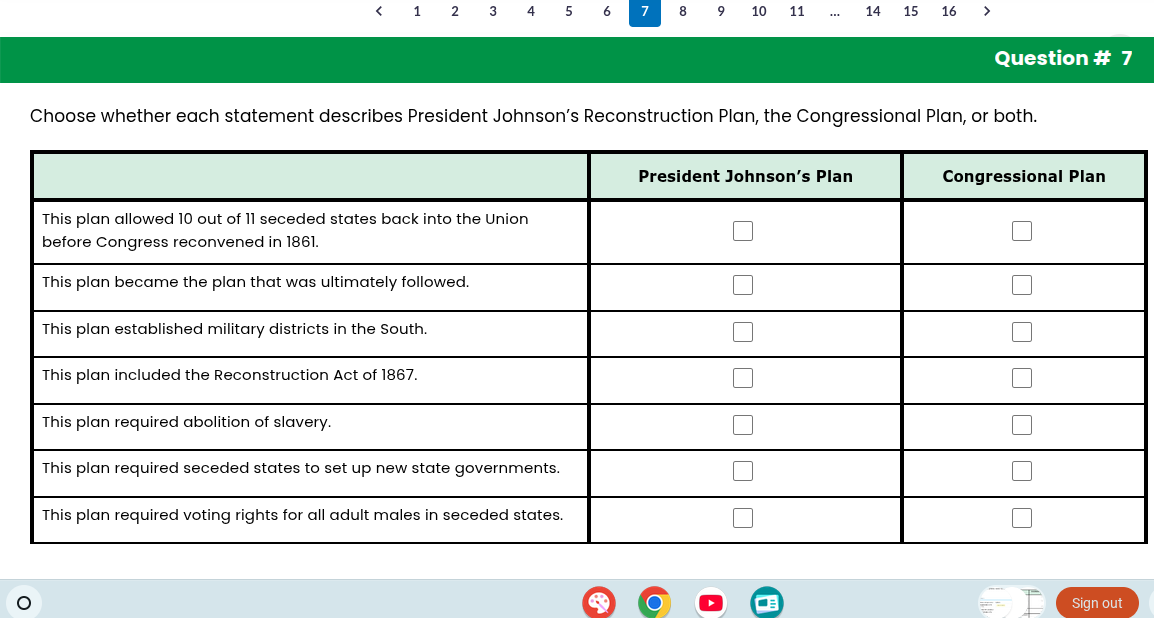
choose whether each statement describes president johnson’s reconstruction plan, the congressional plan, or both.
| president johnson’s plan | congressional plan | |
|---|---|---|
| this plan became the plan that was ultimately followed. | □ | □ |
| this plan established military districts in the south. | □ | □ |
| this plan included the reconstruction act of 1867. | □ | □ |
| this plan required abolition of slavery. | □ | □ |
| this plan required seceded states to set up new state governments. | □ | □ |
| this plan required voting rights for all adult males in seceded states. | □ | □ |
To solve this, we analyze each statement based on knowledge of Johnson's Reconstruction Plan and the Congressional (Radical Republican) Plan:
1. "This plan allowed 10 out of 11 seceded states back into the Union before Congress reconvened in 1861."
- Johnson’s Plan: Johnson’s lenient plan allowed quick readmission; this matches.
- Congressional Plan: The Congressional Plan was more stringent and did not prioritize quick readmission.
→ Check: President Johnson’s Plan
2. "This plan became the plan that was ultimately followed."
- Johnson’s Plan: Johnson’s plan was opposed by Congress, and his policies were overridden.
- Congressional Plan: The Radical Republicans’ plan (with military reconstruction, etc.) was ultimately enforced.
→ Check: Congressional Plan
3. "This plan established military districts in the South."
- Johnson’s Plan: Johnson opposed military rule in the South.
- Congressional Plan: The Reconstruction Acts of 1867 (part of the Congressional Plan) divided the South into military districts.
→ Check: Congressional Plan
4. "This plan included the Reconstruction Act of 1867."
- Johnson’s Plan: Johnson vetoed the Reconstruction Acts.
- Congressional Plan: The Reconstruction Act of 1867 was a key part of the Congressional (Radical Republican) Plan.
→ Check: Congressional Plan
5. "This plan required abolition of slavery."
- Johnson’s Plan: Johnson’s plan (and the 13th Amendment, which he supported) required abolition, but the 13th Amendment was already in process. However, both plans (in practice) required abolition (since slavery was already abolished by 1865). But more precisely:
- Johnson’s Plan: Required states to repudiate secession and abolish slavery (via state constitutions).
- Congressional Plan: Also required abolition (as a baseline).
→ However, the 13th Amendment (abolishing slavery) was ratified in 1865, so both plans operated in a post - slavery context. But if we consider the plan’s requirements: Both required abolition (since seceded states had to accept the 13th Amendment or abolish slavery in their new constitutions).
→ Check: Both (President Johnson’s Plan and Congressional Plan)
6. "This plan required seceded states to set up new state governments."
- Johnson’s Plan: Johnson’s plan required seceded states to draft new constitutions and set up new governments (with loyalty oaths).
- Congressional Plan: The Congressional Plan also required seceded states to set up new governments (with stricter requirements, like black suffrage).
→ Check: Both (President Johnson’s Plan and Congressional Plan)
7. "This plan required voting rights for all adult males in seceded states."
- Johnson’s Plan: Johnson’s plan did not require black male suffrage (he opposed it).
- Congressional Plan: The Congressional Plan (via Reconstruction Acts) required black male suffrage for readmission.
→ Check: Congressional Plan
Final Answers (with checks):
| Statement | President Johnson’s Plan | Congressional Plan |
|---|---|---|
| This plan became the plan that was ultimately followed. | ❌ | ✔️ |
| This plan established military districts in the South.…

Snap & solve any problem in the app
Get step-by-step solutions on Sovi AI
Photo-based solutions with guided steps
Explore more problems and detailed explanations
To solve this, we analyze each statement based on knowledge of Johnson's Reconstruction Plan and the Congressional (Radical Republican) Plan:
1. "This plan allowed 10 out of 11 seceded states back into the Union before Congress reconvened in 1861."
- Johnson’s Plan: Johnson’s lenient plan allowed quick readmission; this matches.
- Congressional Plan: The Congressional Plan was more stringent and did not prioritize quick readmission.
→ Check: President Johnson’s Plan
2. "This plan became the plan that was ultimately followed."
- Johnson’s Plan: Johnson’s plan was opposed by Congress, and his policies were overridden.
- Congressional Plan: The Radical Republicans’ plan (with military reconstruction, etc.) was ultimately enforced.
→ Check: Congressional Plan
3. "This plan established military districts in the South."
- Johnson’s Plan: Johnson opposed military rule in the South.
- Congressional Plan: The Reconstruction Acts of 1867 (part of the Congressional Plan) divided the South into military districts.
→ Check: Congressional Plan
4. "This plan included the Reconstruction Act of 1867."
- Johnson’s Plan: Johnson vetoed the Reconstruction Acts.
- Congressional Plan: The Reconstruction Act of 1867 was a key part of the Congressional (Radical Republican) Plan.
→ Check: Congressional Plan
5. "This plan required abolition of slavery."
- Johnson’s Plan: Johnson’s plan (and the 13th Amendment, which he supported) required abolition, but the 13th Amendment was already in process. However, both plans (in practice) required abolition (since slavery was already abolished by 1865). But more precisely:
- Johnson’s Plan: Required states to repudiate secession and abolish slavery (via state constitutions).
- Congressional Plan: Also required abolition (as a baseline).
→ However, the 13th Amendment (abolishing slavery) was ratified in 1865, so both plans operated in a post - slavery context. But if we consider the plan’s requirements: Both required abolition (since seceded states had to accept the 13th Amendment or abolish slavery in their new constitutions).
→ Check: Both (President Johnson’s Plan and Congressional Plan)
6. "This plan required seceded states to set up new state governments."
- Johnson’s Plan: Johnson’s plan required seceded states to draft new constitutions and set up new governments (with loyalty oaths).
- Congressional Plan: The Congressional Plan also required seceded states to set up new governments (with stricter requirements, like black suffrage).
→ Check: Both (President Johnson’s Plan and Congressional Plan)
7. "This plan required voting rights for all adult males in seceded states."
- Johnson’s Plan: Johnson’s plan did not require black male suffrage (he opposed it).
- Congressional Plan: The Congressional Plan (via Reconstruction Acts) required black male suffrage for readmission.
→ Check: Congressional Plan
Final Answers (with checks):
| Statement | President Johnson’s Plan | Congressional Plan |
|---|---|---|
| This plan became the plan that was ultimately followed. | ❌ | ✔️ |
| This plan established military districts in the South. | ❌ | ✔️ |
| This plan included the Reconstruction Act of 1867. | ❌ | ✔️ |
| This plan required abolition of slavery. | ✔️ | ✔️ |
| This plan required seceded states to set up new state governments. | ✔️ | ✔️ |
| This plan required voting rights for all adult males in seceded states. | ❌ | ✔️ |
(Note: For question 5, the "both" answer is based on the fact that both plans operated in a context where slavery was abolished, and seceded states had to formally accept abolition in their new governance structures. For question 6, both plans required new state governments, though with different criteria.)