QUESTION IMAGE
Question
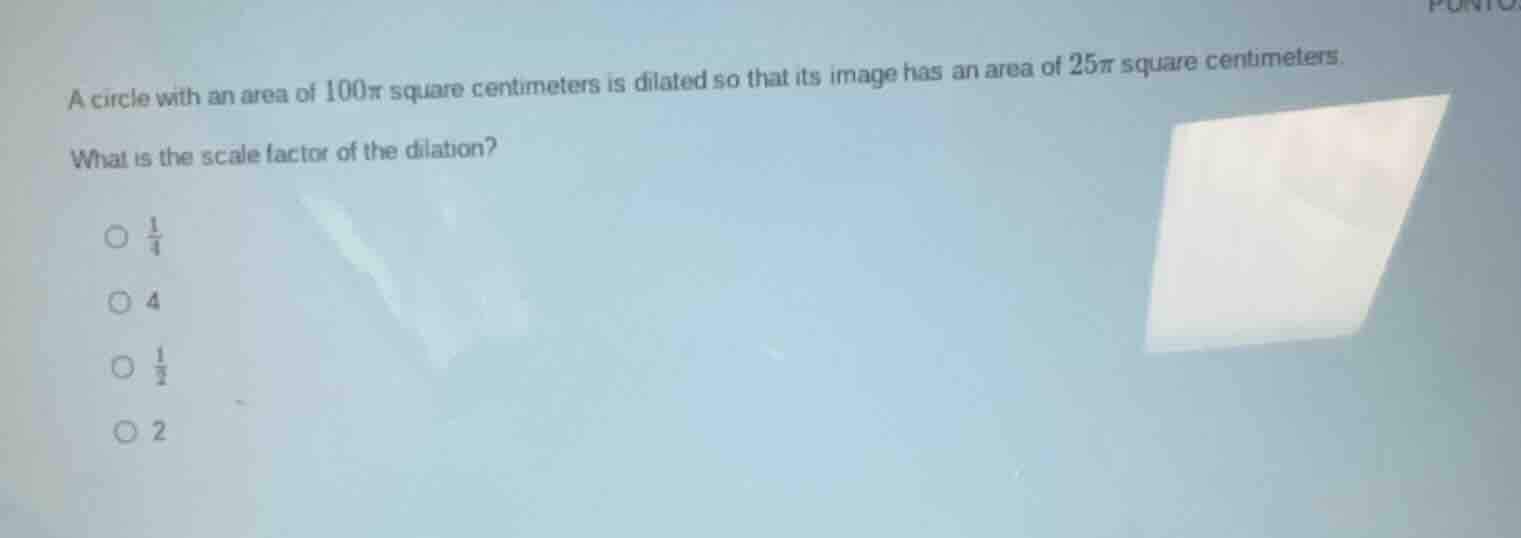
a circle with an area of 100π square centimeters is dilated so that its image has an area of 25π square centimeters. what is the scale factor of the dilation? ○ \\(\frac{1}{4}\\) ○ 4 ○ \\(\frac{1}{2}\\) ○ 2
Step1: Recall the relationship between area and scale factor
For similar figures, the ratio of their areas is the square of the ratio of their corresponding linear measurements (scale factor). Let the scale factor be \( k \), the area of the original circle be \( A_1 \), and the area of the dilated circle be \( A_2 \). Then \( \frac{A_2}{A_1}=k^2 \).
Step2: Calculate the ratio of the areas
Given \( A_1 = 100\pi \) and \( A_2 = 25\pi \), so \( \frac{A_2}{A_1}=\frac{25\pi}{100\pi}=\frac{25}{100}=\frac{1}{4} \).
Step3: Solve for the scale factor \( k \)
Since \( \frac{A_2}{A_1}=k^2=\frac{1}{4} \), take the square root of both sides: \( k = \sqrt{\frac{1}{4}}=\frac{1}{2} \)? Wait, no, wait. Wait, \( \frac{25}{100}=\frac{1}{4} \), so \( k^2=\frac{1}{4} \)? Wait, no, original area is 100π, dilated is 25π. So dilated area is smaller, so scale factor is less than 1. Wait, \( \frac{A_2}{A_1}=\frac{25\pi}{100\pi}=\frac{1}{4} \), so \( k^2=\frac{1}{4} \), so \( k = \frac{1}{2} \)? Wait, no, wait, no. Wait, area scale factor is \( k^2 \), so if the area becomes \( \frac{1}{4} \) of the original, then \( k^2=\frac{1}{4} \), so \( k=\frac{1}{2} \)? Wait, no, 25 is 1/4 of 100? 25*4=100, yes. So \( k^2 = \frac{1}{4} \), so \( k = \frac{1}{2} \)? Wait, no, \( (\frac{1}{2})^2=\frac{1}{4} \), yes. Wait, but let's check again. Original radius: \( A=\pi r^2=100\pi \), so \( r^2=100 \), \( r = 10 \). Dilated area: \( 25\pi=\pi R^2 \), so \( R^2=25 \), \( R = 5 \). So scale factor \( k=\frac{R}{r}=\frac{5}{10}=\frac{1}{2} \). Wait, but the options have \( \frac{1}{2} \) as an option (the third option: \( \frac{1}{2} \)). Wait, but wait, the first option is \( \frac{1}{4} \), second 4, third \( \frac{1}{2} \), fourth 2. So let's re-express:
Wait, \( A_1 = 100\pi \), \( A_2 = 25\pi \). The ratio of areas is \( \frac{25\pi}{100\pi}=\frac{1}{4} \). Since area ratio is \( k^2 \), then \( k^2=\frac{1}{4} \), so \( k = \frac{1}{2} \) (since scale factor for dilation (reduction) is positive and less than 1). So the scale factor is \( \frac{1}{2} \). Wait, but let's check the radius. Original radius \( r \): \( \pi r^2 = 100\pi \implies r^2 = 100 \implies r = 10 \). Dilated radius \( R \): \( \pi R^2 = 25\pi \implies R^2 = 25 \implies R = 5 \). So scale factor \( k = \frac{R}{r} = \frac{5}{10} = \frac{1}{2} \). So the correct option is the third one: \( \frac{1}{2} \). Wait, but the first option is \( \frac{1}{4} \), which would be if \( k^2=\frac{1}{16} \), but no. So the correct scale factor is \( \frac{1}{2} \).
Wait, but let's do it again. Area of circle: \( A = \pi r^2 \). Let original radius be \( r_1 \), dilated radius be \( r_2 \). Then \( A_1 = \pi r_1^2 = 100\pi \implies r_1^2 = 100 \implies r_1 = 10 \). \( A_2 = \pi r_2^2 = 25\pi \implies r_2^2 = 25 \implies r_2 = 5 \). Scale factor \( k = \frac{r_2}{r_1} = \frac{5}{10} = \frac{1}{2} \). So the scale factor is \( \frac{1}{2} \), which is the third option.
Wait, but earlier I thought \( k^2 = \frac{1}{4} \), so \( k = \frac{1}{2} \), which matches. So the correct option is \( \frac{1}{2} \), which is the third option (the one with \( \frac{1}{2} \)).

Snap & solve any problem in the app
Get step-by-step solutions on Sovi AI
Photo-based solutions with guided steps
Explore more problems and detailed explanations
\(\frac{1}{2}\) (the third option, i.e., the option with \(\frac{1}{2}\))