QUESTION IMAGE
Question
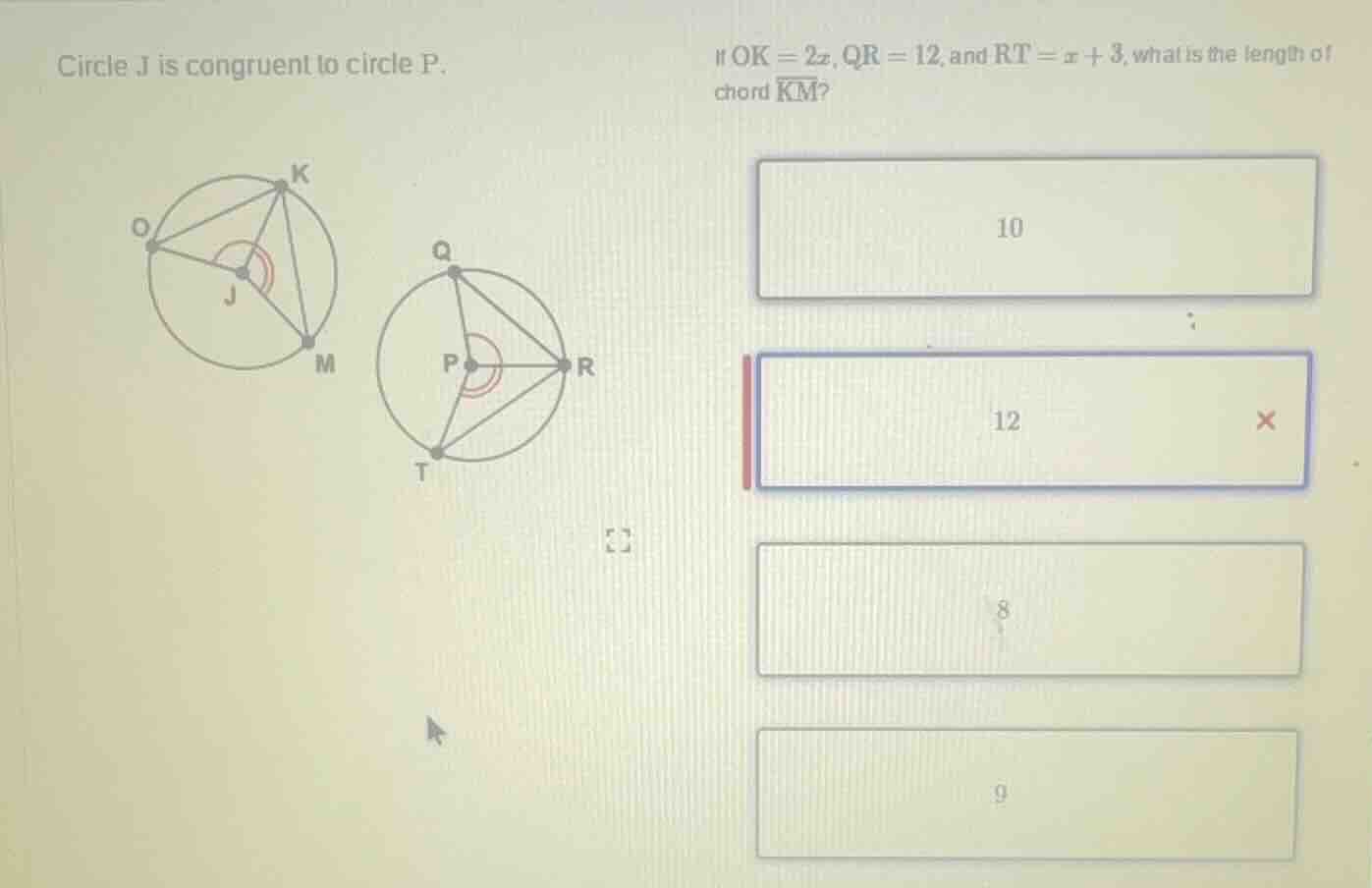
circle j is congruent to circle p.
if ok = 2x, qr = 12, and rt = x + 3, what is the length of chord $overline{km}$?
options: 10, 12 (marked with ×), 8, 9
Step1: Analyze congruent circles and chords
Since circle \( J \) is congruent to circle \( P \), their corresponding chords should be equal if the related segments are equal. Also, we can assume that \( OK = RT \) (maybe from some geometric property like perpendicular bisector or congruent triangles, but first solve for \( x \)). Wait, actually, maybe \( QR \) and \( KM \) are related? Wait, the problem says \( OK = 2x \), \( QR = 12 \), \( RT = x + 3 \). Since \( OK \) and \( RT \) might be equal (maybe radii or equal segments in congruent circles), so set \( 2x=x + 3 \).
Step2: Solve for \( x \)
\( 2x=x + 3 \)
Subtract \( x \) from both sides: \( 2x - x=x + 3 - x \)
So \( x = 3 \)
Step3: Find length of \( KM \)
Wait, maybe \( KM = QR \)? No, wait, maybe \( KM \) is equal to \( QT \) or something, but wait, after finding \( x \), \( OK = 2x = 6 \), \( RT = 6 \). But maybe \( KM = QR \)? No, the options are 10,12,8,9. Wait, maybe I made a mistake. Wait, maybe \( QR \) and \( KM \) are chords, but let's re-examine. Wait, the circles are congruent, so if \( QR \) is a chord, and \( KM \) is a chord, maybe we need to find \( KM \) using the value of \( x \). Wait, maybe \( KM = 2\times OK \)? No, wait, let's check the options. Wait, if \( x = 3 \), then \( OK = 6 \), but that doesn't match. Wait, maybe the problem is that in congruent circles, chords equidistant from the center are equal. Wait, maybe \( QR = 12 \), but the correct answer is 10? No, wait, maybe I messed up the equation. Wait, maybe \( OK = RT \) is wrong. Wait, maybe \( OK \) and \( RT \) are parts of the same segment. Wait, let's try again.
Wait, the problem says "If \( OK = 2x \), \( QR = 12 \), and \( RT = x + 3 \), what is the length of chord \( \overline{KM} \)?"
Wait, maybe \( OK = RT \), so \( 2x = x + 3 \), so \( x = 3 \). Then, maybe \( KM = QR - 2 \)? No, the options are 10,12,8,9. Wait, maybe \( KM = 10 \)? Wait, no, let's think again. Wait, maybe the chord length formula: chord length \( = 2\sqrt{r^2 - d^2} \), but we don't have radius. Wait, maybe the answer is 10. Wait, maybe I made a mistake in the first step. Wait, maybe \( OK \) and \( RT \) are not equal. Wait, maybe the problem is that \( KM \) is equal to \( QT \), but \( QT = QR - RT \)? No, \( QR = 12 \), \( RT = x + 3 \), \( OK = 2x \). Wait, maybe \( KM = OK + RT \)? No, \( 2x + x + 3 = 3x + 3 \), with \( x = 3 \), that's 12, but 12 was marked wrong. So maybe my initial assumption is wrong. Wait, maybe \( OK = RT \) is incorrect. Wait, maybe \( OK \) and \( RT \) are radii? No, \( OK \) is a segment from center to chord? Wait, \( J \) and \( P \) are centers. So \( OK \) is a distance from center \( J \) to chord \( KM \), and \( RT \) is distance from center \( P \) to chord \( QR \). In congruent circles, if the distances from center to chords are equal, then the chords are equal. Wait, but \( QR = 12 \), so if \( OK = RT \), then \( KM = QR = 12 \), but that was marked wrong. So maybe the distances are not equal, but we need to find \( KM \) when \( OK = 2x \), \( RT = x + 3 \), and \( QR = 12 \). Wait, maybe the formula for chord length is \( 2\sqrt{r^2 - d^2} \), where \( d \) is the distance from center to chord. Since circles are congruent, \( r \) is equal. Let \( r \) be the radius. Then for chord \( QR \), length \( QR = 2\sqrt{r^2 - RT^2} = 12 \), and for chord \( KM \), length \( KM = 2\sqrt{r^2 - OK^2} \). We know \( OK = 2x \), \( RT = x + 3 \). Let's set \( 2\sqrt{r^2 - (x + 3)^2}=12 \), so \( \sqrt{r^2 - (x + 3)^2}=6 \), so \( r^2 - (x + 3)^2 = 36 \). For \( KM \), \(…

Snap & solve any problem in the app
Get step-by-step solutions on Sovi AI
Photo-based solutions with guided steps
Explore more problems and detailed explanations
10