QUESTION IMAGE
Question
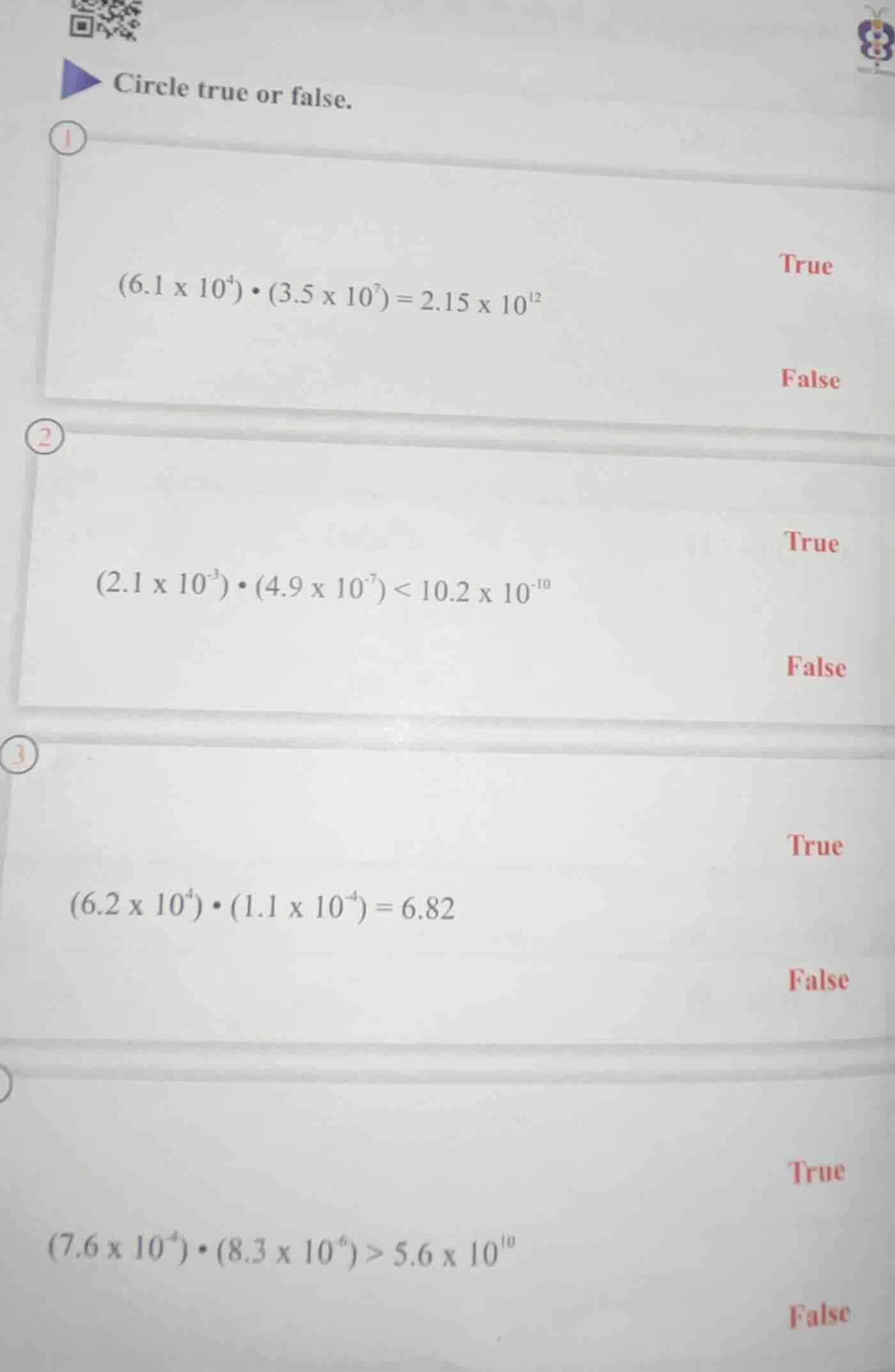
circle true or false.
1
$(6.1 \times 10^4) \cdot (3.5 \times 10^7) = 2.15 \times 10^{12}$
true
false
2
$(2.1 \times 10^{-3}) \cdot (4.9 \times 10^{-7}) < 10.2 \times 10^{-10}$
true
false
3
$(6.2 \times 10^4) \cdot (1.1 \times 10^{-4}) = 6.82$
true
false
$(7.6 \times 10^{-4}) \cdot (8.3 \times 10^{-6}) > 5.6 \times 10^{10}$
true
false
Question 1
Step1: Multiply coefficients and exponents
First, multiply the coefficients: \(6.1\times3.5 = 21.35\). Then, add the exponents of 10: \(10^{4}\times10^{7}=10^{4 + 7}=10^{11}\). So the product is \(21.35\times10^{11}\).
Step2: Convert to scientific notation
Convert \(21.35\times10^{11}\) to proper scientific notation: \(2.135\times10^{12}\). The given result is \(2.15\times10^{12}\), which is not equal.
Step1: Multiply coefficients and exponents
Multiply the coefficients: \(2.1\times4.9 = 10.29\). Add the exponents of 10: \(10^{-3}\times10^{-7}=10^{-3-7}=10^{-10}\). So the product is \(10.29\times10^{-10}\).
Step2: Compare with given value
We have \(10.29\times10^{-10}\) and \(10.2\times10^{-10}\). Since \(10.29>10.2\), \(10.29\times10^{-10}>10.2\times10^{-10}\), so the inequality \(<\) is false.
Step1: Multiply coefficients and exponents
Multiply the coefficients: \(6.2\times1.1 = 6.82\). Add the exponents of 10: \(10^{4}\times10^{-4}=10^{4+( - 4)}=10^{0}=1\). Then the product is \(6.82\times1 = 6.82\).
Step2: Check equality
The product is equal to \(6.82\) as given.

Snap & solve any problem in the app
Get step-by-step solutions on Sovi AI
Photo-based solutions with guided steps
Explore more problems and detailed explanations
False