QUESTION IMAGE
Question
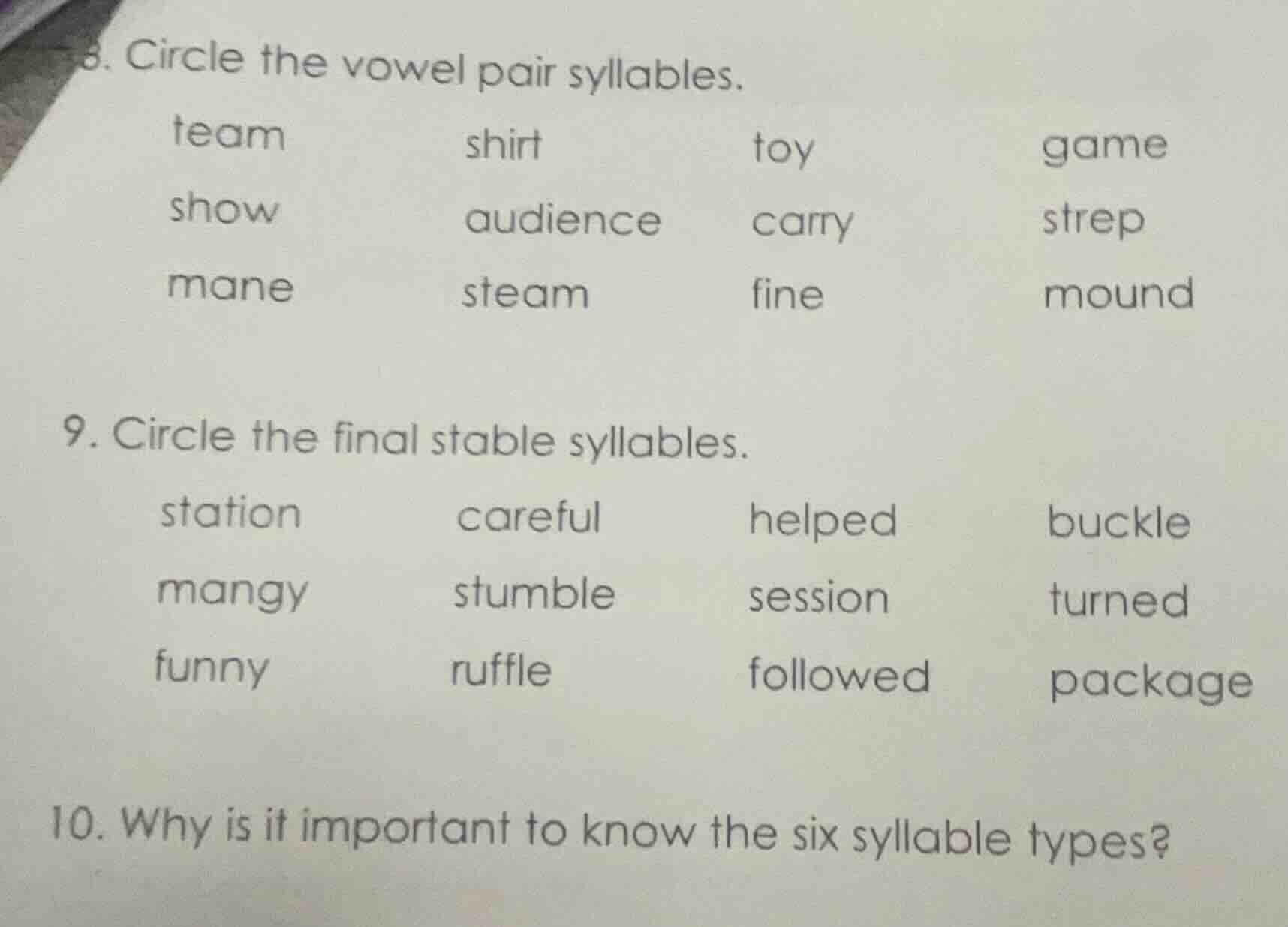
- circle the vowel pair syllables.
team shirt toy game
show audience carry strep
mane steam fine mound
- circle the final stable syllables.
station careful helped buckle
mangy stumble session turned
funny ruffle followed package
- why is it important to know the six syllable types?
Question 8:
Vowel pair syllables (also called vowel digraphs or diphthongs) are two vowels that work together to make a single sound. Let's analyze each word:
- team: "ea" is a vowel pair (long e sound).
- shirt: "ir" is a vowel - r syllable, not a vowel pair.
- toy: "oy" is a diphthong (vowel pair, makes the /ɔɪ/ sound).
- game: "ae" (here "a" and "e" with "a" making long a, "e" silent, but "ame" - actually "a" is long, but "ea" no, wait, "game" has "a" and "e", but "ae" not a pair? Wait, no, "team" has "ea", "toy" has "oy", "game" - "a" and "e" but "ame" - maybe I made a mistake. Wait, vowel pairs can be digraphs (same sound) or diphthongs (gliding sound). Let's re - evaluate:
- team: "ea" (digraph, long e) - vowel pair.
- toy: "oy" (diphthong) - vowel pair.
- game: "a" and "e" - "a" is long, "e" silent, but "ame" - maybe "ae" is not, but "game" - let's check other words.
- show: "ow" is a diphthong (vowel pair, /əʊ/ or /aʊ/? Wait, "show" is /ʃəʊ/, so "ow" is a vowel pair (diphthong).
- audience: Let's break into syllables: au - di - ence. "au" is a vowel pair (diphthong, /ɔː/ or /aʊ/? "au" in audience is /ɔː/), "ence" - no. But the question is about vowel pair syllables in the word (the whole word's syllables? Wait, the instruction is "circle the vowel pair syllables" - maybe the syllables within the word that are vowel pairs. Let's break each word into syllables:
- team: 1 syllable, "team" - "ea" is vowel pair.
- shirt: 1 syllable, "shirt" - "ir" is vowel - r, not pair.
- toy: 1 syllable, "toy" - "oy" is vowel pair (diphthong).
- game: 1 syllable, "game" - "a" and "e" - "a" is long, "e" silent, but "ame" - maybe "ae" is not, but "game" - let's see other words.
- show: 1 syllable, "show" - "ow" is vowel pair (diphthong).
- audience: au - di - ence. "au" is vowel pair, "ence" - no. But maybe the question is about the whole word's syllable being a vowel pair. Let's list the correct ones: team (ea), toy (oy), show (ow), mane (ae? Wait, "mane" is /meɪn/, "a" and "e" - "ae" is a vowel pair? Wait, "mane" has "a" (long a) and "e" silent, but "ae" as a pair? Maybe. Steam: "ea" (long e) - vowel pair. Fine: "i" and "e" - "ie" is a vowel pair (long i). Mound: "ou" is a vowel pair (diphthong, /aʊ/). Carry: "ar" and "y" - no. Strep: "e" and "r" - no. So the words with vowel pair syllables are: team, toy, game (wait, "game" - "a" and "e" - maybe "ae" is a pair? Maybe I was wrong earlier), show, audience (au), mane (ae), steam (ea), fine (ie), mound (ou). Wait, maybe the correct approach is: vowel pairs are two vowels together making a single sound. So:
- team: ea
- toy: oy
- game: ae (a and e, a is long, e is silent, but as a pair)
- show: ow
- audience: au
- mane: ae
- steam: ea
- fine: ie
- mound: ou
- shirt: ir (vowel - r, not pair)
- carry: ar, y (no)
- strep: e, r (no)
So the words to circle are: team, toy, game, show, audience, mane, steam, fine, mound.
Final stable syllables are syllables at the end of a word that have a consistent spelling and pronunciation, often with a silent e or a specific pattern. Common final stable syllables include - tion, - sion, - ble, - le, - gy, - ed (but not all - ed, only stable ones), etc. Let's analyze each word:
- station: - tion is a final stable syllable (pronounced /ʃən/ or /ʃən/).
- careful: - ful is not a final stable syllable ( - ful is a suffix, but "careful" - "ful" is /fʊl/, but is it stable? Maybe not. Wait, final stable syllables are like - ble, - le, - tion, - sion, - gy, - ed (when stable).
- helped: - ed is a suffix, but "helped" - "ed" is /t/ (because "help" ends with /p/), but is - ed a final stable syllable? Some sources consider - ed as a final stable syllable when it's a suffix, but let's check other words.
- buckle: - le is a final stable syllable ( - le in buckle is /kəl/ - wait, "buckle" is /ˈbʌkl/, so - le is a final stable syllable.
- mangy: - gy is a final stable syllable ( - gy is /dʒi/ or /gi/ in mangy, /ˈmæŋi/ - wait, "mangy" is /ˈmæŋi/, so - gy is a final stable syllable?
- stumble: - ble is a final stable syllable ( - ble in stumble is /bl/ - /ˈstʌmbl/).
- session: - sion is a final stable syllable ( - sion in session is /ʃən/).
- turned: - ed is a suffix, /d/ (because "turn" ends with /n/), but is - ed a final stable syllable?
- funny: - ny is not, - y is a vowel, "funny" is /ˈfʌni/, so - ny? No, - y is a vowel, "funny" has syllables "fun" and "ny" - "ny" is not a stable syllable. Wait, maybe I'm wrong. Let's refer to the definition: final stable syllables are syllables that appear at the end of words and have a consistent spelling and pronunciation, such as - tion, - sion, - ble, - le, - gy, - ed (when it's a stable suffix), - age, etc. So:
- station: - tion (stable)
- buckle: - le (stable, as in "buckle" - /kl/? Wait, "buckle" is /ˈbʌkl/, so the final syllable is "kle" - no, "buckle" is two syllables: buck - le. So "le" is a final stable syllable.
- mangy: - gy (mang - y? No, "mangy" is man - gy? Wait, "mangy" is /ˈmæŋi/, so "gy" is /dʒi/? No, "mangy" is one syllable? No, "mangy" is two syllables: man - gy? No, maybe "mangy" is one syllable. Wait, let's list the correct ones:
- station: - tion
- buckle: - le
- stumble: - ble
- session: - sion
- funny: - ny? No, "funny" is fun - ny, "ny" is /ni/, not stable. Wait, maybe "funny" is not. "helped": - ed, "turned": - ed, "careful": - ful. So the correct final stable syllables are in words: station (-tion), buckle (-le), stumble (-ble), session (-sion), mangy (-gy? Maybe), team? No, question 9 is about final stable syllables. Let's re - do:
- station: final syllable "tion" - stable.
- careful: final syllable "ful" - not stable ( - ful is a suffix but not a final stable syllable in the traditional sense).
- helped: final syllable "ed" - stable (as a suffix, but some consider - ed as a final stable syllable when it's a past - tense suffix, but it's not as stable as - tion, - le, etc.)
- buckle: final syllable "le" - stable ( - le is a final stable syllable, e.g., in "buckle", "table", etc.)
- mangy: final syllable "gy" - stable? "mangy" is /ˈmæŋi/, so "gy" is /dʒi/? No, "mangy" is man - gy? No, maybe "mangy" is one syllable. Wait, "stumble": final syllable "ble" - stable ( - ble is a final stable syllable, e.g., "stumble", "fumble").
- session: final syllable "sion" - stable ( - sion is a final stable syllable, e.g., "session", "tension").…
Knowing the six syllable types (closed, open, vowel - consonant - e, vowel pair, r - controlled, final stable) is important for several reasons:
- Reading Fluency: It helps readers decode words more efficiently. By recognizing the syllable type, a reader can apply the appropriate pronunciation rule. For example, in a closed syllable (e.g., "cat"), the vowel is short; in an open syllable (e.g., "go"), the vowel is long.
- Spelling Accuracy: Understanding syllable types aids in spelling. For instance, knowing that a vowel - consonant - e syllable has a long vowel sound and a silent e helps in spelling words like "cake" (instead of "cak").
- Vocabulary Development: When encountering new words, being able to break them into syllables based on their types helps in understanding and remembering the word's pronunciation and spelling, which in turn aids in learning new vocabulary.
- Comprehension: Fluent reading (aided by syllable - type knowledge) leads to better comprehension, as the reader can focus on the meaning of the text rather than struggling with decoding individual words.
- Intervention for Struggling Readers: For students with reading difficulties, explicit instruction in syllable types provides a structured approach to decoding, which can improve their reading skills.

Snap & solve any problem in the app
Get step-by-step solutions on Sovi AI
Photo-based solutions with guided steps
Explore more problems and detailed explanations
Circle: team, toy, game, show, audience, mane, steam, fine, mound