QUESTION IMAGE
Question
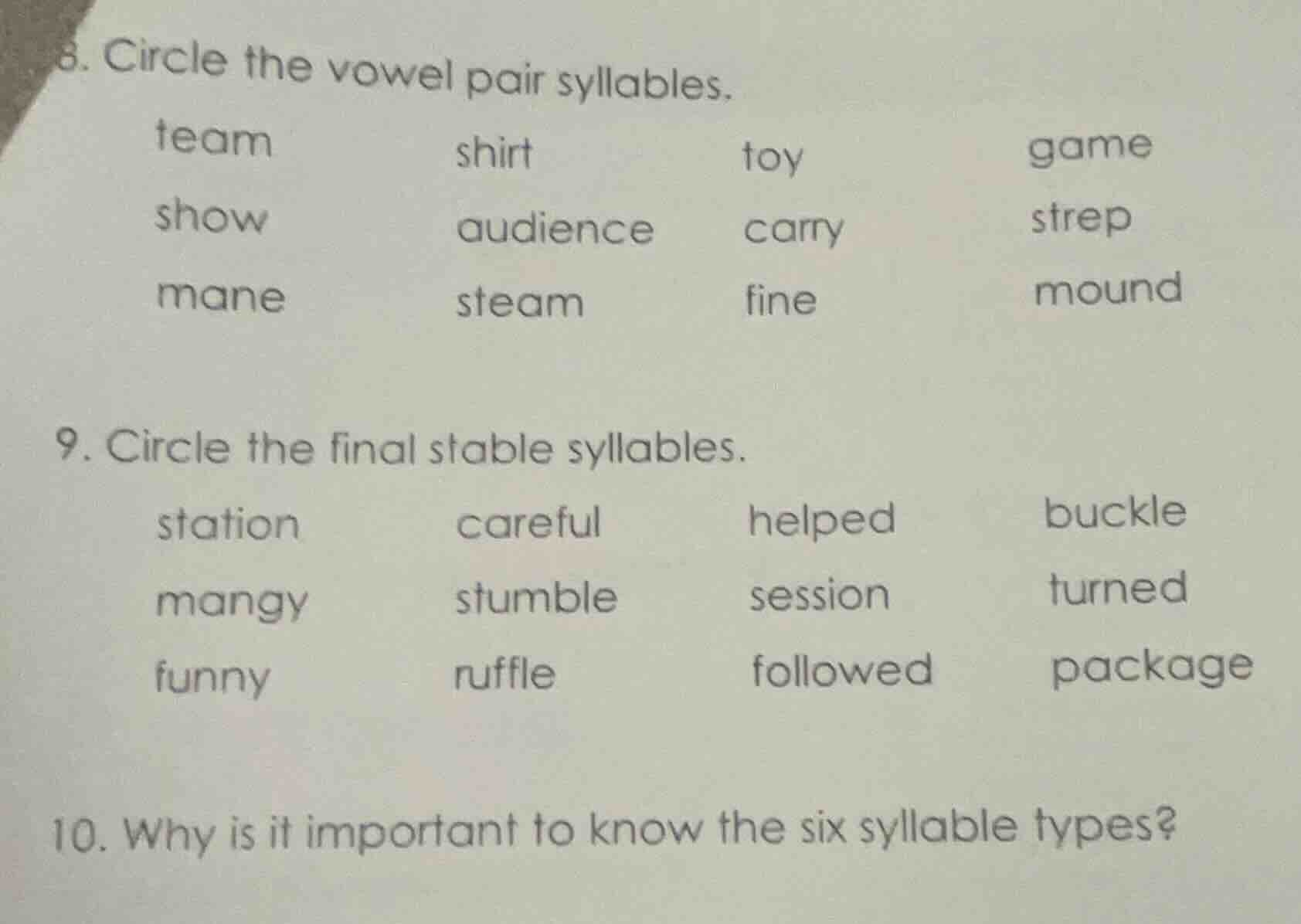
- circle the vowel pair syllables.
team shirt toy game
show audience carry strep
mane steam fine mound
- circle the final stable syllables.
station careful helped buckle
mangy stumble session turned
funny ruffle followed package
- why is it important to know the six syllable types?
Question 8
To identify vowel pair syllables, we look for syllables with two vowels that work together to make a single sound (vowel digraphs or vowel teams) or a vowel - consonant - vowel where the first and last vowels form a sound (vowel pairs in a syllable).
- team: The "ea" is a vowel pair (digraph) making the long "e" sound.
- shirt: Has the vowel "ir" which is a vowel pair (r - controlled vowel pair) making the /ɜː/ (or /ɜr/) sound.
- toy: The "oy" is a vowel pair (diphthong) making the /ɔɪ/ sound.
- game: The "a" and "e" form a vowel - consonant - vowel syllable where "a" is long and "e" is silent, and the "a" and the silent "e" relate to the vowel sound (a vowel pair - like situation in terms of syllable structure with vowel and silent e).
- show: The "ow" is a vowel pair (diphthong) making the /əʊ/ sound.
- audience: The "au" in "aud" is a vowel pair (digraph) making the /ɔː/ (or /ɑː/) sound, and "ie" in "ience" is a vowel pair (digraph) making the /iː/ sound.
- carry: The "ar" is a vowel - consonant - r combination, but the "a" and "r" form a vowel - r pair (r - controlled vowel pair) making the /ær/ sound.
- strep: Does not have a vowel pair (has "e" and "e" but they are not a pair in the syllable sense here, and "r" in between, so no vowel pair).
- mane: The "a" and "e" form a vowel - consonant - vowel syllable with "a" long and "e" silent, a vowel pair - like situation.
- steam: The "ea" is a vowel pair (digraph) making the long "e" sound.
- fine: The "i" and "e" form a vowel - consonant - vowel syllable with "i" long and "e" silent, a vowel pair - like situation.
- mound: The "ou" is a vowel pair (diphthong) making the /aʊ/ sound.
So we circle: team, shirt, toy, game, show, audience, carry, mane, steam, fine, mound.
Question 9
Final stable syllables are syllables at the end of a word that have a consistent spelling and pronunciation, often with a consonant + le (but also other stable final syllables). The common final stable syllable is the "le" syllable (consonant + le), but there are others too.
- station: The "tion" is a final stable syllable (pronounced /ʃən/ or /tʃən/).
- careful: Does not have a final stable syllable (ends with "ful" which is a suffix but "ful" is not a typical final stable syllable in the same way as "le" or "tion" etc., and "care" is the first syllable).
- helped: Ends with "ed" which is a suffix, not a final stable syllable (the "ed" has different pronunciations and is not a stable final syllable in the sense of a consistent syllable with its own sound like "le" or "tion").
- buckle: The "le" at the end is a final stable syllable (consonant "k" + "le" making /kəl/ or /kl/ sound).
- mangy: Ends with "gy" which is not a final stable syllable.
- stumble: The "le" at the end is a final stable syllable (consonant "b" + "le" making /bl/ sound).
- session: The "sion" is a final stable syllable (pronounced /ʃən/).
- turned: Ends with "ed" which is a suffix, not a final stable syllable.
- funny: Ends with "ny" which is not a final stable syllable.
- ruffle: The "le" at the end is a final stable syllable (consonant "f" + "le" making /fl/ sound).
- followed: Ends with "ed" which is a suffix, not a final stable syllable.
- package: The "age" at the end is a final stable syllable (pronounced /ɪdʒ/ or /eɪdʒ/).
So we circle: station, buckle, stumble, session, ruffle, package.
Question 10
Knowing the six syllable types is important for several reasons:
- Reading: It helps readers decode words. When a reader can identify the type of syllable (e.g., closed syllable: consonant - vowel - consonant, open syllable: vowel - consonant (or no consonant at the end), vowel - consonant - e, vowel pair, r - controlled, final stable syllable), they can apply the appropriate pronunciation rules. For example, in a closed syllable like "cat", the vowel is short; in an open syllable like "go", the vowel is long.
- Spelling: It aids in spelling words correctly. Understanding syllable types helps in knowing how vowels behave in different syllable contexts. For instance, in a vowel - consonant - e syllable (like "cake"), the "e" is silent and the vowel before the consonant is long. This knowledge helps in spelling words with silent e correctly.
- Vocabulary Development: By being able to break words into syllables based on their types, learners can better understand the structure of words. This can help in learning new words, as they can analyze the syllables and relate them to known words with similar syllable structures.
- Fluency: When readers can quickly identify syllable types and their corresponding sounds, they can read more fluently. They don't have to struggle with each word, as they can apply the syllable - type rules to pronounce words accurately and smoothly.

Snap & solve any problem in the app
Get step-by-step solutions on Sovi AI
Photo-based solutions with guided steps
Explore more problems and detailed explanations
Knowing the six syllable types is important for decoding (reading) words accurately, spelling words correctly, developing vocabulary by understanding word structure, and improving reading fluency.