QUESTION IMAGE
Question
circumference of a circle
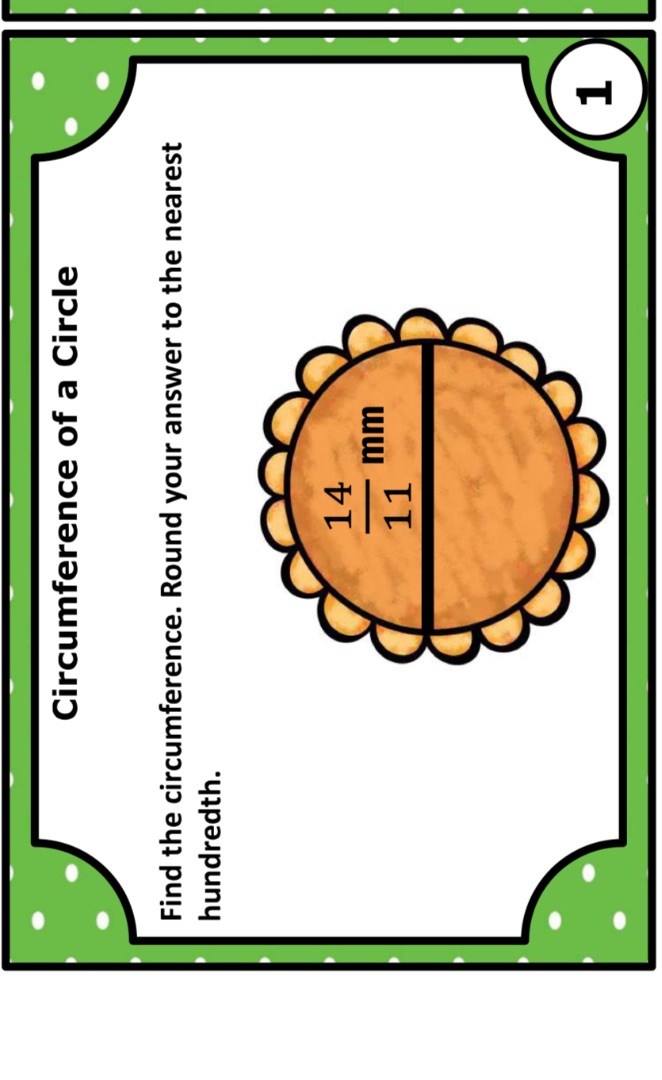
find the circumference. round your answer to the nearest hundredth.
\\(\frac{14}{11}\\) mm
Step1: Identify the diameter
The diameter \( d \) of the circle is \( \frac{14}{11} \) mm.
Step2: Recall the circumference formula
The formula for the circumference \( C \) of a circle is \( C = \pi d \).
Step3: Substitute the diameter into the formula
Substitute \( d = \frac{14}{11} \) into the formula: \( C = \pi \times \frac{14}{11} \).
Step4: Calculate the value
First, calculate \( \frac{14}{11} \approx 1.2727 \). Then multiply by \( \pi \) (using \( \pi \approx 3.1416 \)): \( C \approx 3.1416 \times 1.2727 \approx 4.00 \) (rounded to the nearest hundredth). Wait, let's do it more accurately. \( \frac{14}{11} \times \pi=\frac{14\pi}{11}\approx\frac{14\times3.1415926535}{11}\approx\frac{43.982297149}{11}\approx3.99839065\approx4.00 \) when rounded to the nearest hundredth? Wait, no, let's recalculate. \( 14\div11 = 1.272727... \). Then \( 1.272727\times3.1415926535 = 1.272727\times3 + 1.272727\times0.1415926535 = 3.818181 + 0.179999\approx4.00 \)? Wait, no, 1.2727273.1416: 13.1416=3.1416, 0.2727273.1416≈0.2727273 + 0.2727270.1416≈0.818181 + 0.0386≈0.856781. Then total is 3.1416+0.856781≈3.998381≈4.00 when rounded to the nearest hundredth. Wait, but let's check with more precise calculation. \( 14/11 = 1.2727272727 \). Multiply by π (3.1415926535): 1.2727272727 3.1415926535. Let's do 1.2727272727 3 = 3.8181818181, 1.2727272727 0.1415926535 = 1.27272727270.1 + 1.27272727270.04 + 1.27272727270.0015926535 = 0.1272727273 + 0.0509090909 + 0.0020272727≈0.1272727273+0.0509090909=0.1781818182+0.0020272727≈0.1802090909. Then total is 3.8181818181+0.1802090909≈3.998390909≈4.00 when rounded to the nearest hundredth. Wait, but maybe I made a mistake. Wait, the diameter is 14/11 mm? Wait, the diagram shows 14/11 mm as the diameter? Wait, the line is the diameter, so d = 14/11 mm. Then circumference C = πd = π(14/11). Let's compute that: 14*π=43.98229715, divided by 11 is 43.98229715/11≈3.99839065≈4.00 when rounded to the nearest hundredth. Wait, but 3.99839065 is approximately 4.00 when rounded to the nearest hundredth because the thousandth place is 8, which is more than 5, so we round up the hundredth place: 3.99 + 0.01 = 4.00. Yes.

Snap & solve any problem in the app
Get step-by-step solutions on Sovi AI
Photo-based solutions with guided steps
Explore more problems and detailed explanations
\boxed{4.00} (in mm, rounded to the nearest hundredth)