QUESTION IMAGE
Question
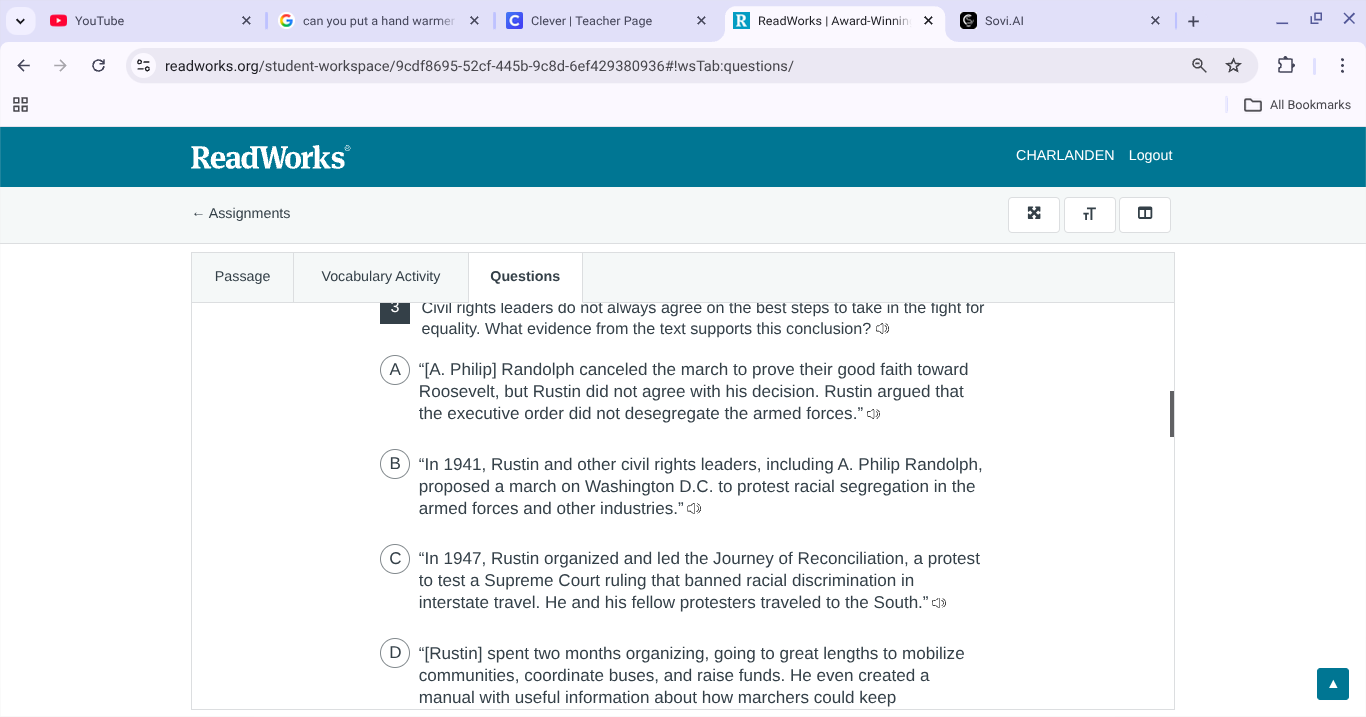
3 civil rights leaders do not always agree on the best steps to take in the fight for equality. what evidence from the text supports this conclusion? a \a. philip randolph canceled the march to prove their good faith toward roosevelt, but rustin did not agree with his decision. rustin argued that the executive order did not desegregate the armed forces.\ b \in 1941, rustin and other civil rights leaders, including a. philip randolph, proposed a march on washington d.c. to protest racial segregation in the armed forces and other industries.\ c \in 1947, rustin organized and led the journey of reconciliation, a protest to test a supreme court ruling that banned racial discrimination in interstate travel. he and his fellow protesters traveled to the south.\ d
ustin spent two months organizing, going to great lengths to mobilize communities, coordinate buses, and raise funds. he even created a manual with useful information about how marchers could keep
To determine the correct answer, we analyze each option:
- Option A: Shows a disagreement between Randolph (canceled march) and Rustin (argued the executive order didn't desegregate armed forces), which supports that civil rights leaders don't always agree on steps for equality.
- Option B: Only states that Rustin and others proposed a march, no disagreement shown.
- Option C: Describes Rustin organizing a protest, no disagreement among leaders.
- Option D: Details Rustin's organization efforts, no disagreement.

Snap & solve any problem in the app
Get step-by-step solutions on Sovi AI
Photo-based solutions with guided steps
Explore more problems and detailed explanations
A. "A. Philip Randolph canceled the march to prove their good faith toward Roosevelt, but Rustin did not agree with his decision. Rustin argued that the executive order did not desegregate the armed forces."