QUESTION IMAGE
Question
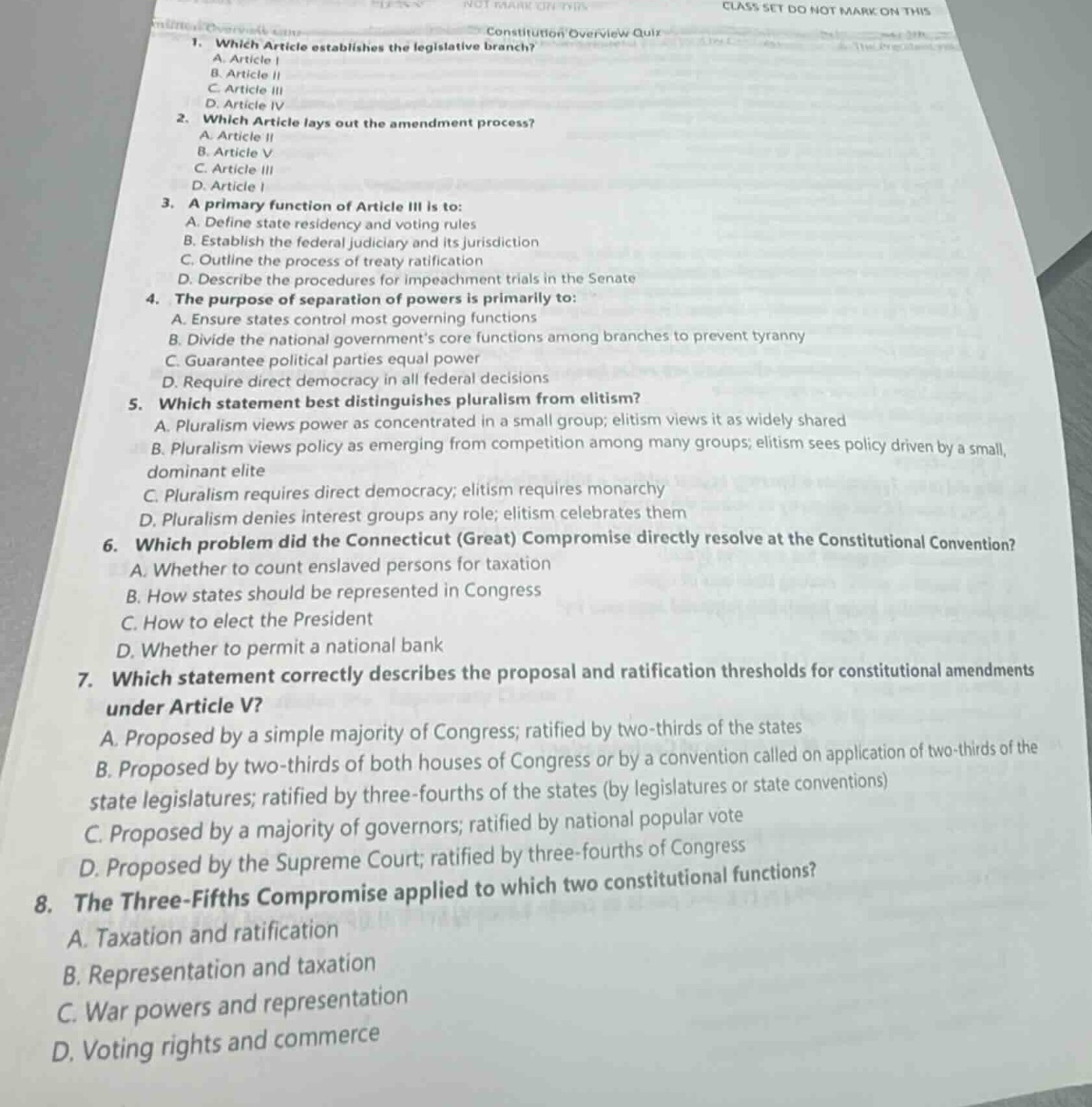
class set do not mark on thisconstitution overview quiz1. which article establishes the legislative branch?a. article ib. article iic. article iiid. article iv2. which article lays out the amendment process?a. article iib. article vc. article iiid. article i3. a primary function of article iii is to:a. define state residency and voting rulesb. establish the federal judiciary and its jurisdictionc. outline the process of treaty ratificationd. describe the procedures for impeachment trials in the senate4. the purpose of separation of powers is primarily to:a. ensure states control most governing functionsb. divide the national governments core functions among branches to prevent tyrannyc. guarantee political parties equal powerd. require direct democracy in all federal decisions5. which statement best distinguishes pluralism from elitism?a. pluralism views power as concentrated in a small group; elitism views it as widely sharedb. pluralism views policy as emerging from competition among many groups; elitism sees policy driven by a small, dominant elitec. pluralism requires direct democracy; elitism requires monarchyd. pluralism denies interest groups any role; elitism celebrates them6. which problem did the connecticut (great) compromise directly resolve at the constitutional convention?a. whether to count enslaved persons for taxationb. how states should be represented in congressc. how to elect the presidentd. whether to permit a national bank7. which statement correctly describes the proposal and ratification thresholds for constitutional amendments under article v?a. proposed by a simple majority of congress; ratified by two-thirds of the statesb. proposed by two-thirds of both houses of congress or by a convention called on application of two-thirds of the state legislatures; ratified by three-fourths of the states (by legislatures or state conventions)c. proposed by a majority of governors; ratified by national popular voted. proposed by the supreme court; ratified by three-fourths of congress8. the three-fifths compromise applied to which two constitutional functions?a. taxation and ratificationb. representation and taxationc. war powers and representationd. voting rights and commerce
- Article I of the U.S. Constitution creates the legislative (Congress) branch.
- Article V outlines the formal process to amend the U.S. Constitution.
- Article III establishes the federal court system and its authority.
- Separation of powers splits government authority to stop any single branch from becoming too powerful.
- Pluralism holds that power is spread across competing groups; elitism holds power is held by a small, elite group.
- The Connecticut Compromise resolved disputes between large and small states by creating a bicameral Congress with proportional and equal representation.
- Article V requires amendments to be proposed by a two-thirds vote in Congress or a national convention (called by two-thirds of states), then ratified by three-fourths of states.
- The Three-Fifths Compromise counted enslaved people for both congressional representation and federal tax calculations.

Snap & solve any problem in the app
Get step-by-step solutions on Sovi AI
Photo-based solutions with guided steps
Explore more problems and detailed explanations
- A. Article I
- B. Article V
- B. Establish the federal judiciary and its jurisdiction
- B. Divide the national government's core functions among branches to prevent tyranny
- B. Pluralism views policy as emerging from competition among many groups; elitism sees policy driven by a small, dominant elite
- B. How states should be represented in Congress
- B. Proposed by two-thirds of both houses of Congress or by a convention called on application of two-thirds of the state legislatures; ratified by three-fourths of the states (by legislatures or state conventions)
- B. Representation and taxation